In the wood export industry, “Marine Grade” is the most prestigious—and most regulated—certification a panel can hold. Whether you are building a luxury yacht hull or high-end outdoor cabinetry for a seaside villa,understanding the BS 1088 standard is critical for preventing catastrophic failure in high-moisture environments.
At lumberpanel.com, we ensure our marine-grade products meet these rigorous international benchmarks to protect your reputation and your projects.
- What is the BS 1088 Standard?
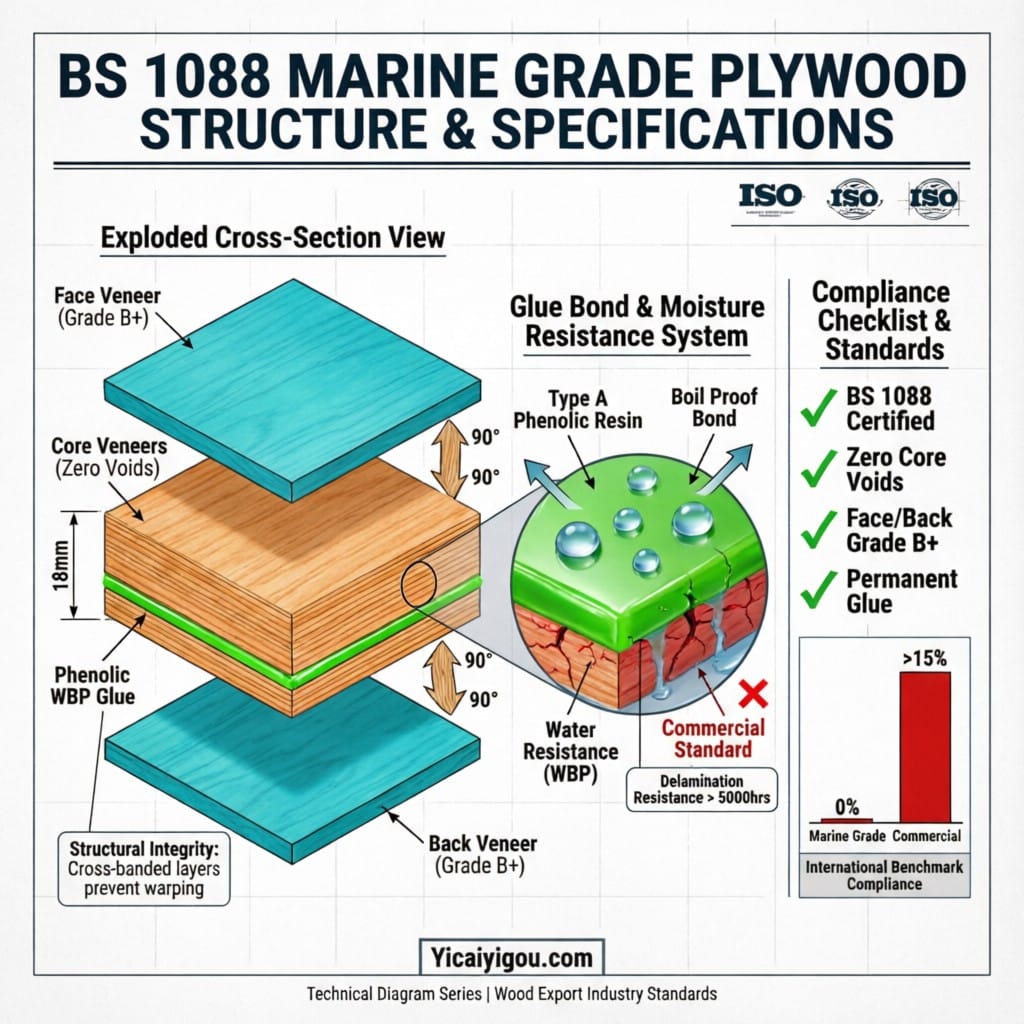
BS 1088 is a British Standard for marine plywood that is recognized globally. To carry this stamp, a panel must meet three non-negotiable criteria:
Glue Quality: It must use a permanent, Type A Phenolic WBP glue (as discussed in Article #3).
Veneer Quality: Both the face and back veneers must be at least Grade B or better, meaning they are free from open knots and splits.
Zero Voids: The inner core veneers must be “gap-free.” In standard plywood, a small 2mm gap in the core is acceptable; in Marine Grade, a single void is a point of failure where water can collect and rot the wood from the inside out.
- Marine Grade vs. Exterior Plywood
Many buyers mistakenly believe that any “Waterproof” plywood is Marine Grade. This is incorrect.
While Exterior Plywood uses WBP glue, it allows for lower-grade core veneers and small voids. Marine Grade Plywood is specifically engineered for “immersion” or constant high-humidity exposure. It is the difference between a board that can survive a rainstorm and a board that can survive being part of a boat hull.
- Sourcing Marine Grade from China
When sourcing from Linyi or other Chinese hubs, always specify the wood species. True BS 1088 Marine Plywood is typically made from naturally durable hardwoods like Okoume or Meranti. These species have a natural resistance to fungal decay, adding a second layer of protection alongside the WBP glue. - Technical Inspection Tip
When your shipment arrives, check the edges. A true Marine Grade panel will show a perfectly solid, tight cross-section with no visible holes or overlaps in the core layers. If you see gaps, it is not BS 1088.
Image Attachment
Frequently Asked Questions
What is the main difference between BS 1088 marine plywood and commercial-grade plywood?
The primary difference lies in the manufacturing standards and material quality. BS 1088 marine plywood is a strict British Standard that mandates the use of durable, defect-free face and core veneers (typically from species like Okoume or Douglas Fir), with no gaps or voids in the core plies, and a waterproof phenolic resin adhesive (WBP – Weather and Boil Proof). Commercial-grade plywood, often labeled “exterior” or “marine-type,” may use lower-grade veneers with permitted core gaps, patches, or filler, and while it may use a waterproof glue, it does not guarantee the same structural integrity, durability, or resistance to delamination in constant moisture or high-stress applications.
Can I use commercial exterior plywood instead of BS 1088 for a boat or dock project?
It is not recommended for critical structural or immersion applications. Commercial exterior plywood is designed to withstand occasional moisture but lacks the void-free core and consistent glue bond of BS 1088. In a boat hull or dock deck, trapped water in core voids can lead to rot, delamination, and structural failure over time. BS 1088 plywood is engineered for continuous exposure to water and humidity, making it the only safe choice for marine vessels, floating docks, and other high-moisture environments where safety and longevity are paramount.
Does BS 1088 certification guarantee the plywood is 100% waterproof?
No material is 100% waterproof, but BS 1088 certification ensures the plywood is manufactured to the highest standard for water resistance. The phenolic resin adhesive used is classified as WBP (Weather and Boil Proof), meaning it can withstand repeated cycles of boiling and drying without delaminating in lab tests. However, the plywood’s longevity still depends on proper edge sealing, surface finishing, and installation. Even BS 1088 plywood will degrade if left unsealed and exposed to standing water for extended periods, but it offers far superior resistance compared to commercial grades.
How can I visually tell if plywood is genuine BS 1088 marine grade?
Genuine BS 1088 plywood typically has a stamp or label indicating compliance with the standard, often including the manufacturer’s name, species, and glue type. Visually, the face veneers should be smooth, free of large knots or patches, and the core plies should show no visible gaps or voids when viewed from the edge. The edges should appear tight and uniform. Be cautious of plywood labeled only as “marine” or “exterior” without a specific BS 1088 mark, as these may not meet the standard. Reputable suppliers also provide a certificate of conformity upon request.
Is BS 1088 marine plywood worth the higher cost for non-marine projects like outdoor furniture or kitchen cabinets?
It depends on the project’s exposure to moisture. For outdoor furniture, kitchen cabinets near sinks, or bathroom vanities, BS 1088 offers exceptional durability and peace of mind due to its void-free core and waterproof glue. However, for most interior or sheltered outdoor applications, a high-quality exterior-grade plywood (e.g., ACX or B/BB exterior) is often sufficient and more cost-effective. The premium price of BS 1088 is best justified when the plywood will face direct, prolonged moisture, high humidity, or structural stress—such as in boat building, dock construction, or outdoor kitchens in wet climates.
| Specification | BS 1088 Marine Plywood | Commercial Standard Plywood |
|---|---|---|
| Face & Core Veneer Quality | No knots, voids, or core gaps; all veneers are grade A or B | May contain small knots, filler patches, and limited core voids |
| Adhesive & Bond Durability | WBP (Weather & Boil Proof) phenolic resin; passes 72-hour boil test | Often MR (Moisture Resistant) or WBP; boil test not always required |
| Number of Plies (18mm thickness) | Minimum 7 plies for dimensional stability | Typically 5 plies; may vary by manufacturer |
| Formaldehyde Emission Class | E1 (low emission, ≤0.1 ppm) | E1 or E2 (≤0.1–0.3 ppm); not always certified |
| Typical Warranty & Lifespan | 5–10 years in marine exposure; often backed by manufacturer | 1–3 years; not intended for prolonged water immersion |
“`json
“`