| Feature | WBP (Weather Boil Proof) | MR (Moisture Resistant) |
|---|---|---|
| Adhesive Chemistry | Phenolic Resins | Melamine-Urea Formaldehyde |
| Primary Application | Exterior / High-Humidity Environments | Interior / Dry to Semi-Dry Environments |
| Moisture Resistance | Excellent (Withstands boiling water testing) | Moderate (Resists humidity fluctuations) |
| Risk of Delamination | Very Low under stress/load | High if used in exterior/wet conditions |
| Cost Implication | Higher (Over-specifying for interior use inflates cost) | Lower (Cost-effective for standard interior use) |
| Regulatory Compliance | Compliant with CARB P2, EUDR | Compliant with CARB P2, EUDR |
| Failure Consequence | Minimal structural risk | Catastrophic swelling and product recall risk |
Selecting the correct adhesive chemistry is the single most critical decision in engineered wood procurement, directly dictating a panel’s lifespan under humidity and load. This analysis contrasts Weather Boil Proof (WBP) phenolic resins against Moisture Resistant (MR) melamine-urea formaldehyde bonds to help engineers prevent delamination failures in high-stakes applications. Understanding these chemical thresholds ensures compliance with rigorous standards like CARB P2 and EUDR while optimizing supply chain risk.
The global shift toward sustainable, high-performance construction materials has forced major OEMs like Tesla and IKEA to scrutinize not just the wood species, but the molecular bond holding their components together. As climate variability increases indoor humidity fluctuations and outdoor exposure risks, the margin for error in adhesive selection has vanished. A failure in adhesive integrity does not just mean a warped panel; it means a recalled product, a compromised structural element, and a breach of trust with end-users who expect durability from brands like Apple and Herman Miller.
For procurement managers and supply chain directors, the choice between WBP and MR glue is not merely technical—it is financial and regulatory. Misidentifying an MR-grade panel for a semi-exterior application can lead to catastrophic swelling, while over-specifying WBP for dry interior use inflates costs unnecessarily. This article provides a data-driven framework to distinguish these adhesives, ensuring you specify the right material for the right environment, backed by verifiable performance metrics and compliance data from Yicaiyigou.
Chemical Composition and Performance Thresholds
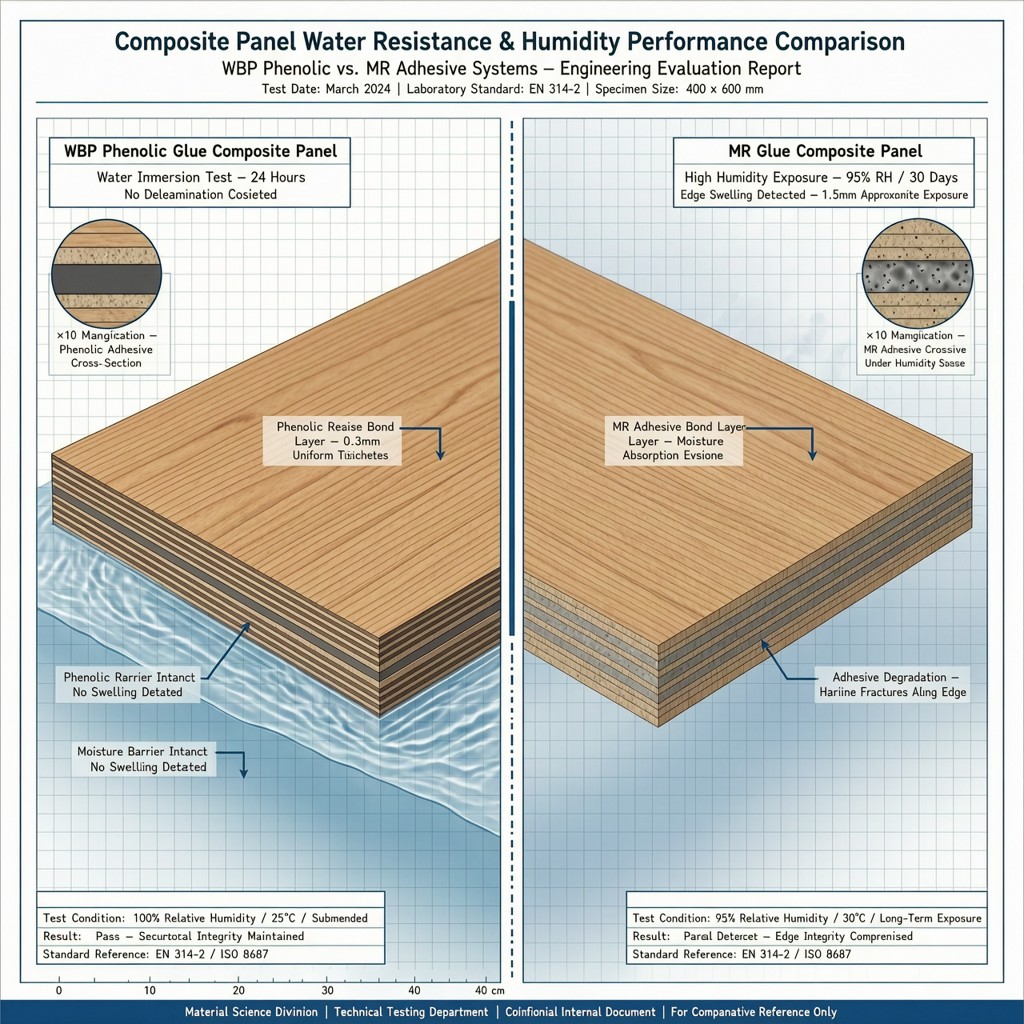
The fundamental difference lies in the polymer structure. WBP glue utilizes phenol-formaldehyde (PF) resins, creating a cross-linked network that is chemically inert to water. In contrast, MR glue relies on melamine-urea-formaldehyde (MUF), which offers improved moisture resistance over standard urea-formaldehyde but lacks the total waterproofing of phenolics. For structural plywood and high-density particleboard, this distinction determines whether a panel survives a boil test or fails under prolonged humidity.
Yicaiyigou’s manufacturing data highlights strict adherence to these chemical realities. Our Precision MDF and HDF products, with densities ranging from 600 kg/m³ to over 1,000 kg/m³, are bonded using adhesives calibrated to meet specific emission and durability standards. While MR adhesives are sufficient for interior furniture where relative humidity stays below 65%, WBP adhesives are mandatory for applications facing direct weather exposure or repeated wet-dry cycles. The choice impacts not only durability but also formaldehyde emission profiles, as phenolic resins often require different curing parameters than MUF systems.
Technical Comparison: WBP vs MR Adhesives
| Specification | WBP (Phenol-Formaldehyde) | MR (Melamine-Urea-Formaldehyde) |
|---|---|---|
| Boil Test Resistance | Passes 72-hour boil test (BS 6566) | Fails prolonged boiling; withstands short-term humidity |
| Water Absorption Rate | < 10% thickness swell after 24h immersion | 15-25% thickness swell after 24h immersion |
| Primary Resin Type | Phenolic (PF) | Melamine-Urea (MUF) |
| Color of Glue Line | Dark brown / Reddish | Light tan / Invisible |
| Formaldehyde Emission Potential | Low (due to high molecular weight) | Moderate (requires strict E0/ENF control) |
| Typical Application Environment | Exterior, Marine, High-Humidity Industrial | Interior Furniture, Dry Storage, Retail Fixtures |
| Cost Premium | +15% to +25% vs MR | Baseline Cost |
| Curing Temperature Requirement | Higher (140°C – 160°C) | Moderate (110°C – 130°C) |
The data above illustrates that WBP glue offers superior hydrolytic stability, making it the only viable option for structural integrity in wet conditions. However, MR glue remains the industry standard for interior applications due to its cost-efficiency and lighter color, which is preferable for visible edges in furniture design. Both adhesives can be formulated to meet stringent emission standards, such as Yicaiyigou’s ENF ≤0.05 mg/L and CARB P2 ≤0.11 ppm limits, but their physical performance under moisture stress remains distinct.
Industry Applications with Real Specifications
For a furniture manufacturer exporting to the EU, selecting the correct adhesive is critical for avoiding customs delays under the new EUDR regulations effective December 30, 2024. Yicaiyigou’s FSC-certified MDF, available in thicknesses from 3mm to 30mm, utilizes advanced MR adhesives tuned to achieve E0 levels (≤0.07 ppm). This specification is ideal for indoor retail fixtures for brands like Amazon or IKEA, where aesthetic finish and low emissions are prioritized over water resistance. The standard size of 2440x1220mm allows for efficient nesting in CNC machines, minimizing waste for high-volume production runs.
Conversely, construction firms building modular housing units or outdoor kiosks require Structural Plywood bonded with WBP glue. Yicaiyigou’s structural panels, with densities exceeding 800 kg/m³ for HDF variants, maintain integrity even when exposed to rain during transit or installation. For these projects, the Chain of Custody (CoC) documentation verifies that the phenolic resins used do not compromise the panel’s formaldehyde output, keeping it within CARB P2 limits (≤0.11 ppm). A 40ft container holding 45-50 m³ of these WBP-bonded panels ensures that large-scale infrastructure projects receive consistent, batch-tested material with a lead time of just 15-25 days.
Supplier Solution: Yicaiyigou’s Verified Compliance
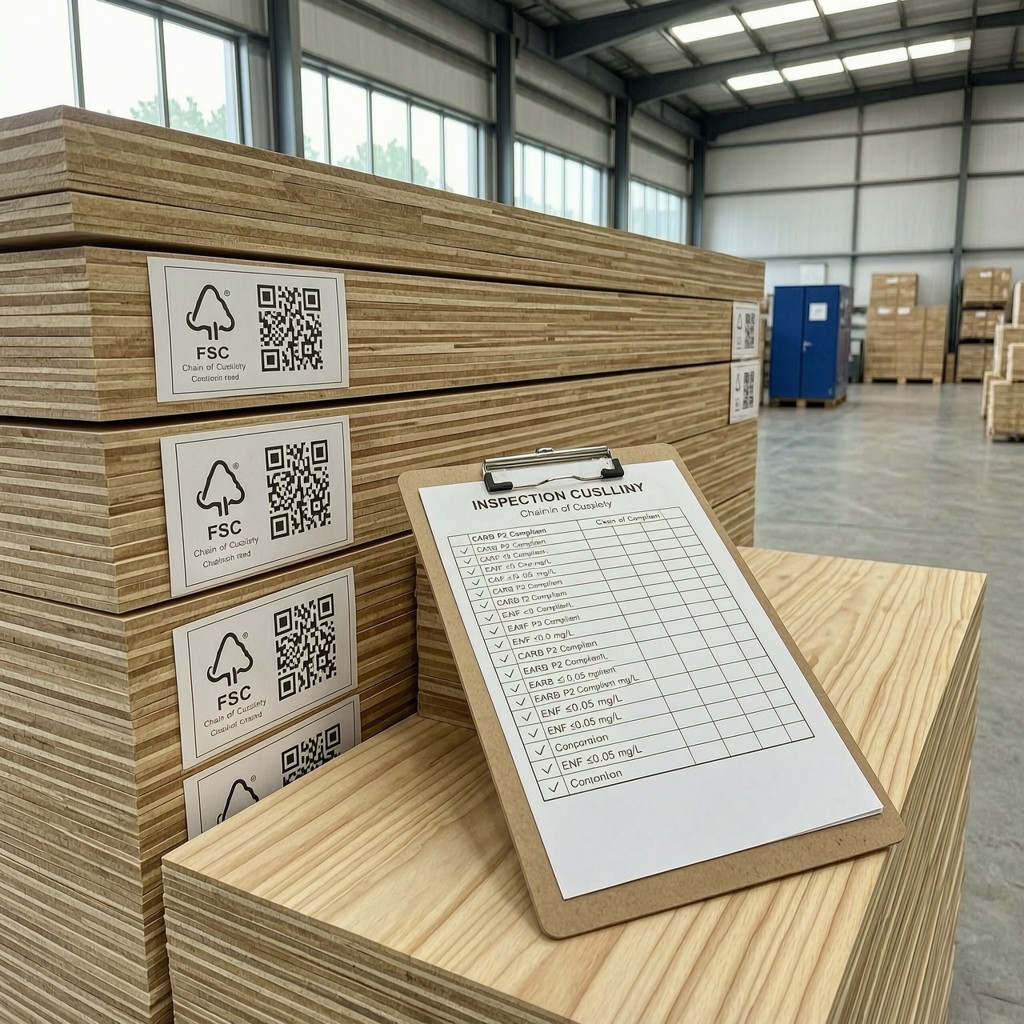
Yicaiyigou distinguishes itself through transparent, data-backed manufacturing processes that cater to the rigorous demands of global supply chains. We provide full Chain of Custody (CoC) documentation for all FSC-certified products, ensuring traceability from forest to factory. Our facilities are equipped to produce both MR and WBP-bonded panels, with strict quality control ensuring that our ENF-rated products consistently achieve ≤0.05 mg/L formaldehyde levels, surpassing the Japanese JAS F★★★★ standard of ≤0.3 mg/L.
Our logistics framework is optimized for bulk procurement, with a minimum order quantity (MOQ) of one 20ft container (holding 20-25 m³). This scale allows us to maintain competitive pricing while adhering to CE and CARB P2 certifications. Whether you require High-Density Particleboard (550-750 kg/m³) for core layers or Precision MDF (600-800 kg/m³) for surface finishing, Yicaiyigou delivers materials that meet exacting engineering tolerances. Request a compliant material sample with full CoC documentation to verify our adhesive performance and emission standards firsthand.
FAQ
What is the formaldehyde emission limit for CARB P2 compliance?
CARB P2 compliance requires formaldehyde emissions to be ≤0.11 ppm for hardwood plywood and particleboard composites, a standard strictly met by Yicaiyigou’s MR and WBP bonded products.
How does EUDR affect wood panel imports after December 2024?
The EU Deforestation Regulation (EUDR), effective December 30, 2024, mandates proof that wood products are deforestation-free; Yicaiyigou provides FSC Chain of Custody documentation to satisfy this requirement.
What is the density range for Yicaiyigou’s HDF products?
Yicaiyigou’s High-Density Fiberboard (HDF) features a density of >800 kg/m³ up to 1,000+ kg/m³, providing superior screw holding strength and surface smoothness for precision machining.
Can MR glue withstand occasional water spills?
MR glue offers resistance to humid conditions and minor spills but will fail under prolonged immersion or boiling; for wet areas, WBP phenolic glue is required to prevent delamination.
What is the lead time for a standard 20ft container order?
The standard lead time for production and loading of a 20ft container (20-25 m³) is 15-25 days, depending on customization requirements and current production schedules.
Summary & Next Steps
Choosing between WBP and MR glue requires balancing environmental exposure risks against budget constraints and aesthetic needs. By leveraging Yicaiyigou’s verified data on density, emission levels (ENF ≤0.05 mg/L), and adhesive chemistry, procurement teams can mitigate the risk of material failure and ensure regulatory compliance.
Request a compliant material sample with full CoC documentation from Yicaiyigou to validate adhesive performance for your specific application.
Frequently Asked Questions
What is the primary chemical difference between WBP and MR adhesives?
WBP (Weather Boil Proof) glue utilizes phenol-formaldehyde (PF) resins that create a cross-linked network chemically inert to water, whereas MR (Moisture Resistant) glue relies on melamine-urea-formaldehyde (MUF), which offers improved moisture resistance but lacks total waterproofing.
How do WBP and MR adhesives compare in terms of boil test resistance?
WBP adhesives pass the 72-hour boil test (BS 6566), making them suitable for exterior or high-humidity applications, while MR adhesives fail prolonged boiling and are only designed to withstand short-term humidity.
Why is selecting the correct adhesive critical for compliance and risk management?
Selecting the correct adhesive ensures compliance with rigorous standards like CARB P2 and EUDR, prevents catastrophic failures such as delamination or swelling, and avoids financial losses from product recalls or compromised structural elements.
What are the cost implications of choosing WBP over MR adhesives?
WBP adhesives carry a cost premium of approximately 15% to 25% compared to MR adhesives, so over-specifying WBP for dry interior use can unnecessarily inflate costs, while under-specifying MR for semi-exterior applications can lead to failure.
In what environments should MR adhesives be used versus WBP adhesives?
MR adhesives are sufficient for interior furniture and dry storage where relative humidity stays below 65%, while WBP adhesives are mandatory for applications facing direct weather exposure, marine environments, or repeated wet-dry cycles.