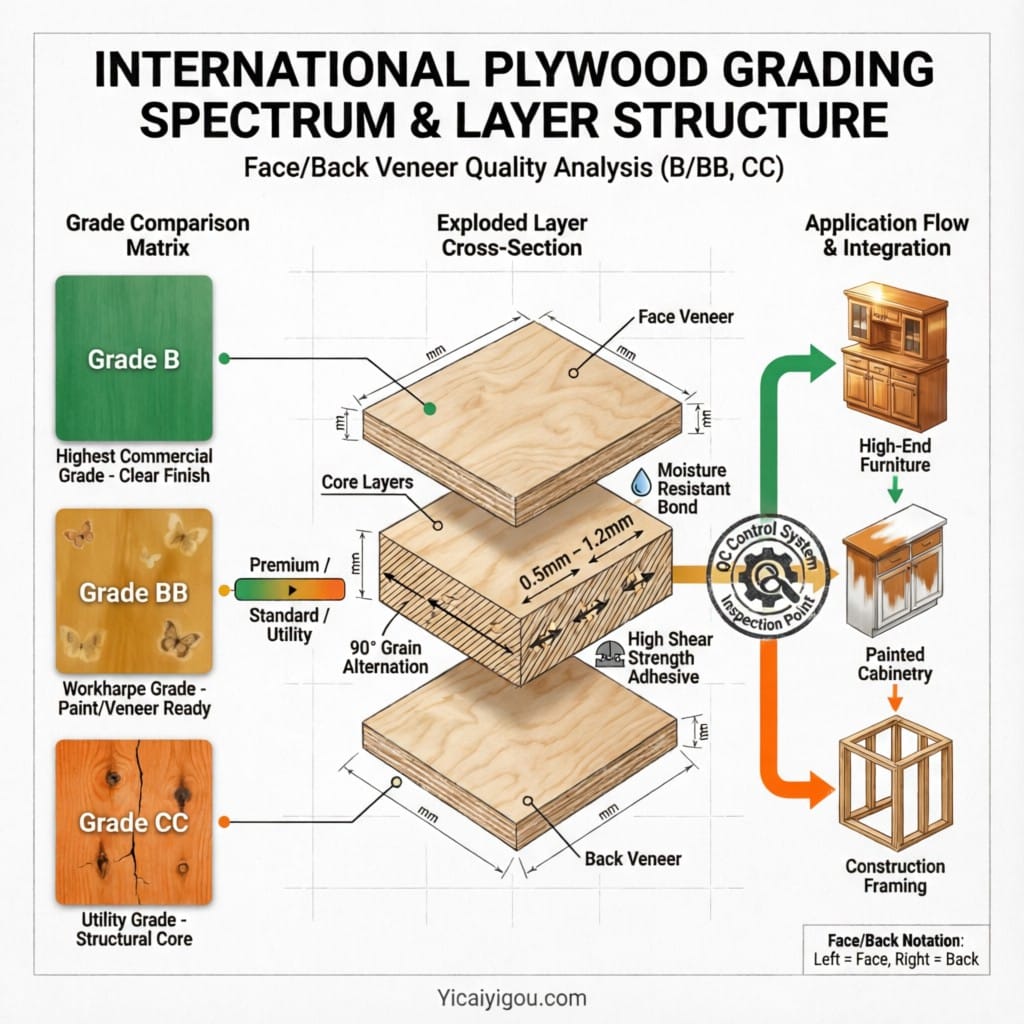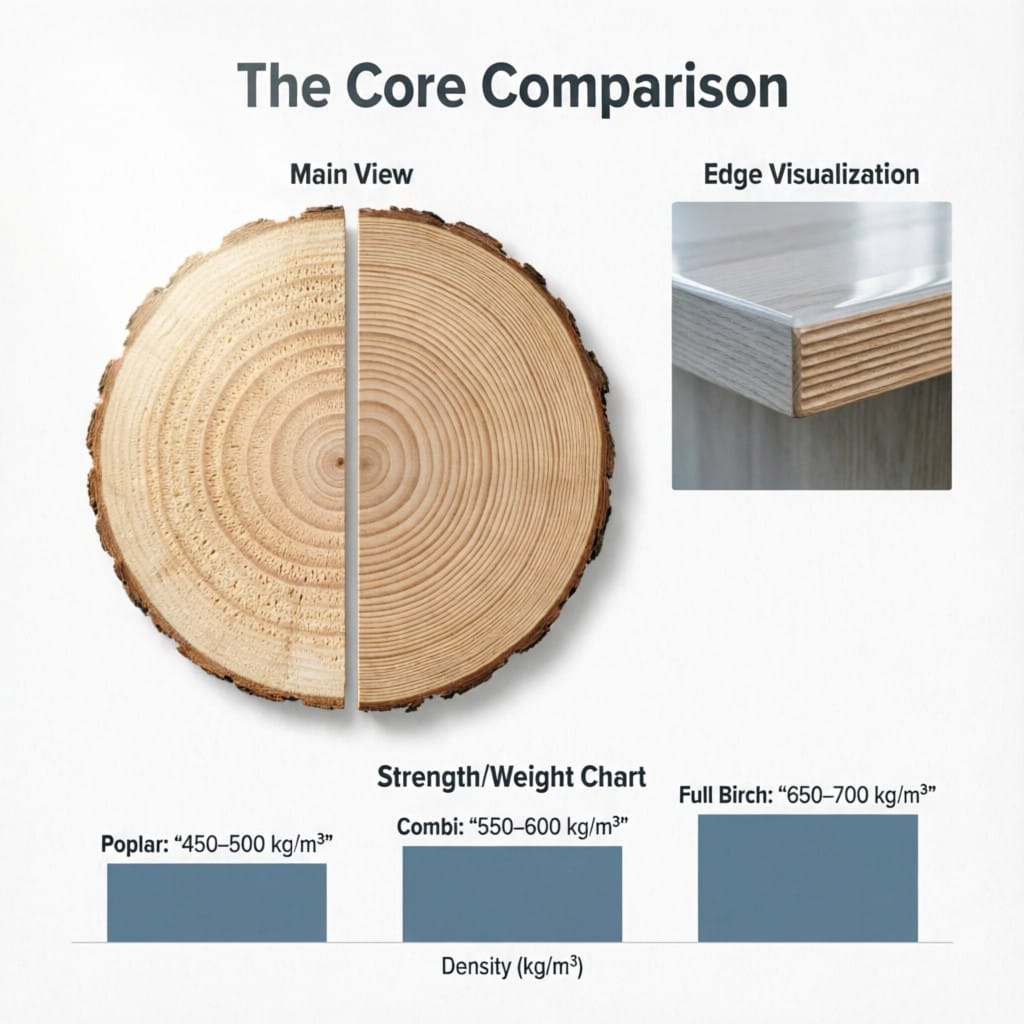
| Specification | Poplar Core | Pine Core |
|---|---|---|
| Density Profile | Uniform density; minimal variation | Higher structural rigidity; variable density |
| Dimensional Stability | High stability under humidity loads | Moderate; prone to swelling/shrinking if not treated |
| Surface Quality | Minimal grain telegraphing; smooth finish | Risk of resin bleed and surface irregularities |
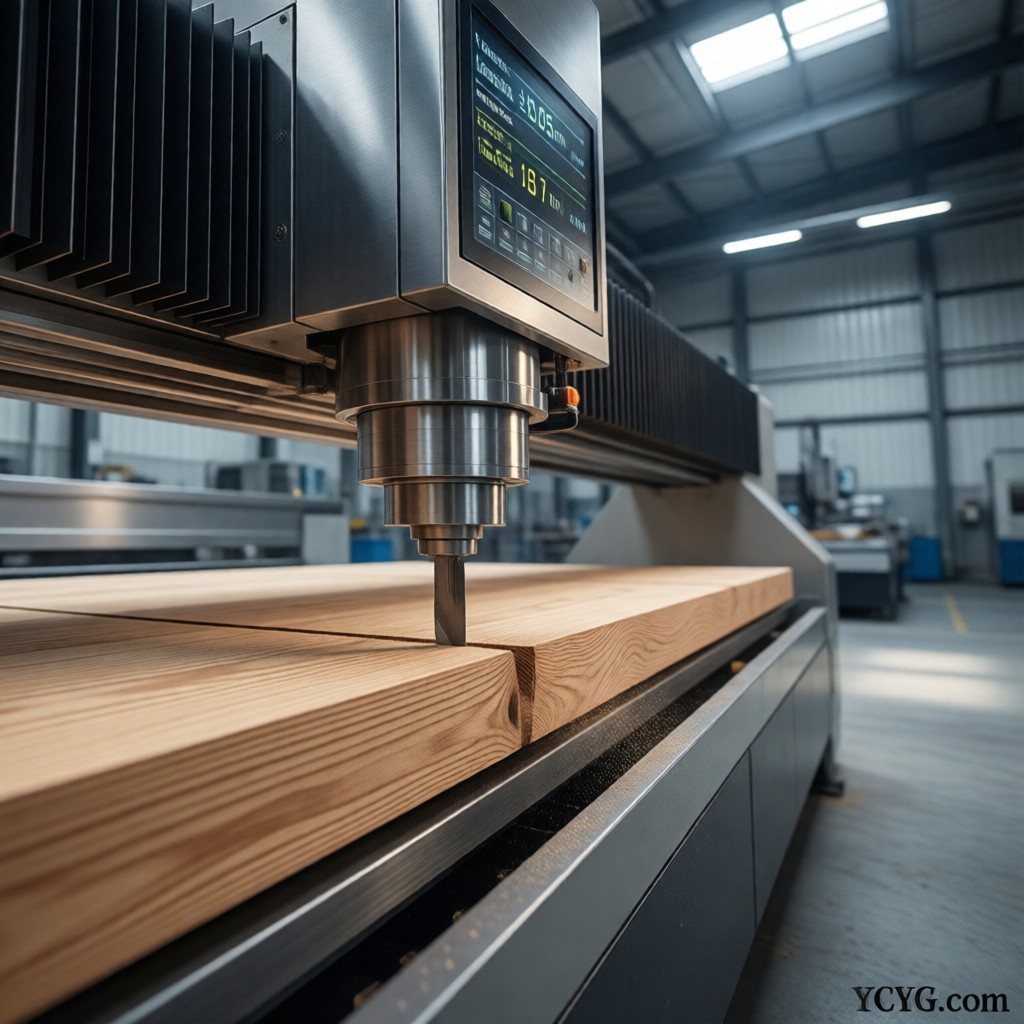
| Machining Tolerance | Excellent for CNC routing and edge-banding | Good, but requires careful handling to maintain precision |
| Primary Risk Factor | Lower structural rigidity compared to pine | Warping risks and resin issues |
| Regulatory Compliance | Compliant with CARB P2 and ENF standards | Compliant with CARB P2 and ENF standards |
| Ideal Application | High-precision MDF/HDF faces; architectural millwork | Structural plywood; applications requiring high rigidity |
Selecting the right softwood core is a critical engineering decision that directly impacts panel flatness, machining tolerance, and final product longevity. This analysis compares poplar and pine cores against strict density and stability metrics to help procurement managers minimize warping risks and ensure compliance with global emission standards like CARB P2 and ENF.
The Shift Toward Precision-Core Composites
Modern furniture manufacturing and architectural millwork have moved beyond aesthetic considerations to prioritize dimensional stability under varying humidity loads. Major OEMs supplying brands like IKEA and Apple now require core materials that maintain tight tolerances during CNC routing and edge-banding processes. A core that swells or shrinks unpredictably can ruin high-precision MDF or HDF faces, leading to costly rejections at the assembly stage.
The choice between poplar and pine is no longer just about cost; it is about risk management in the supply chain. Poplar offers uniform density and minimal grain telegraphing, while pine provides higher structural rigidity but requires careful handling to avoid resin bleed and surface irregularities. Understanding these differences allows buyers to specify the correct substrate for their specific application, reducing waste and ensuring consistent quality across large production runs.
This article details the technical specifications of both wood types, providing a data-driven framework for selecting the optimal core for precision MDF, structural plywood, and high-density particleboard applications. By focusing on measurable traits like density ranges and formaldehyde emission limits, procurement teams can make informed decisions that align with both performance requirements and regulatory compliance.
Technical Specifications and Performance Metrics
When evaluating softwood cores, engineers must look beyond visual appearance to quantifiable physical properties. The following table compares poplar and pine across eight critical performance indicators relevant to B2B manufacturing. Note that both materials are viable but serve different engineering needs.
| Metric | Poplar Core | Pine Core |
|---|---|---|
| Average Density | 400–500 kg/m³ | 500–600 kg/m³ |
| Janka Hardness | 540 lbf (2,400 N) | 380–420 lbf (1,690–1,870 N) |
| Modulus of Elasticity | 10.3 GPa | 8.8–11.0 GPa |
| Shrinkage (Radial) | 3.7% | 3.9% |
| Shrinkage (Tangential) | 7.1% | 7.6% |
| Machinability Rating | High (Minimal tear-out) | Medium (Resin gumming risk) |
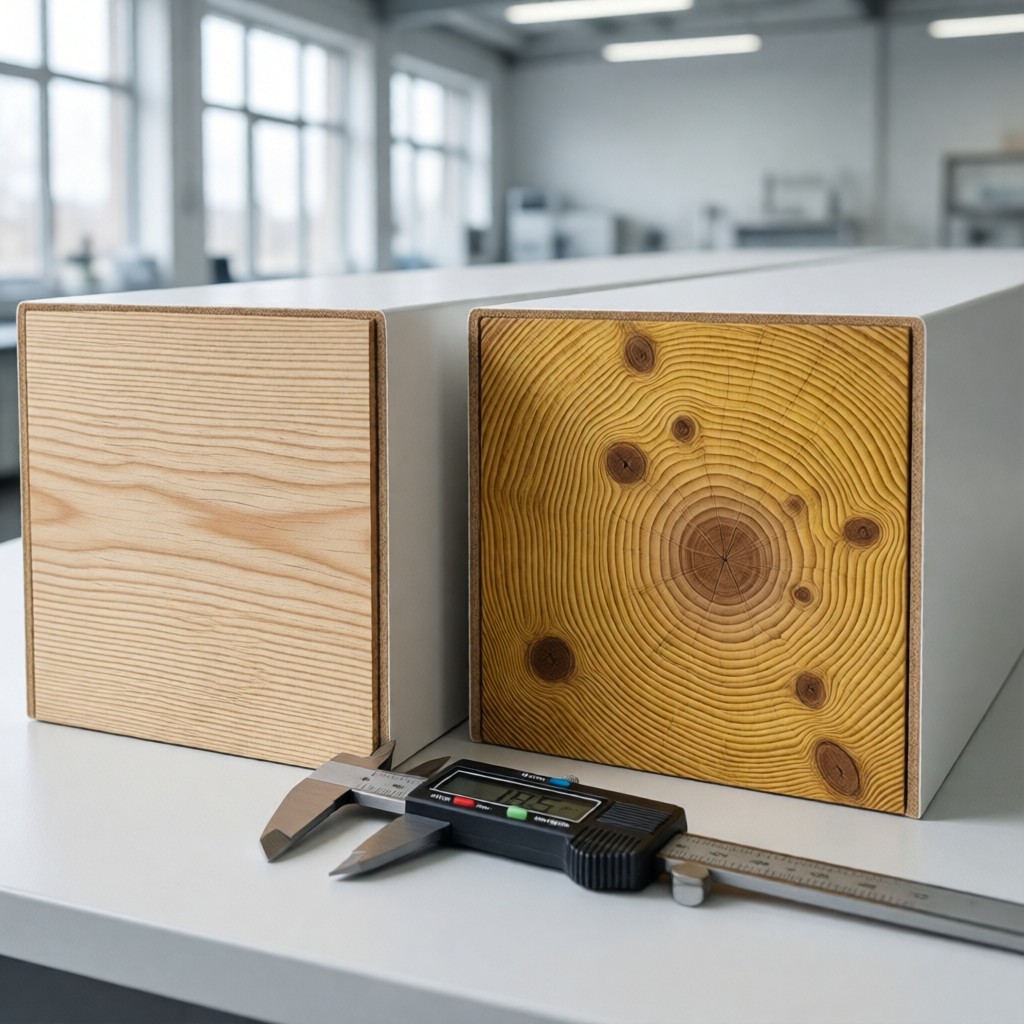
| Grain Telegraphing Risk | Low (Uniform texture) | High (Knots may show through) |
| Typical Cost Index | Baseline (1.0x) | Variable (0.9x–1.2x) |
Poplar’s lower density makes it lighter and easier to machine, reducing tool wear during high-volume production. Its uniform cell structure minimizes the risk of “telegraphing,” where the core’s grain pattern becomes visible through thin veneers or laminates. Pine, while slightly harder in some species, often contains resin pockets that can interfere with adhesive bonding and surface finishing. However, pine’s higher stiffness-to-weight ratio can be advantageous in structural applications where load-bearing capacity is prioritized over surface perfection.
Industry Applications with Real Specifications
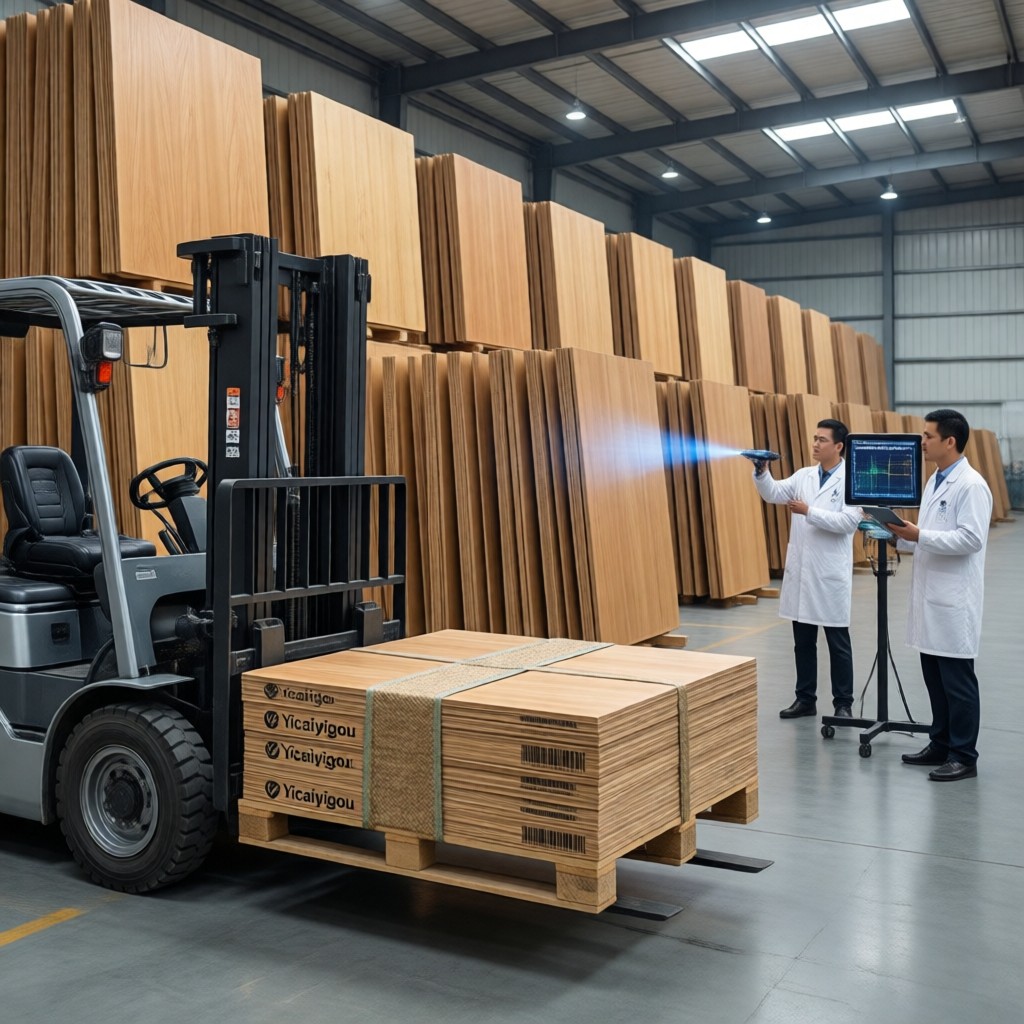
Yicaiyigou leverages these material characteristics to produce specialized composite panels tailored for exacting industry standards. For high-end furniture manufacturers exporting to Europe, our poplar-core Structural Plywood is engineered to meet ENF ≤0.05 mg/L formaldehyde emission limits. This ultra-low emission profile is critical for indoor air quality compliance in residential and commercial spaces, particularly under the upcoming EUDR requirements effective December 30, 2024.
In contrast, for heavy-duty shelving and structural components, our pine-core High-Density Particleboard offers superior screw-holding strength. With a density range of 550–750 kg/m³, these boards provide the necessary rigidity for load-bearing applications. When paired with our Precision MDF faces (density 600–800 kg/m³), the resulting composite panel balances structural integrity with a flawless surface ready for painting or laminating. Standard sizes of 2440x1220mm and thicknesses from 3mm to 30mm allow for seamless integration into existing CNC workflows.
Supply Chain Reliability and Compliance
Sourcing core materials requires more than just technical suitability; it demands verified compliance and logistical reliability. Yicaiyigou maintains full Chain of Custody (CoC) documentation for all FSC-certified products, ensuring traceability from forest to factory. This transparency is essential for buyers serving clients like Amazon or Herman Miller, who require proof of sustainable sourcing to meet their own corporate responsibility goals.
Our manufacturing facilities are certified to CARB P2 standards, limiting formaldehyde emissions to ≤0.11 ppm for composites. Additionally, we offer E0 (≤0.07 ppm) and ENF (≤0.05 mg/L) options for markets with stricter air quality regulations. With a lead time of 15–25 days and container loading capacities of 20–25 m³ for 20ft containers and 45–50 m³ for 40ft containers, we provide predictable supply chain performance. Minimum order quantities start at one 20ft container, making us accessible to both mid-sized distributors and large-scale OEMs.
Which One To Choose
Specify Poplar Core for high-gloss laminated furniture, painted cabinetry, and applications where surface perfection and minimal grain telegraphing are critical. Specify Pine Core for structural shelving, sub-flooring, and utility furniture where load-bearing capacity and cost-efficiency take precedence over surface aesthetics.
FAQ
What is the formaldehyde emission limit for ENF certification?
ENF certification requires formaldehyde emissions to be ≤0.05 mg/L, which is stricter than E0 (≤0.07 ppm) and CARB P2 (≤0.11 ppm).
How much volume fits in a 40ft container?
A 40ft container typically holds 45–50 m³ of standard 2440x1220mm panels, depending on thickness and packaging configuration.
What is the density range for Yicaiyigou’s Precision MDF?
Our Precision MDF has a density range of 600–800 kg/m³, ensuring consistent machining and surface quality.
Is FSC certification available for both poplar and pine cores?
Yes, Yicaiyigou provides FSC-certified options for both poplar and pine cores, complete with Chain of Custody documentation.
What is the minimum order quantity (MOQ)?
The MOQ is one 20ft container, which holds approximately 20–25 m³ of product.
Summary & Next Steps
Choosing between poplar and pine cores depends on balancing surface quality requirements with structural needs and budget constraints. Poplar excels in aesthetic applications requiring flawless finishes, while pine offers robust performance for structural uses. Both options are available from Yicaiyigou with full compliance documentation, including FSC, CARB P2, and ENF certifications.
Request a compliant material sample with full CoC documentation from Yicaiyigou to verify density and emission levels for your specific project requirements.
Frequently Asked Questions
Why is selecting the right softwood core critical for modern furniture manufacturing?
Selecting the right softwood core is a critical engineering decision that directly impacts panel flatness, machining tolerance, and final product longevity. It helps minimize warping risks, ensures compliance with global emission standards like CARB P2 and ENF, and prevents costly rejections caused by swelling or shrinking during CNC routing and edge-banding processes.
What are the primary differences between poplar and pine cores regarding machinability and surface finish?
Poplar offers high machinability with minimal tear-out and has a low risk of grain telegraphing due to its uniform texture. In contrast, pine has a medium machinability rating with a risk of resin gumming and a high risk of grain telegraphing, where knots may show through veneers or laminates.
How do the density and hardness metrics compare between poplar and pine cores?
Poplar cores have an average density of 400–500 kg/m³ and a Janka Hardness of 540 lbf (2,400 N). Pine cores are denser, ranging from 500–600 kg/m³, but generally have lower Janka Hardness values between 380–420 lbf (1,690–1,870 N).
In which applications might pine be preferred over poplar despite its surface irregularities?
Pine may be preferred in structural applications where load-bearing capacity is prioritized over surface perfection. Its higher stiffness-to-weight ratio provides greater structural rigidity, making it advantageous for uses where mechanical strength is more critical than aesthetic smoothness.
What regulatory compliance standards are highlighted for wood cores in the article?
The article highlights the importance of complying with global emission standards such as CARB P2 and ENF. Specifically, it mentions that poplar-core Structural Plywood can be engineered to meet ENF ≤0.05 mg/L formaldehyde emission limits, which is critical for indoor air quality compliance in residential and commercial spaces.