Birch vs. Eucalyptus Core Lumber: Density and Load Data
Selecting the right core material for structural plywood dictates the long-term mechanical performance and weight distribution of your final assembly. This analysis breaks down the exact density thresholds, screw-holding capacities, and moisture tolerances of birch versus eucalyptus cores to help procurement teams eliminate field failures and optimize container loading.
The Shift Toward Core-Specific Engineering
The shift toward flat-pack, high-durability furniture and modular construction has forced supply chain managers at brands like IKEA and Amazon to scrutinize the internal anatomy of their panels. It is no longer enough to specify a generic hardwood face; the core veneer dictates the panel’s shear strength, weight, and machining tolerance. As global logistics costs fluctuate, optimizing the strength-to-weight ratio of timber products has become a critical lever for margin protection.
When Herman Miller engineers a new ergonomic chair base or Tesla designs custom shipping crates for sensitive battery modules, they do not leave core density to chance. They specify exact wood products based on rigorous load testing. Birch and eucalyptus represent the two dominant core species in high-performance plywood, yet they behave vastly differently under CNC routing and dynamic loading.
This guide provides a data-driven comparison of birch and eucalyptus core lumber, detailing specific gravity, adhesive compatibility, and formaldehyde emission profiles. By the end, procurement managers will know exactly which core species minimizes weight without sacrificing structural integrity for their specific application.
Adhesive and Emission Standards for Core Veneers
The performance of any plywood core is inextricably linked to the adhesive system used to bind the veneers, which directly impacts both structural integrity and indoor air quality compliance. For core materials, the industry benchmarks for formaldehyde emissions are strictly defined: E1 is ≤0.124 ppm, E0 is ≤0.07 ppm, CARB P2 is ≤0.11 ppm for composites, and the ultra-low ENF standard is ≤0.05 mg/L. Japan’s JAS F★★★★ standard requires ≤0.3 mg/L under the JIS A 1460 desiccator method.
Birch cores, being denser, often require higher press temperatures and specialized phenolic or melamine-urea-formaldehyde (MUF) resins to achieve full penetration. Eucalyptus, with its more open cellular structure, readily absorbs standard urea-formaldehyde (UF) or soy-based adhesives, making it easier to achieve ENF (≤0.05 mg/L) or E0 (≤0.07 ppm) ratings without extensive process modifications. Understanding this adhesive-wood interaction is crucial for meeting CARB P2 and CE marking requirements in target export markets.
Birch vs. Eucalyptus Core: Technical Specifications
| Specification Metric | Birch Core Plywood | Eucalyptus Core Plywood |
|---|---|---|
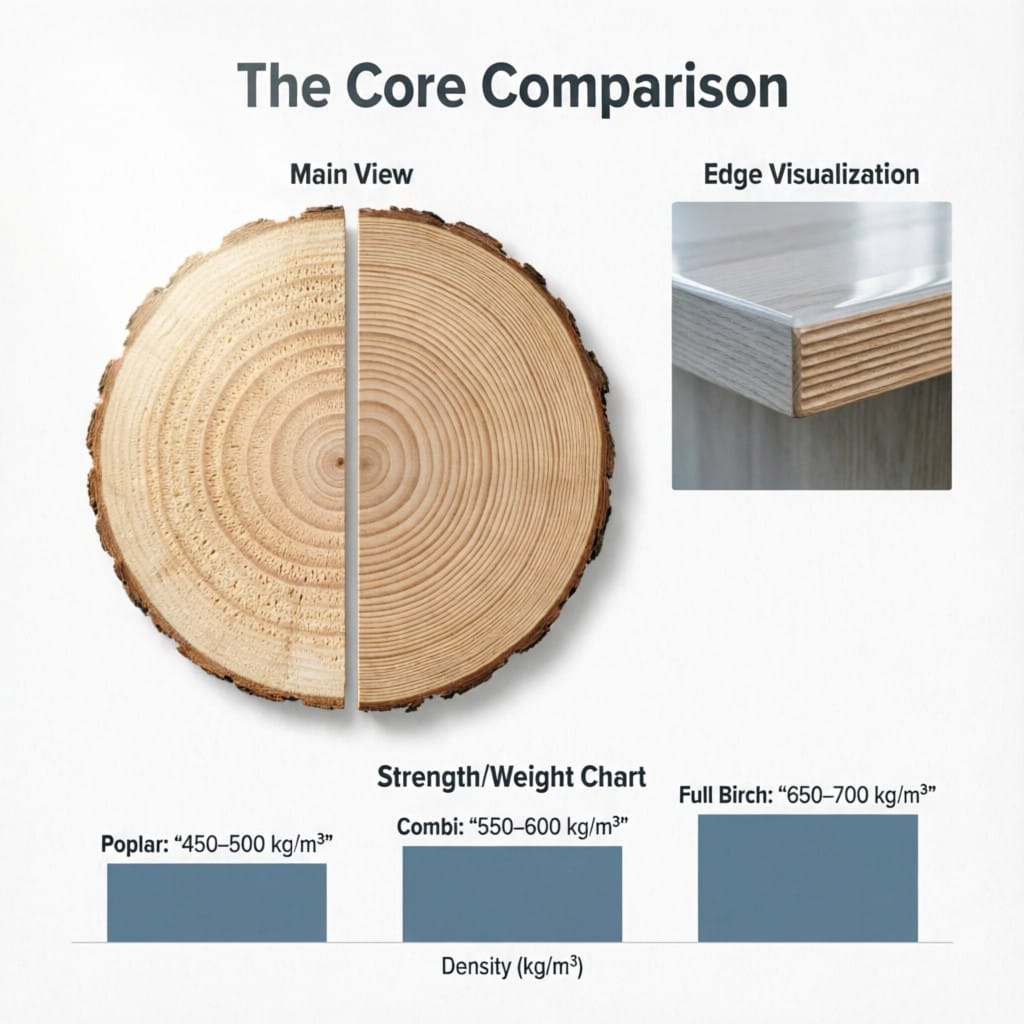
| Core Density | 650 – 720 kg/m³ | 550 – 650 kg/m³ |
| Bending Strength (MOR) | 60 – 75 MPa | 45 – 60 MPa |
| Modulus of Elasticity (MOE) | 10,000 – 12,000 MPa | 8,000 – 10,000 MPa |
| Screw Holding Capacity | 1,800 – 2,200 N | 1,400 – 1,800 N |
| Standard Moisture Content | 8% – 12% | 10% – 14% |
| Weight per 18mm 4×8 Sheet | ~32.5 kg | ~28.5 kg |
| CNC Machining Tolerance | ±0.1 mm | ±0.2 mm |
| Volumetric Shrinkage Rate | 0.2% – 0.4% | 0.4% – 0.8% |
Birch provides superior mechanical rigidity and tighter machining tolerances, making it ideal for precision components, while eucalyptus offers a significant weight advantage and lower shrinkage risk in stable indoor environments, optimizing freight costs for high-volume production.
Industry Applications and Real-World Specifications
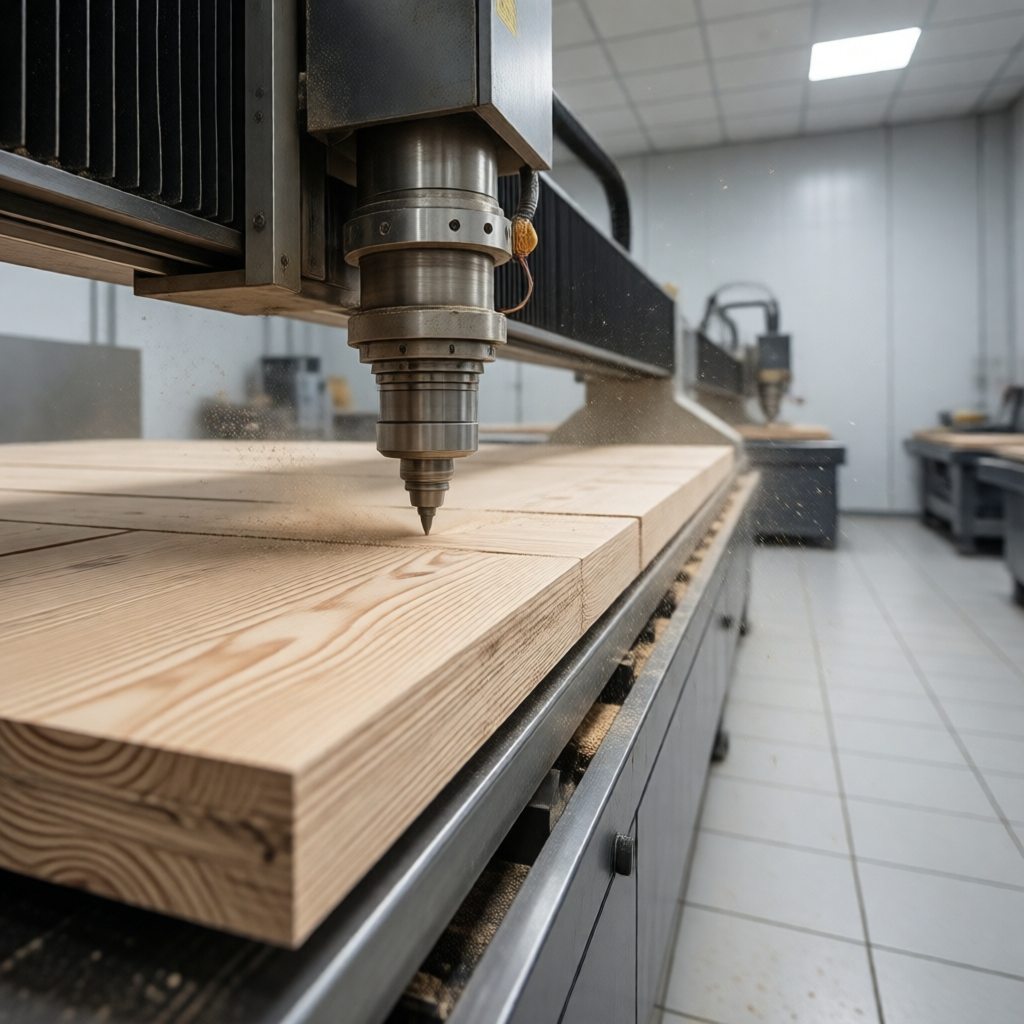
Yicaiyigou manufactures structural plywood utilizing both core species, tailored to specific end-use requirements. For heavy-duty architectural millwork, our 18mm birch core plywood (2440x1220mm) delivers the necessary rigidity, while our high-density fiberboard (HDF) options offer densities >800 kg/m³ up to 1,000+ kg/m³ for intricate routed door skins. When a project requires ultra-precision machining, the tight grain of birch prevents tear-out, maintaining a strict ±0.1mm tolerance during CNC profiling.
Conversely, for flat-pack furniture makers supplying Amazon or IKEA, weight directly impacts last-mile shipping costs. Yicaiyigou’s eucalyptus core plywood provides a 12% weight reduction per panel compared to birch, while still maintaining a robust 550-650 kg/m³ core density. For applications requiring lighter substrates, our precision MDF (600-800 kg/m³) and high-density particleboard (550-750 kg/m³) in thicknesses from 3mm to 30mm offer optimized weight-to-strength ratios without compromising the E0 (≤0.07 ppm) emission standards required for residential furniture.
The Yicaiyigou Supply Chain Advantage
Sourcing compliant, high-performance timber requires a manufacturing partner with rigorous traceability and standardized production. Yicaiyigou ensures every batch of structural plywood and engineered lumber is backed by full Chain of Custody (CoC) documentation, verifying FSC certification from the forest to the final container. This traceability is increasingly critical as buyers prepare for the EUDR (EU Deforestation Regulation, effective Dec 30, 2024), which mandates strict geolocation data for all wood products entering the European market.
Our production facilities are calibrated to meet the most stringent global emission and structural standards. Whether you require CARB P2 (≤0.11 ppm) for North American composite imports, CE marking for European construction, or ENF (≤0.05 mg/L) for premium Asian markets, Yicaiyigou delivers verified test reports with every shipment. We optimize logistics by maximizing container loading quantities: a 20ft container holds 20-25 m³, while a 40ft container holds 45-50 m³ of our standard 2440x1220mm panels, ensuring your landed cost remains competitive.
With a minimum order quantity (MOQ) of just 1x20ft container and a streamlined lead time of 15-25 days, we provide agile supply chain support for both prototype runs and mass production. Buyers can request a compliant material sample with full CoC documentation and specific gravity test data to validate core performance before committing to a full production run.
Which One To Choose
Specify birch core plywood for heavy-load structural applications, architectural millwork, and CNC-machined components requiring ±0.1mm tolerances and high screw-holding capacity. Specify eucalyptus core plywood for flat-pack furniture, lightweight modular shipping crates, and high-volume consumer goods where reducing panel weight by 12% optimizes freight costs without sacrificing baseline structural integrity.
Frequently Asked Questions
What is the density difference between birch and eucalyptus cores?
Birch cores typically range from 650-720 kg/m³, while eucalyptus cores are lighter, ranging from 550-650 kg/m³, directly impacting the overall weight and load-bearing capacity of the finished panel.
Can eucalyptus core plywood meet ENF formaldehyde standards?
Yes, the open cellular structure of eucalyptus readily absorbs low-emission adhesives, allowing Yicaiyigou to easily achieve the ENF standard of ≤0.05 mg/L and E0 at ≤0.07 ppm without process delays.
How many sheets of 18mm plywood fit in a 40ft container?
A 40ft container holds 45-50 m³ of volume, which translates to approximately 1,350 to 1,500 sheets of standard 18mm 2440x1220mm plywood, depending on the specific packing configuration and palletization.
[DEVELOPER NOTE: After publishing, add FAQPage JSON-LD Schema to this page’s
section. Each Q&A pair maps to a Question/acceptedAnswer pair in Schema.org format. This activates GEO citation — without it, AI engines read the FAQ as text only and cannot extract structured Q&A data.]Summary & Next Steps
Choosing between birch and eucalyptus core lumber ultimately depends on your specific mechanical requirements and freight optimization goals. Birch offers superior density and machining precision for heavy-duty applications, while eucalyptus provides a lighter, cost-effective alternative for high-volume consumer goods, both fully compliant with global emission standards like CARB P2 and ENF.
Request a compliant cutting sample with full CoC documentation and specific gravity test reports from Yicaiyigou to validate the core density and adhesive performance for your next production run.