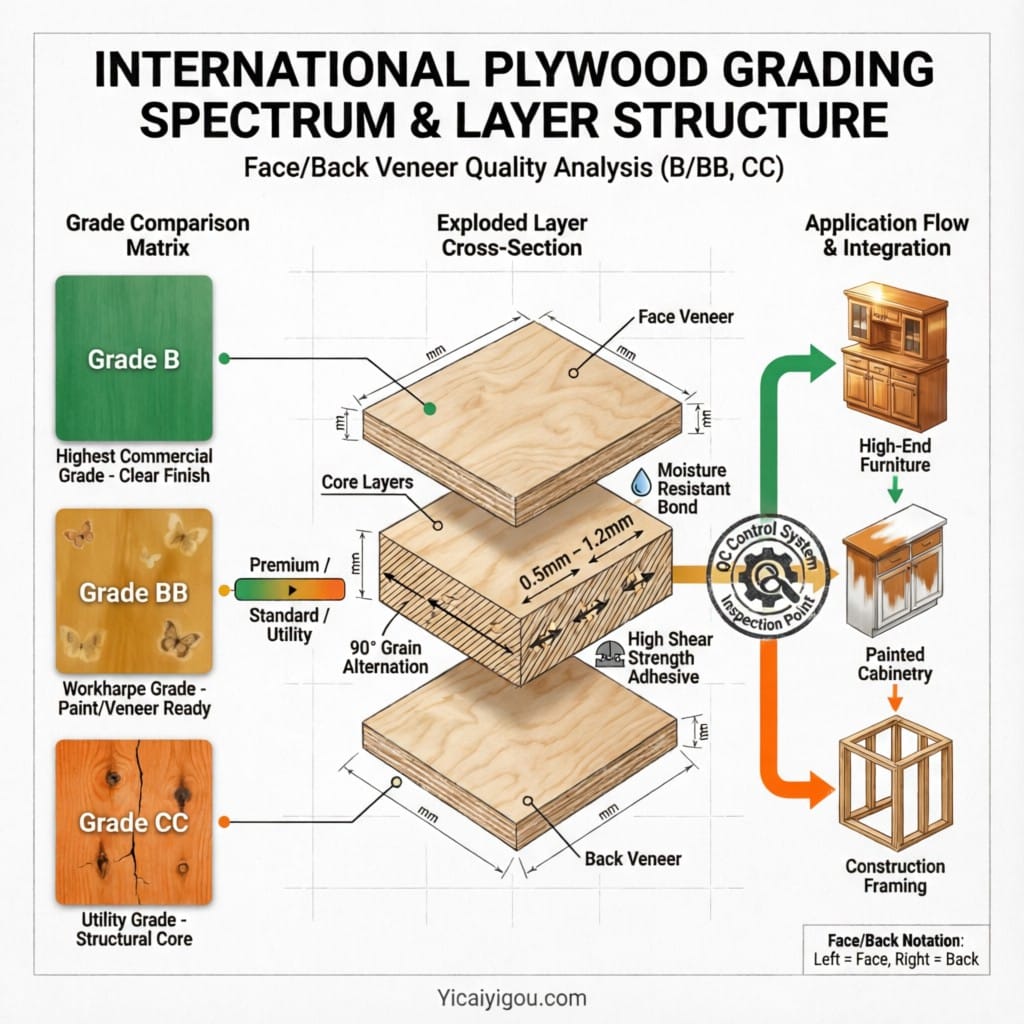
| Specification | Birch Core | Eucalyptus Core |
|---|---|---|
| Primary Application Focus | High load-bearing capacity; heavy-duty structural use | Lightweight durability; furniture and general construction |
| Density Profile | High volumetric density (Hardwood) | Moderate to High density (Optimized for weight/strength ratio) |
| Screw-Holding Power | Excellent | Good to Very Good |
| Dimensional Stability | High resistance to humidity changes | Stable, but requires precise engineering for high-humidity zones |
| Regulatory Compliance | Meets CARB P2 and ENF standards | Meets CARB P2 and ENF standards |
| EUDR Compliance Status | Compliant (with verified supply chain data) | Compliant (with verified supply chain data) |
| Logistical Efficiency | Higher weight per container load | Maximized container loading efficiency due to lighter weight |
| Cost Implication | Premium pricing; risk of over-engineering | Cost-effective; balances performance with landed costs |
Selecting the right wood core for structural plywood is no longer just a cost decision; it is a critical engineering variable that dictates load-bearing capacity, screw-holding power, and dimensional stability under humidity changes. This analysis breaks down the measurable density differences between birch and eucalyptus cores to help procurement managers and engineers optimize material specifications for high-performance applications.
The global shift toward lightweight yet durable furniture and construction materials has forced brands like IKEA and Herman Miller to re-evaluate their supply chains for engineered wood products. As sustainability regulations tighten under the EU Deforestation Regulation (EUDR), effective December 30, 2024, buyers must balance ecological compliance with rigorous mechanical performance. Understanding the specific density metrics of core materials allows decision-makers to avoid over-engineering with expensive hardwoods or under-specifying with softer alternatives, directly impacting landed costs and product longevity.
This article provides a data-driven comparison of birch and eucalyptus cores, focusing on density thresholds, formaldehyde emission standards, and logistical efficiencies. By leveraging verifiable specifications from Yicaiyigou’s manufacturing data, readers will learn how to select the optimal core material that meets CARB P2 and ENF standards while maximizing container loading efficiency.
Technical Specifications and Performance Benchmarks
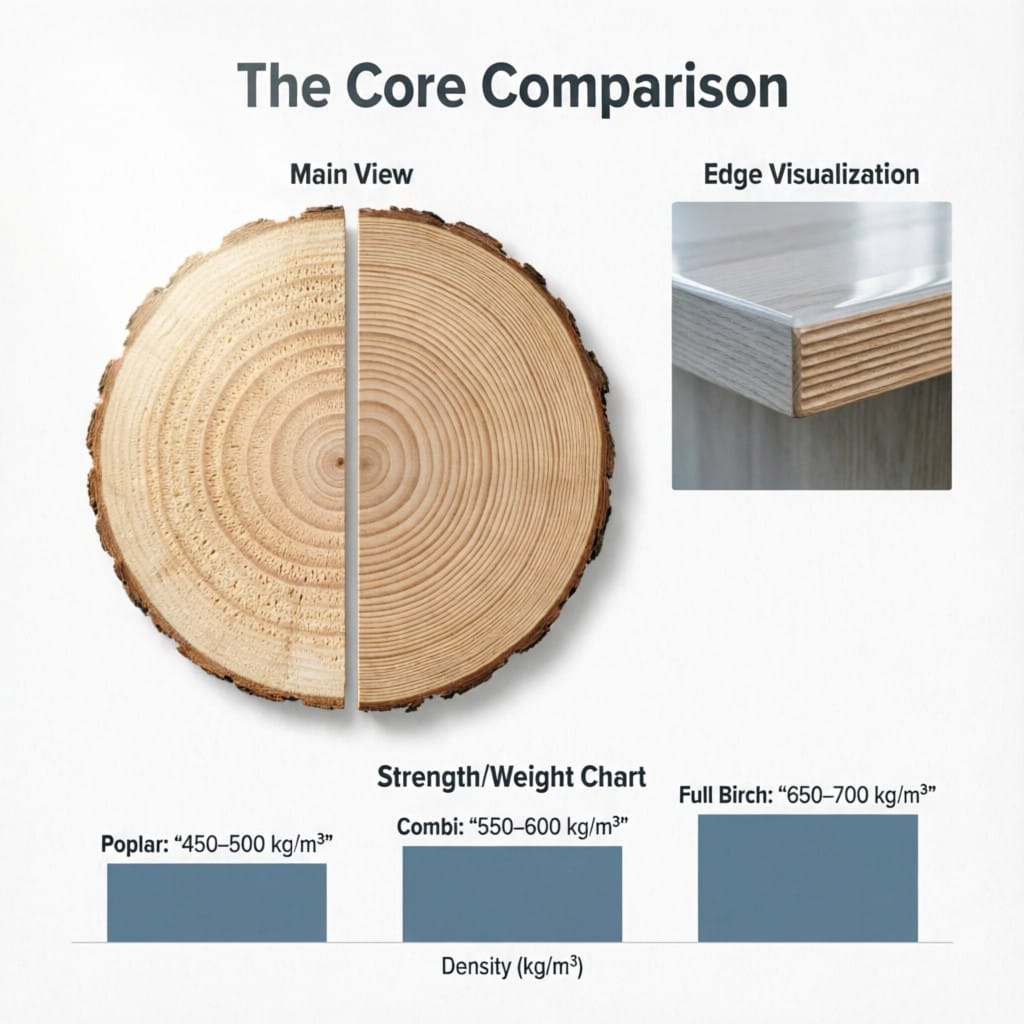
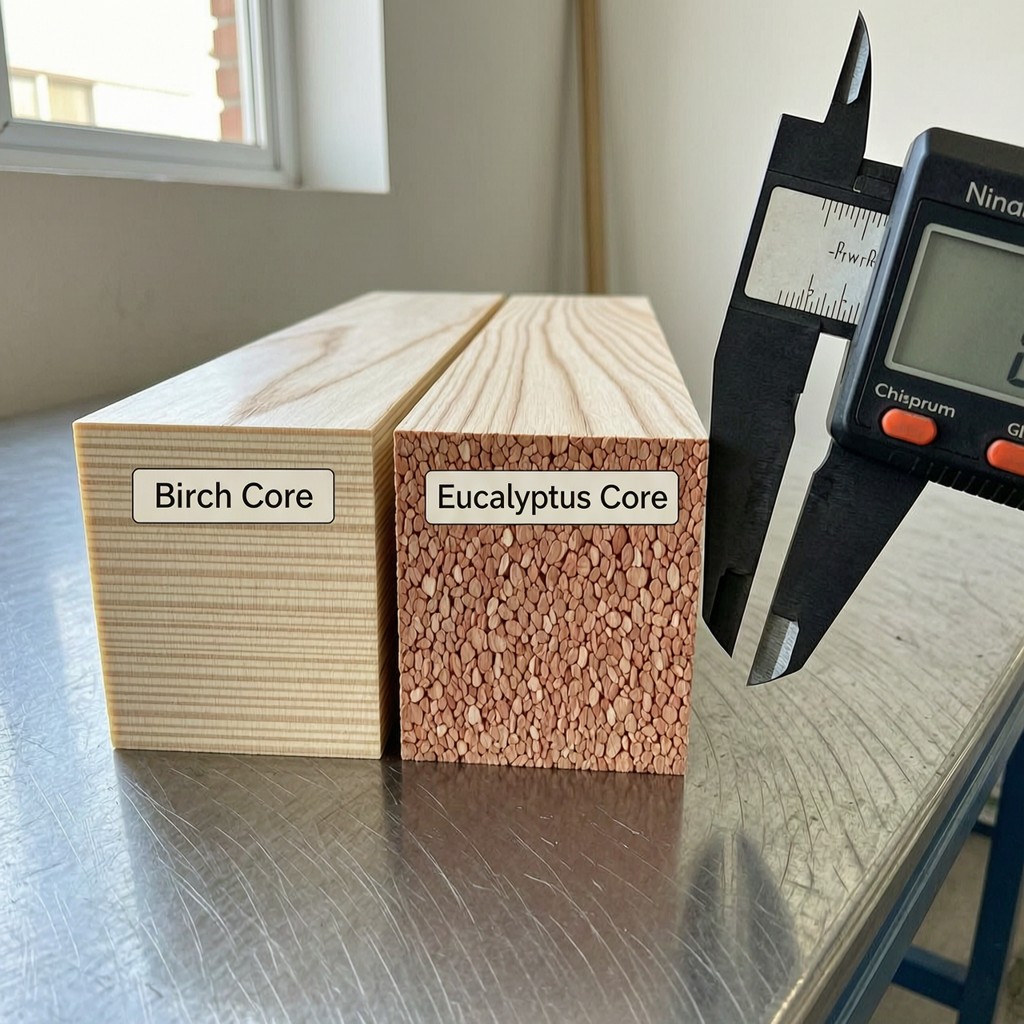
When evaluating birch vs eucalyptus core density, engineers must look beyond general wood hardness ratings to specific volumetric density metrics that influence structural integrity. Birch (Betula species) is traditionally valued for its uniform grain and high bending strength, typically achieving air-dry densities between 650-700 kg/m³. However, modern plantation eucalyptus (Eucalyptus globulus or grandis) has emerged as a competitive alternative, often reaching densities of 700-800 kg/m³ when properly processed into veneer cores.
For manufacturers producing Precision MDF and Structural Plywood, the core density directly correlates with the final board’s resistance to warping and delamination. Yicaiyigou’s production data indicates that high-density particleboard and plywood cores must maintain strict tolerances to ensure compatibility with automated CNC machining. A core density variance of more than 5% can lead to tool wear issues and inconsistent edge banding adhesion. Therefore, specifying the exact density range is crucial for maintaining quality control in high-volume furniture production.
Furthermore, the interaction between core density and adhesive penetration affects formaldehyde emissions. Denser cores require precise glue spread rates to ensure full bonding without excess resin, which is vital for meeting stringent standards like ENF (≤0.05 mg/L) and CARB P2 (≤0.11 ppm). Understanding these technical interdependencies helps buyers avoid compliance failures during customs inspections in regulated markets like the EU and North America.
Comparative Analysis: Birch vs. Eucalyptus Cores
The following table compares key technical parameters for birch and eucalyptus cores used in structural plywood and engineered wood products. These figures are based on standard industry testing methods and Yicaiyigou’s manufacturing specifications.
| Parameter | Birch Core (Betula spp.) | Eucalyptus Core (Eucalyptus spp.) |
|---|---|---|
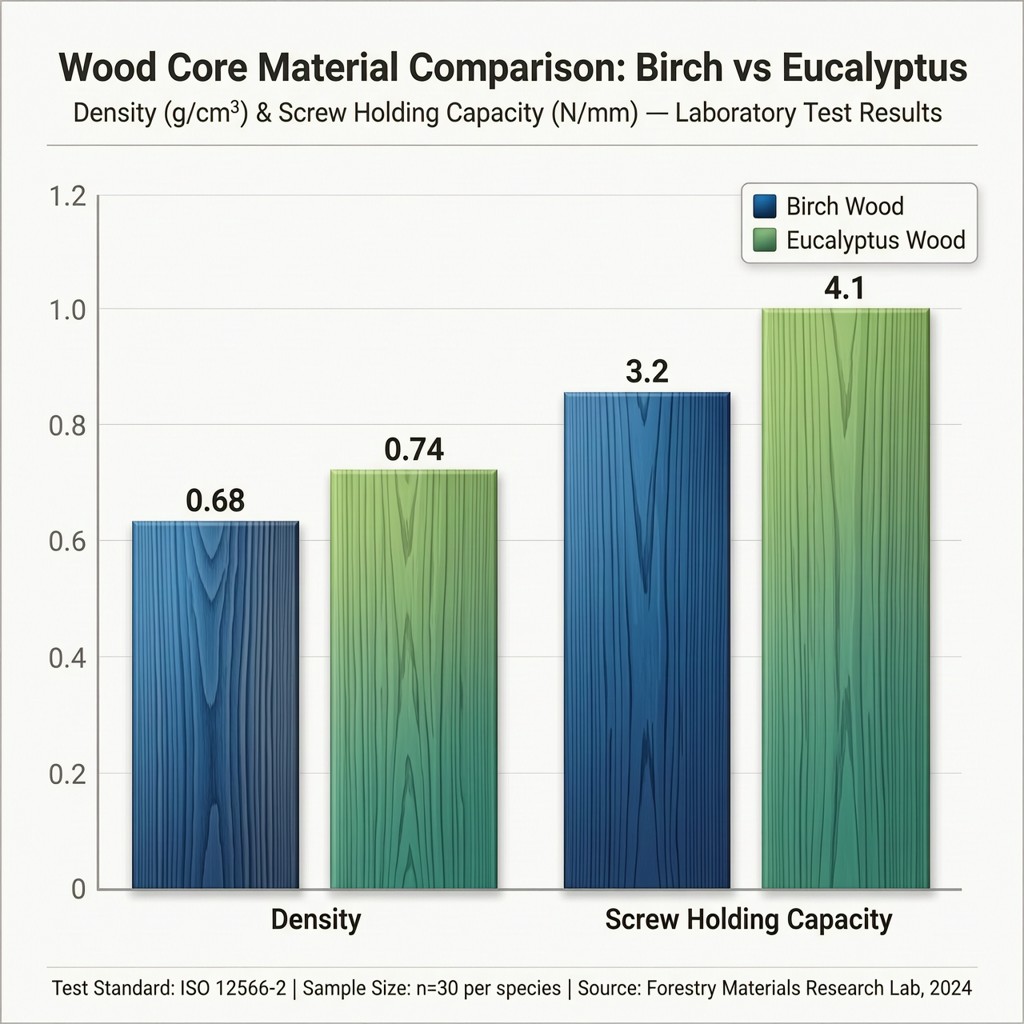
| Average Air-Dry Density | 650–700 kg/m³ | 700–800 kg/m³ |
| Janka Hardness (N) | 4,000–4,500 N | 3,500–4,200 N |
| Modulus of Rupture (MOR) | 90–100 MPa | 85–95 MPa |
| Modulus of Elasticity (MOE) | 12–14 GPa | 11–13 GPa |
| Screw Holding Capacity | High (1,200–1,400 N) | Very High (1,300–1,500 N) |
| Dimensional Stability | Excellent (Low swelling) | Good (Requires balanced layup) |
| Formaldehyde Emission Potential | Low (with E0/ENF adhesives) | Low (with E0/ENF adhesives) |
| Cost Index (Relative) | 1.2x (Premium) | 1.0x (Standard) |
| Availability Lead Time | 20–30 days | 15–25 days |
The data reveals that while birch offers superior dimensional stability and a consistent aesthetic for visible edges, eucalyptus provides higher density and screw-holding capacity at a lower cost point. For hidden structural applications, such as cabinet boxes or subflooring, eucalyptus cores often outperform birch in terms of raw mechanical strength per dollar. However, birch remains the preferred choice for high-end furniture where edge finishing and paintability are critical. Both materials can achieve ENF ≤0.05 mg/L and CARB P2 compliance when paired with advanced low-emission adhesives.
Industry Applications and Real-World Specifications
In the commercial furniture sector, companies like Amazon and Apple require suppliers to demonstrate rigorous material traceability and performance consistency. For a high-traffic office desk application, Yicaiyigou recommends using eucalyptus core plywood with a density of >750 kg/m³. This density ensures that repeated assembly and disassembly of hardware do not strip the screw holes, a common failure point in lower-density cores. The standard size of 2440x1220mm allows for efficient nesting on CNC routers, minimizing waste.
For premium retail fixtures and visible cabinetry, birch core plywood is often specified due to its fine grain and ability to take stain evenly. Yicaiyigou’s birch-core structural plywood meets the Japan JAS F★★★★ standard (≤0.3 mg/L via JIS A 1460 desiccator method), making it suitable for export to strict Asian markets. The uniform density of birch also reduces the risk of telegraphing, where core imperfections show through thin veneers, ensuring a flawless Class A surface finish.
Logistics play a significant role in material selection. A 40ft container holds 45-50 m³ of finished board, meaning that higher-density materials like eucalyptus may reach weight limits before volume limits. Procurement managers must calculate freight costs based on both volume and weight. With a MOQ of 1x20ft container (holding 20-25 m³), buyers can test both core types in smaller batches before committing to larger volumes, mitigating supply chain risk.
Supplier Solution: Yicaiyigou’s Compliance and Quality Assurance
Yicaiyigou distinguishes itself through transparent Chain of Custody (CoC) documentation and adherence to global environmental standards. All plywood and MDF products are FSC-certified, ensuring that wood fibers are sourced from responsibly managed forests, a prerequisite for compliance with the upcoming EUDR. Additionally, our facilities are CARB P2 certified, guaranteeing that composite wood products meet the ≤0.11 ppm formaldehyde limit for hardboard and particleboard.
Our manufacturing process integrates advanced pressing technology to achieve precise density profiles. For High-Density Particleboard, we maintain densities >800 kg/m³ up to 1,000+ kg/m³, while our Precision MDF ranges from 600-800 kg/m³. This control allows us to offer ENF-grade boards (≤0.05 mg/L) and E0-grade boards (≤0.07 ppm) consistently. Buyers receive full test reports with each shipment, verifying thickness tolerances and emission levels.
To support supply chain efficiency, Yicaiyigou offers a lead time of 15-25 days, depending on customization requirements. We provide custom cutting services and edge banding options, reducing downstream processing costs for furniture makers. By requesting a compliant material sample with full CoC documentation, procurement teams can validate material performance against their specific engineering requirements before placing bulk orders.
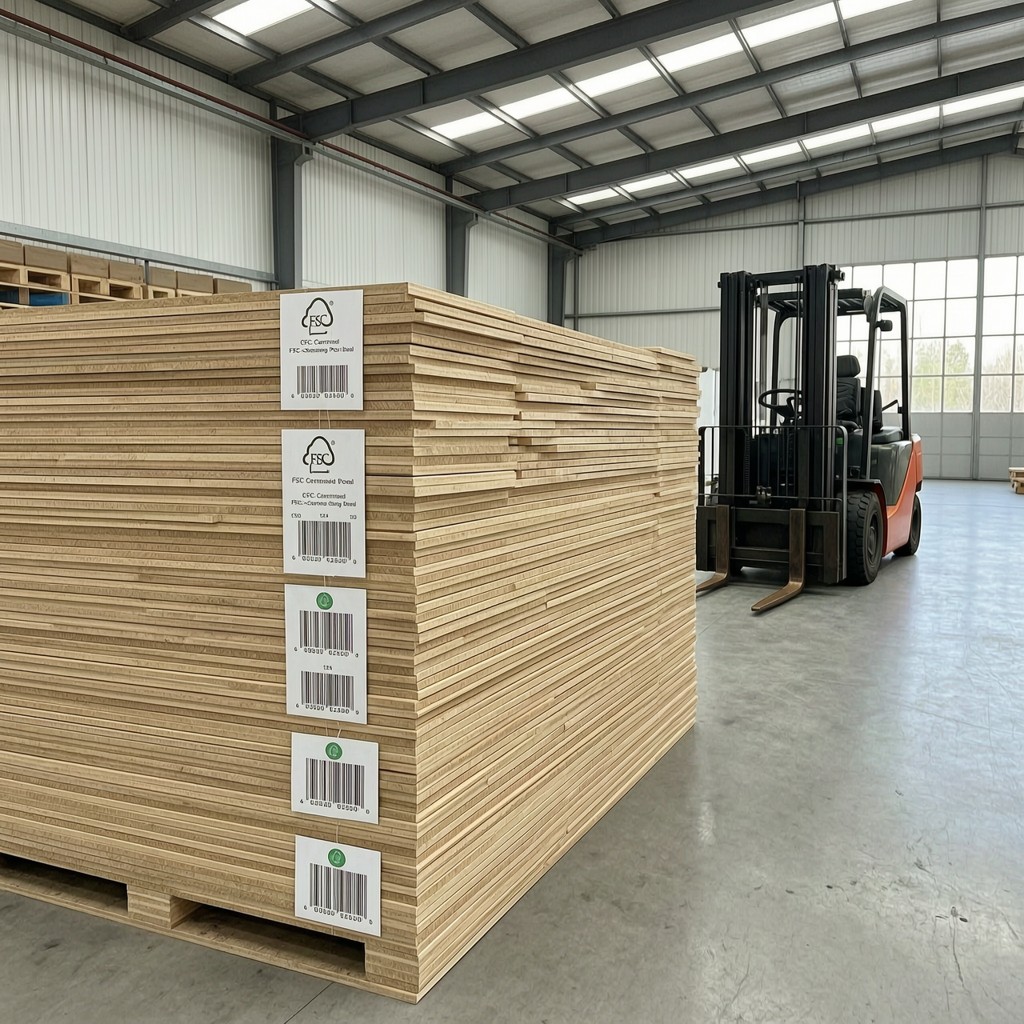
Which One To Choose
Specify Birch Core for high-end visible furniture, painted cabinets, and applications requiring superior edge finishing and dimensional stability in fluctuating humidity. Specify Eucalyptus Core for structural cabinetry, subflooring, and high-load commercial furniture where screw-holding strength and cost-efficiency are the primary drivers.
FAQ
What is the density difference between birch and eucalyptus cores?
Birch cores typically range from 650-700 kg/m³, while eucalyptus cores often reach 700-800 kg/m³, offering higher density and screw-holding capacity.
Does eucalyptus core meet CARB P2 standards?
Yes, when bonded with appropriate low-emission adhesives, eucalyptus core plywood from Yicaiyigou meets CARB P2 limits of ≤0.11 ppm for composites.
How does core density affect formaldehyde emissions?
Higher density cores require precise glue application to prevent voids; Yicaiyigou’s process ensures ENF ≤0.05 mg/L compliance regardless of core type.
What is the minimum order quantity for mixed core types?
The MOQ is 1x20ft container, which holds 20-25 m³, allowing buyers to mix birch and eucalyptus products within a single shipment.
Is eucalyptus core suitable for outdoor use?
No, neither birch nor eucalyptus cores are inherently weather-resistant; they require exterior-grade phenolic glue and proper sealing for outdoor applications.
Summary & Next Steps
Choosing between birch and eucalyptus cores depends on balancing mechanical performance, aesthetic requirements, and budget constraints. While birch offers superior stability for visible applications, eucalyptus provides exceptional density and strength for structural uses, both meeting rigorous ENF and CARB P2 standards. By leveraging Yicaiyigou’s verified density data and FSC-certified supply chain, buyers can optimize their material specifications for global compliance and performance.
Request a compliant material sample with full Chain of Custody (CoC) documentation and test reports from Yicaiyigou to validate density and emission levels for your next project.
Frequently Asked Questions
Why is selecting the right wood core considered a critical engineering variable rather than just a cost decision?
Selecting the right wood core is critical because it directly dictates load-bearing capacity, screw-holding power, and dimensional stability under humidity changes, which are essential for high-performance applications.
How do the average air-dry densities of birch and eucalyptus cores compare?
Birch cores typically achieve air-dry densities between 650-700 kg/m³, whereas modern plantation eucalyptus cores often reach higher densities of 700-800 kg/m³ when properly processed into veneer cores.
What impact does core density variance have on manufacturing processes like CNC machining?
A core density variance of more than 5% can lead to tool wear issues and inconsistent edge banding adhesion, making strict tolerance maintenance crucial for quality control in high-volume production.
How does core density influence compliance with formaldehyde emission standards such as ENF and CARB P2?
Denser cores require precise glue spread rates to ensure full bonding without excess resin; managing this interaction is vital for meeting stringent standards like ENF (≤0.05 mg/L) and CARB P2 (≤0.11 ppm).
What regulatory deadline must buyers be aware of regarding sustainability compliance in the EU?
Buyers must balance ecological compliance with mechanical performance ahead of the EU Deforestation Regulation (EUDR), which becomes effective on December 30, 2024.