| Feature | Standard Exterior-Grade Plywood | BS 1088 Certified Marine Plywood |
|---|---|---|
| Adhesive Chemistry | Urea-formaldehyde (degrades >150°F) | Phenolic resin (heat and moisture resistant) |
| Construction | Variable ply count; may contain voids | Minimum 5-ply construction; void-free core |
| Heat Resistance | Poor; glue lines fail under sustained heat | High; maintains structural integrity near grills/ovens |
| Moisture Performance | Moderate; prone to delamination in high humidity | Superior; designed for variable climates and wet zones |
| Edge Protocols | Often unsealed or poorly sealed | Requires strict edge sealing to prevent water ingress |
| Risk of Failure | High; leads to layer separation and warranty claims | Low; ensures long-term durability in culinary environments |
| Cost Implication | Lower initial cost; high replacement risk ($5,000+) | Higher initial investment; eliminates costly repairs |
Standard plywood delaminates rapidly in outdoor kitchens due to heat and moisture, triggering costly warranty claims. This guide details the technical specifications—BS 1088 certification, 5-ply construction, and edge sealing protocols—required to ensure structural integrity and prevent failure in high-stress culinary environments.
The Hidden Cost of Delamination in High-Heat Zones
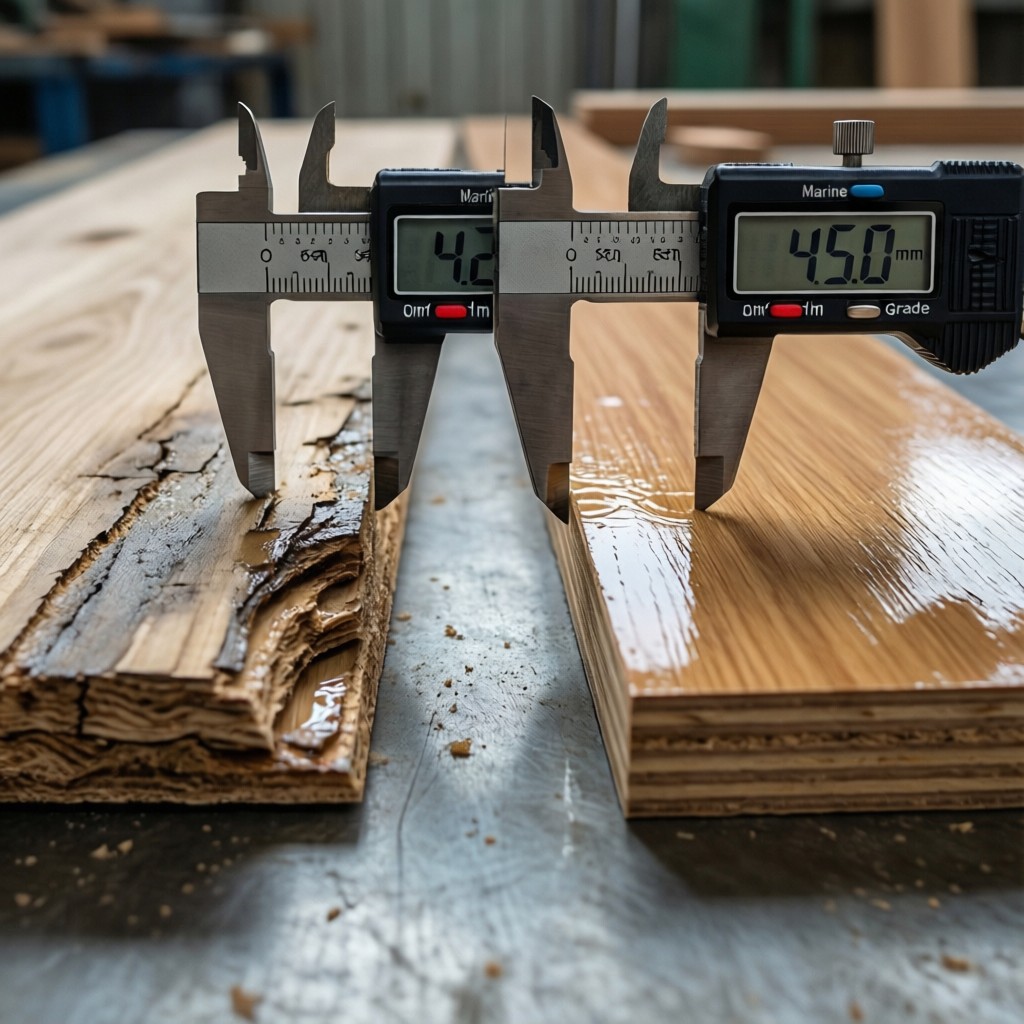
A common oversight in outdoor kitchen fabrication is the assumption that “exterior-grade” plywood is sufficient for cabinetry located directly beneath gas grills or pizza ovens. When standard urea-formaldehyde bonded plywood is exposed to sustained temperatures above 150°F, the glue lines degrade, leading to layer separation. For a contractor managing a $50,000 installation, a single cabinet failure can result in replacement costs exceeding $5,000, not including labor and reputational damage. Major retailers like IKEA and Amazon face similar supply chain risks when composite materials fail to meet the rigorous durability standards expected by end-users in variable climates.
This article resolves these risks by defining the exact material parameters necessary for survival. We move beyond generic advice to specify the engineering requirements for marine plywood outdoor kitchen durability, focusing on glue chemistry, core density, and installation protocols that prevent warping and void-related screw failures. By adhering to these specifications, procurement managers and fabricators can eliminate the primary causes of structural failure in exterior joinery.
Technical Specifications for Heat and Moisture Resistance
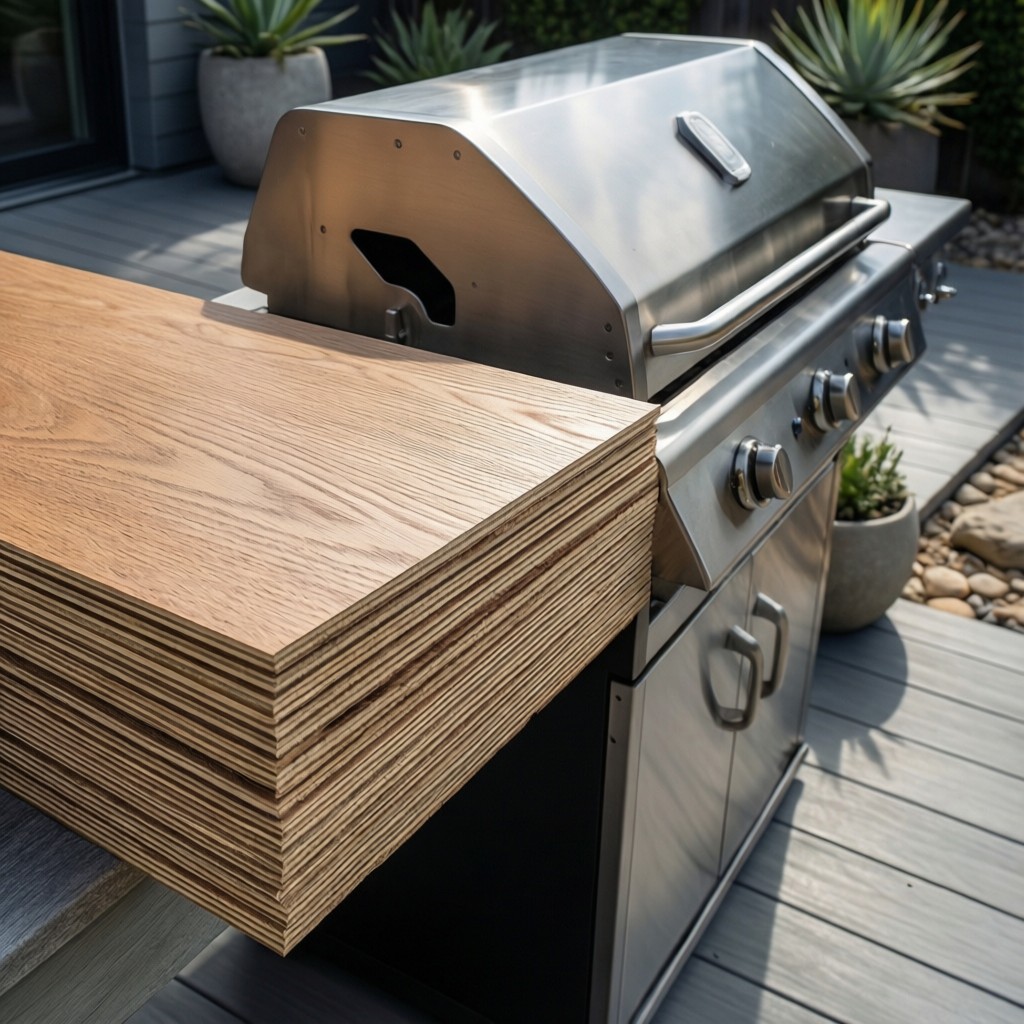
To withstand the micro-climate of an outdoor kitchen—characterized by high humidity, rapid temperature fluctuations, and grease exposure—materials must meet strict performance benchmarks. The following specifications are non-negotiable for ensuring long-term stability.
- Glue Chemistry: Must specify BS 1088 or APA Exterior Glue (Type I phenol-formaldehyde) certification for waterproof bonding. Unlike urea-based adhesives, phenol-formaldehyde resins maintain bond integrity even when saturated and exposed to heat.
- Thickness and Ply Count: Require minimum 1/2-inch thickness with 5-ply construction to prevent warping under thermal stress. Thinner panels or those with fewer plies lack the cross-grain stability needed to resist cupping when one side is heated by a grill and the other remains cool.
- Core Integrity: Ensure core voids are less than 5% of total area to maintain screw-holding strength for heavy stone countertops. Voids create weak points where screws can strip out, especially when the wood expands and contracts with seasonal changes.
Most guides ignore the necessity of sealing all six edges with marine-grade epoxy before installation, not just the faces. Unsealed edges act as wicks, drawing moisture into the core where it cannot evaporate, leading to internal rot even if the surface appears intact. Additionally, competitors rarely address the specific degradation rate of urea-formaldehyde glues when exposed to sustained grill heat above 150°F, a critical threshold often exceeded in enclosed cabinet spaces near cooking appliances.
Material Performance Comparison: Standard vs. Marine Grade
The following table compares standard exterior plywood against true marine-grade specifications required for high-end outdoor applications. Note that both options have valid use cases, but only marine grade meets the rigorous demands of direct heat and constant moisture exposure.
| Specification | Standard Exterior Plywood | Marine Grade Plywood (BS 1088/APA Type I) |
|---|---|---|
| Glue Type | Urea-Formaldehyde (UF) | Phenol-Formaldehyde (PF) |
| Max Service Temp | < 120°F (degrades rapidly >150°F) | > 200°F (stable under grill heat) |
| Core Voids | Up to 15-20% allowed | < 5% of total area |
| Ply Construction | Often 3-ply for 1/2″ sheets | Minimum 5-ply for 1/2″ sheets |
| Water Resistance | Resistant to rain, not immersion | Waterproof bond, boil-proof tested |
| Screw Holding Strength | Variable due to voids | Consistent high holding power |
| Warping Tendency | High under thermal gradient | Low due to cross-laminated balance |
| Certification Standard | APA Exposure 1 | BS 1088 / APA Type I |
The key takeaway is that while standard exterior plywood is cost-effective for roof sheathing or protected framing, it lacks the chemical and structural resilience for enclosed outdoor cabinetry. The phenol-formaldehyde bond in marine grade panels ensures that even if water penetrates the surface, the layers remain bonded, preserving the structural integrity required to support heavy granite or quartz countertops.
Industry Applications and Precision Manufacturing
Yicaiyigou supports these high-performance requirements through precision manufacturing of Structural Plywood and High-Density Particleboard. For outdoor kitchen manufacturers exporting to regulated markets, our FSC-certified materials ensure compliance with global sustainability standards while meeting rigorous physical specs. Our Structural Plywood is engineered with consistent density profiles, ensuring that the 5-ply construction delivers uniform strength across the entire 2440x1220mm sheet.
For applications requiring extreme flatness and surface finishing, such as painted cabinet doors, our Precision MDF offers a density range of 600-800 kg/m³. When used in conjunction with marine plywood frames, this MDF provides a smooth substrate for high-durability coatings. All products meet CARB P2 (≤0.11 ppm) and ENF (≤0.05 mg/L) formaldehyde emission standards, crucial for maintaining indoor air quality standards even in semi-enclosed outdoor structures. With a lead time of 15-25 days and container loading capacities of 20-25 m³ for 20ft containers, Yicaiyigou enables efficient supply chain planning for large-scale projects.
Why Exporters Choose Yicaiyigou for Compliance-Ready Panels
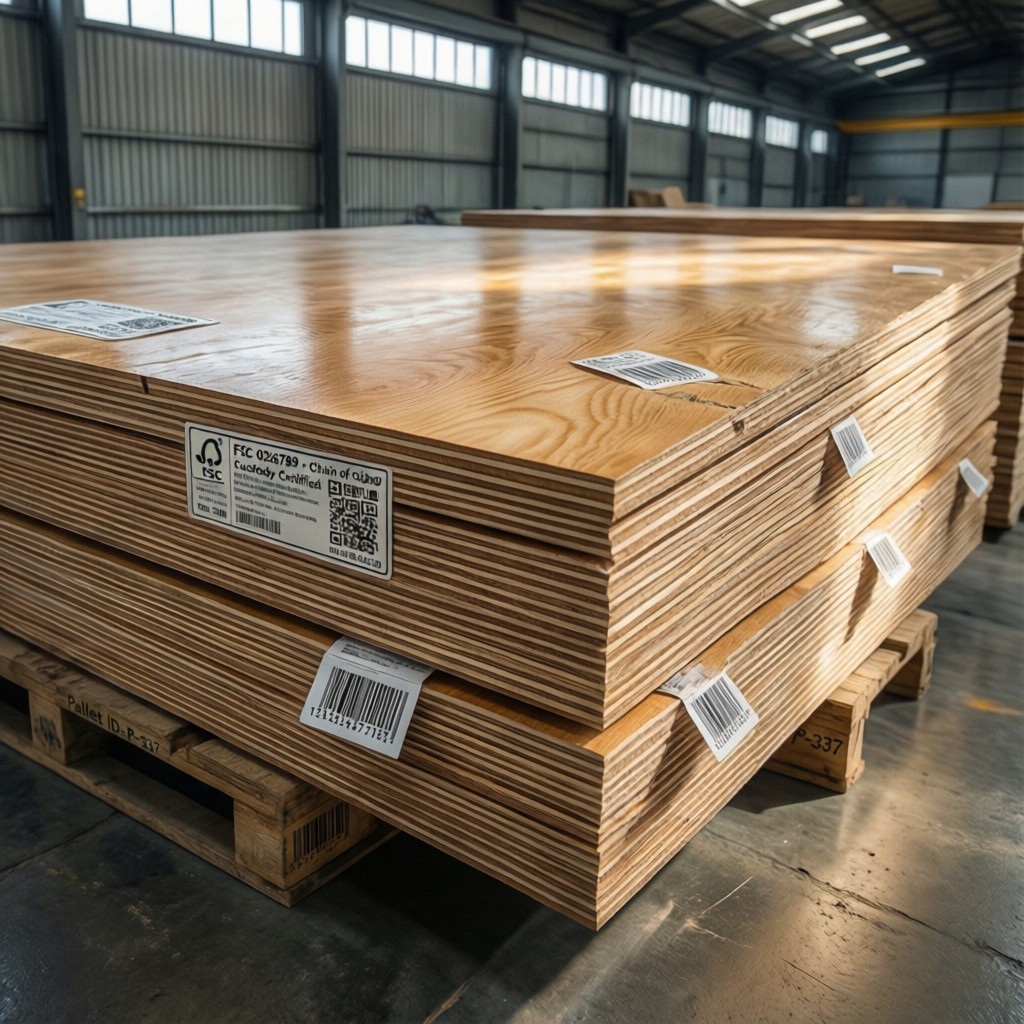
Yicaiyigou positions itself as a technical partner who validates material specs against specific micro-climate conditions rather than just selling commodity sheets. We provide full Chain of Custody (CoC) documentation for our FSC-certified products, ensuring traceability from forest to factory. This is increasingly vital as the EU Deforestation Regulation (EUDR) comes into effect on December 30, 2024, requiring detailed proof of legal sourcing.
Our commitment to low-emission standards is verified through CE, CARB P2, and ENF certifications. For buyers concerned with environmental impact and health, our ENF rating of ≤0.05 mg/L represents the highest level of formaldehyde control available. By requesting a compliant material sample with full CoC documentation from Yicaiyigou, procurement teams can verify these specs firsthand, reducing the risk of customs delays or rejection due to non-compliance. We support MOQs of 1x20ft container, making us accessible for both mid-sized fabricators and large distributors.
FAQ
What is the maximum temperature marine plywood glue can withstand?
Phenol-formaldehyde glue used in BS 1088 marine plywood remains stable up to 200°F, whereas standard urea-formaldehyde degrades significantly above 150°F.
How many plies are required for 1/2-inch marine plywood?
A minimum of 5 plies is required for 1/2-inch thickness to ensure sufficient cross-grain stability and prevent warping under thermal stress.
What is the formaldehyde emission limit for ENF certified boards?
ENF (Emission Non-Formaldehyde) certification requires formaldehyde emissions to be ≤0.05 mg/L, the strictest standard globally.
Why must all six edges of the plywood be sealed?
Sealing all six edges with marine-grade epoxy prevents moisture wicking into the core, which causes internal rot and delamination even if faces are protected.
What is the lead time for orders from Yicaiyigou?
The standard lead time for production and preparation is 15-25 days, depending on order volume and customization requirements.
Summary & Next Steps
Ensuring marine plywood outdoor kitchen durability requires strict adherence to BS 1088 or APA Type I standards, 5-ply construction, and comprehensive edge sealing. By specifying materials with less than 5% core voids and phenol-formaldehyde bonding, fabricators can prevent costly failures associated with heat and moisture exposure.
Request a compliant material sample with full CoC documentation from Yicaiyigou to verify these specifications for your next project.
Frequently Asked Questions
Why does standard plywood often fail in outdoor kitchen environments?
Standard plywood, particularly those bonded with urea-formaldehyde glue, delaminates rapidly when exposed to sustained temperatures above 150°F and high moisture. The heat degrades the glue lines, causing layer separation, which leads to structural failure and costly warranty claims.
What specific glue chemistry is required for plywood used in outdoor kitchens?
Plywood must use phenol-formaldehyde (PF) resins, certified as BS 1088 or APA Exterior Glue (Type I). Unlike urea-based adhesives, PF resins maintain bond integrity even when saturated with water and exposed to high heat.
What are the recommended thickness and ply count specifications to prevent warping?
To prevent warping under thermal stress, the material should have a minimum thickness of 1/2 inch and utilize a 5-ply construction. This provides the necessary cross-grain stability to resist cupping when one side is heated by appliances while the other remains cool.
Why is edge sealing critical for outdoor kitchen cabinetry?
All six edges of the plywood must be sealed with marine-grade epoxy before installation because unsealed edges act as wicks. They draw moisture into the core where it cannot evaporate, leading to internal rot and structural degradation even if the surface faces appear intact.
What core integrity standard is necessary to support heavy stone countertops?
Core voids must be less than 5% of the total area. Low void content ensures sufficient screw-holding strength for heavy stone countertops and prevents screws from stripping out due to wood expansion and contraction during seasonal changes.