| Standard / Regulation | Primary Testing Method | Key Threshold / Limit | Target Market / Application | Risk of Non-Compliance |
|---|---|---|---|---|
| CARB P2 (California Air Resources Board) | Chamber Method (ASTM E1333) | ≤ 0.05 ppm (Formaldehyde) | California, North America | Customs rejection, sales ban in CA |
| EUDR (EU Deforestation Regulation) | Geolocation & Supply Chain Traceability | Zero deforestation post-2020 | European Union (Effective Dec 30, 2024) | Shipment seizure, heavy fines, brand liability |
| ENF (European Norm Formaldehyde) | Chamber Method (EN 717-1) | Class E1: ≤ 0.124 mg/m³ Class E0: ≤ 0.050 mg/m³ |
European Union, High-end Global Retailers | Failed compliance audits, retailer rejection |
| Chinese “E0” Claim (Domestic/Export Mix) | Often Desiccator or Perforator | Varies (Often misaligned with ENF E0) | Domestic China, Non-regulated Export Markets | Misinterpretation leading to EU/CA non-compliance |
| JIS A 5908 (Japanese Industrial Standard) | Desiccator Method | F☆☆☆☆: ≤ 0.3 mg/L | Japan, Asia-Pacific | Incompatible data comparison with Chamber methods |
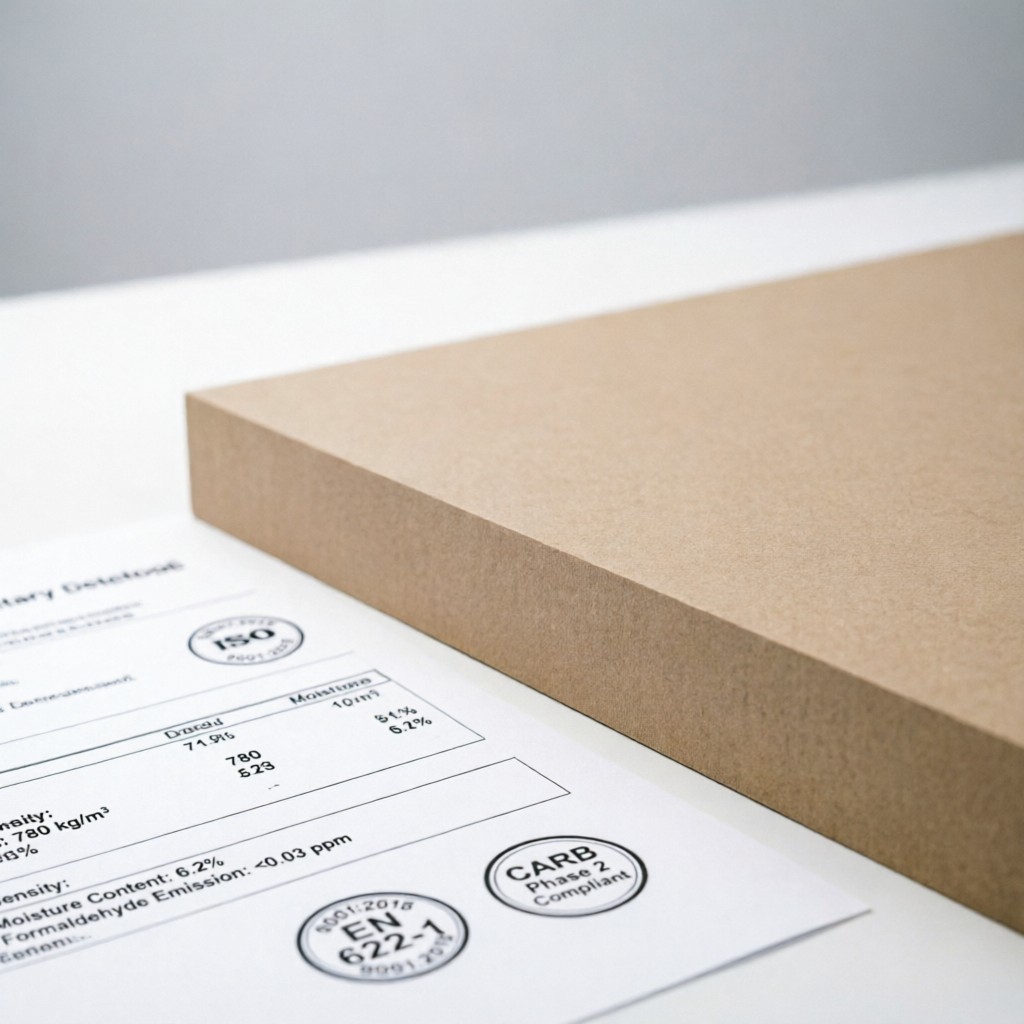
Interpreting a Chinese factory’s lab test report requires more than translation; it demands a forensic understanding of measurement units, testing methods, and regulatory thresholds. For procurement managers sourcing Precision MDF, Structural Plywood, or High-Density Particleboard, misreading these values can lead to costly customs rejections or failed compliance audits in strict markets like the EU and California. This guide breaks down the critical data points you must verify to ensure your supply chain remains compliant with CARB P2, EUDR, and ENF standards.
The global furniture and construction landscape is shifting rapidly under the weight of stricter environmental regulations. Major retailers like IKEA and tech giants like Apple now require granular transparency in their supply chains, moving beyond simple certification badges to raw data verification. When sourcing from China, buyers often receive PDFs filled with technical jargon, leaving them unsure if a supplier’s “E0” claim actually meets the rigorous ≤0.07 ppm threshold required for high-end export markets. Understanding these reports is no longer just a quality control task; it is a financial imperative that protects your brand from liability and ensures smooth logistics through ports enforcing the new EU Deforestation Regulation (EUDR), effective December 30, 2024.

Critical Standards and Measurement Methods
To accurately interpret chinese factory lab report documents, you must first distinguish between the testing methodologies, as they yield different numerical results for the same material. The most common confusion arises between the desiccator method (common in Japan and older Chinese standards) and the perforator or chamber methods (common in Europe and North America). For instance, the Japanese JIS A 1460 standard uses the desiccator method, where a formaldehyde emission of ≤0.3 mg/L qualifies for the F★★★★ rating. In contrast, European and Californian standards often measure emissions in parts per million (ppm) or milligrams per liter (mg/L) using different extraction techniques.
When verifying chinese supplier test results, pay close attention to the unit of measurement. A report stating “0.5” is meaningless without the unit. For Yicaiyigou’s Precision MDF and High-Density Particleboard, we adhere to the strictest global benchmarks. Our ENF grade materials achieve ≤0.05 mg/L, which is currently the highest environmental protection standard globally. Meanwhile, our E0 grade materials maintain levels at ≤0.07 ppm, significantly lower than the standard E1 limit of ≤0.124 ppm. Misinterpreting these units can lead a buyer to believe a product is compliant when it is actually exceeding limits by a factor of ten.
Comparative Analysis: Formaldehyde Emission Standards
The following table compares the key formaldehyde emission standards relevant to importing wood-based panels from China. Note the specific thresholds and testing contexts to avoid compliance gaps.
| Standard | Region/Authority | Max Formaldehyde Limit | Testing Method Context | Application Suitability |
|---|---|---|---|---|
| ENF | China (GB/T 39600-2021) | ≤0.05 mg/L | Climate Chamber | Highest grade, suitable for nurseries, hospitals, and premium export |
| E0 | Industry Best Practice | ≤0.07 ppm | Perforator/Chamber | Premium furniture, indoor fit-outs requiring low VOCs |
| CARB P2 | California, USA | ≤0.11 ppm (Composites) | ASTM E1333 | Mandatory for all composite wood products sold in CA/USA |
| E1 | Europe (EN 13986) | ≤0.124 ppm | Chamber Method | Standard requirement for general construction and furniture in EU |
| JAS F★★★★ | Japan (JIS A 1460) | ≤0.3 mg/L | Desiccator Method | Strict indoor air quality requirements for Japanese market |
| E2 | Older/Less Strict | ≤2.0 mg/L | Desiccator/Perforator | Industrial use only, not suitable for direct indoor human contact |
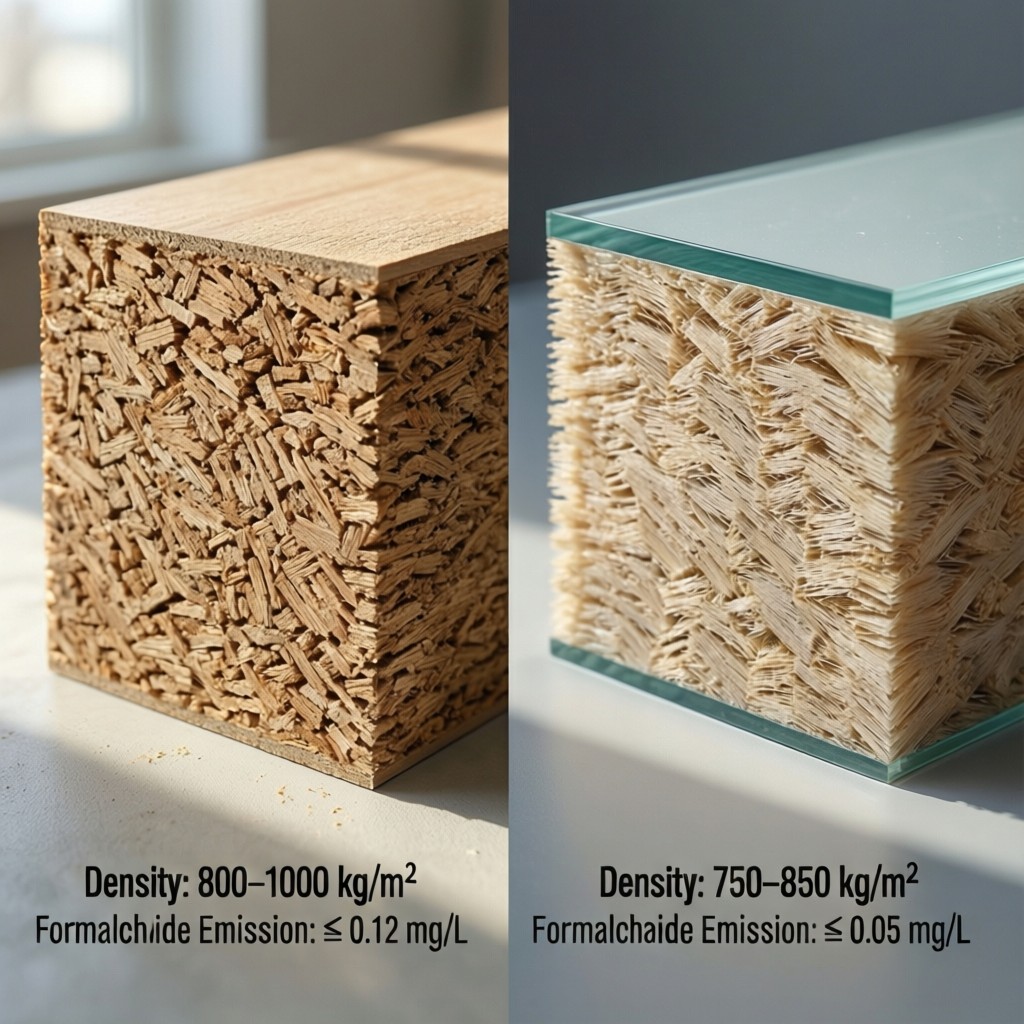
| Density (MDF) | Yicaiyigou Spec | 600-800 kg/m³ | Physical Property | Ensures structural integrity for precision machining |
| Density (HDF) | Yicaiyigou Spec | >800-1,000+ kg/m³ | Physical Property | High-wear surfaces, flooring underlayment, heavy-duty cabinetry |
The key takeaway from this data is that ENF and E0 are not interchangeable with E1 or CARB P2 without careful conversion and verification. While CARB P2 allows up to 0.11 ppm for composites, Yicaiyigou’s ENF rated materials at ≤0.05 mg/L offer a significant safety margin. This buffer is crucial for supply chain managers who need to guarantee compliance even if minor variations occur during mass production. Relying solely on E1 (≤0.124 ppm) may meet basic EU entry requirements but fails to satisfy the growing demand for ultra-low emission materials from brands like Herman Miller and Tesla.
Industry Examples with Real Specifications
For a furniture manufacturer exporting to the European Union, selecting the right board density and emission class is critical. Yicaiyigou’s Structural Plywood and Precision MDF are engineered to meet these dual needs. For example, our MDF with a density range of 600-800 kg/m³ provides the ideal balance for CNC routing and surface finishing, ensuring that intricate designs hold their shape without chipping. When paired with an ENF rating of ≤0.05 mg/L, this material eliminates the risk of customs delays related to VOC compliance, a frequent bottleneck for distributors supplying Amazon’s home goods sector.
In high-traffic commercial applications, such as retail fit-outs for major brands, High-Density Particleboard (HDF) with a density exceeding 800 kg/m³ up to 1,000+ kg/m³ is preferred. This higher density ensures durability against impact and wear. By specifying Yicaiyigou’s HDF with CARB P2 compliance (≤0.11 ppm), facility managers can meet strict indoor air quality mandates while maintaining structural performance. The standard size of 2440x1220mm allows for efficient nesting in cutting software, minimizing waste and optimizing the 45-50 m³ capacity of a 40ft container.
Supplier Solution: Verified Compliance and Traceability
Yicaiyigou distinguishes itself by providing transparent, verifiable data alongside physical products. Every shipment of Precision MDF, Structural Plywood, or High-Density Particleboard comes with full Chain of Custody (CoC) documentation, linking the raw timber to FSC-certified sources. This traceability is essential for complying with the EU Deforestation Regulation (EUDR) effective December 30, 2024. Our lab reports are not generic templates; they reflect batch-specific testing for formaldehyde emissions, ensuring that every batch meets the claimed ENF (≤0.05 mg/L) or E0 (≤0.07 ppm) standards.
Our logistical efficiency supports just-in-time manufacturing schedules. With a lead time of 15-25 days and a minimum order quantity (MOQ) of one 20ft container (holding 20-25 m³), we enable distributors to maintain lean inventory levels without compromising on compliance. We provide CE certification and CARB P2 documentation upon request, allowing seamless entry into North American and European markets. By requesting a compliant material sample with full CoC documentation, buyers can independently verify our claims before committing to large-scale production runs.
FAQ
What is the difference between E0 and ENF formaldehyde standards?
ENF is the strictest standard at ≤0.05 mg/L, while E0 is slightly higher at ≤0.07 ppm; both are superior to the standard E1 limit of ≤0.124 ppm.
How much product fits in a 40ft container?
A 40ft container typically holds 45-50 m³ of Yicaiyigou’s Precision MDF or Structural Plywood, optimized for standard 2440x1220mm sheet sizes.
Is Yicaiyigou compliant with the new EU Deforestation Regulation?
Yes, we provide full Chain of Custody (CoC) documentation and FSC certification to ensure compliance with EUDR requirements effective December 30, 2024.
What is the density range for your High-Density Particleboard?
Our High-Density Particleboard features a density greater than 800 kg/m³, reaching up to 1,000+ kg/m³ for enhanced durability and load-bearing capacity.
How do I verify the authenticity of a Chinese lab test report?
Cross-reference the reported values with known standards (e.g., CARB P2 ≤0.11 ppm) and request batch-specific CoC documentation from the supplier to confirm traceability.
Summary & Next Steps
Navigating the complexities of chinese material certification reports requires a focus on specific numerical thresholds and testing methodologies. By prioritizing suppliers who offer transparent data on formaldehyde emissions (ENF ≤0.05 mg/L, E0 ≤0.07 ppm) and provide robust Chain of Custody documentation, procurement managers can mitigate regulatory risk and ensure product quality. The shift towards stricter global standards like EUDR makes this due diligence non-negotiable for modern supply chains.
Request a compliant material sample with full CoC documentation from Yicaiyigou to verify our ENF and CARB P2 specifications firsthand.
Frequently Asked Questions
Why is simply translating a Chinese factory’s lab test report insufficient for procurement managers?
Translation alone is insufficient because interpreting the report requires a forensic understanding of measurement units, testing methods, and regulatory thresholds. Misreading these technical values can lead to costly customs rejections, failed compliance audits in strict markets like the EU and California, and supply chain liabilities.
What is the key difference between the testing methodologies used in Japan versus those in Europe and North America?
The Japanese JIS A 1460 standard typically uses the desiccator method (where ≤0.3 mg/L qualifies for F★★★★), whereas European and North American standards often use perforator or chamber methods that measure emissions in parts per million (ppm) or milligrams per liter (mg/L) using different extraction techniques, yielding different numerical results for the same material.
What are the specific formaldehyde emission thresholds for ENF and E0 grade materials mentioned in the article?
ENF grade materials achieve a formaldehyde emission level of ≤0.05 mg/L, which is currently the highest global environmental protection standard. E0 grade materials maintain levels at ≤0.07 ppm, which is significantly lower than the standard E1 limit of ≤0.124 ppm.
How does the CARB P2 standard compare to the E1 standard in terms of formaldehyde limits and region?
The CARB P2 standard, mandatory for composite wood products sold in California and the USA, has a maximum formaldehyde limit of ≤0.11 ppm using the ASTM E1333 testing method. In contrast, the E1 standard, required for general construction and furniture in Europe, allows a higher limit of ≤0.124 ppm using the Chamber Method.
Why is verifying raw data in lab reports becoming a financial imperative for buyers sourcing from China?
Verifying raw data is a financial imperative because major retailers and tech giants now require granular transparency beyond simple certification badges. Accurate verification protects brands from liability, ensures smooth logistics through ports enforcing regulations like the EU Deforestation Regulation (EUDR), and prevents the risk of importing products that exceed limits by significant factors due to unit misinterpretation.