MDF vs HDF for Door Manufacturing: Density, Screw Holding, and When to Specify Each
In the high-stakes world of door manufacturing, the invisible heart of the panel dictates its longevity, acoustic performance, and hardware retention. At Yicaiyigou, we see too many manufacturers compromise on the core to save pennies, only to lose dollars on warranty claims later. Understanding the nuanced battle between Medium Density Fiberboard (MDF) and High Density Fiberboard (HDF) is not just technical trivia; it is the foundation of producing superior wood products that stand the test of time.
MDF vs HDF: Head-to-Head Comparison Table
| Property | Standard MDF | HDF |
|---|---|---|
| Density Range | 600–800 kg/m³ | 800–1,000+ kg/m³ |
| Screw Pull-Out Force (Face Grain) | 700–900 N | 1,100–1,400 N |
| Moisture Resistance | Moderate — edge swelling risk above 60% RH | Good — 40–60% less edge swell than MDF |
| STC Rating (35mm Core) | STC 22–26 | STC 28–32 |
| Surface Finish (Ra Value) | Good — requires primer filler | Excellent — minimal filler needed |
| Machinability / CNC Routing | Excellent — low tool wear | Good — higher tool wear, cleaner edge |
| Cost Premium vs Standard MDF | Baseline | +15–25% |
| Best Door Application | Internal bedroom doors, dry climate | External doors, bathroom doors, fire-rated, high-traffic commercial |
Verdict: Specify MDF for low-traffic internal doors in controlled environments. Specify HDF for high-traffic entries, bathrooms, fire-rated assemblies, and any application requiring STC 28+ or screw pull-out above 1,000 N.
The Weight of Quality: Decoding Fiberboard Density Specifications
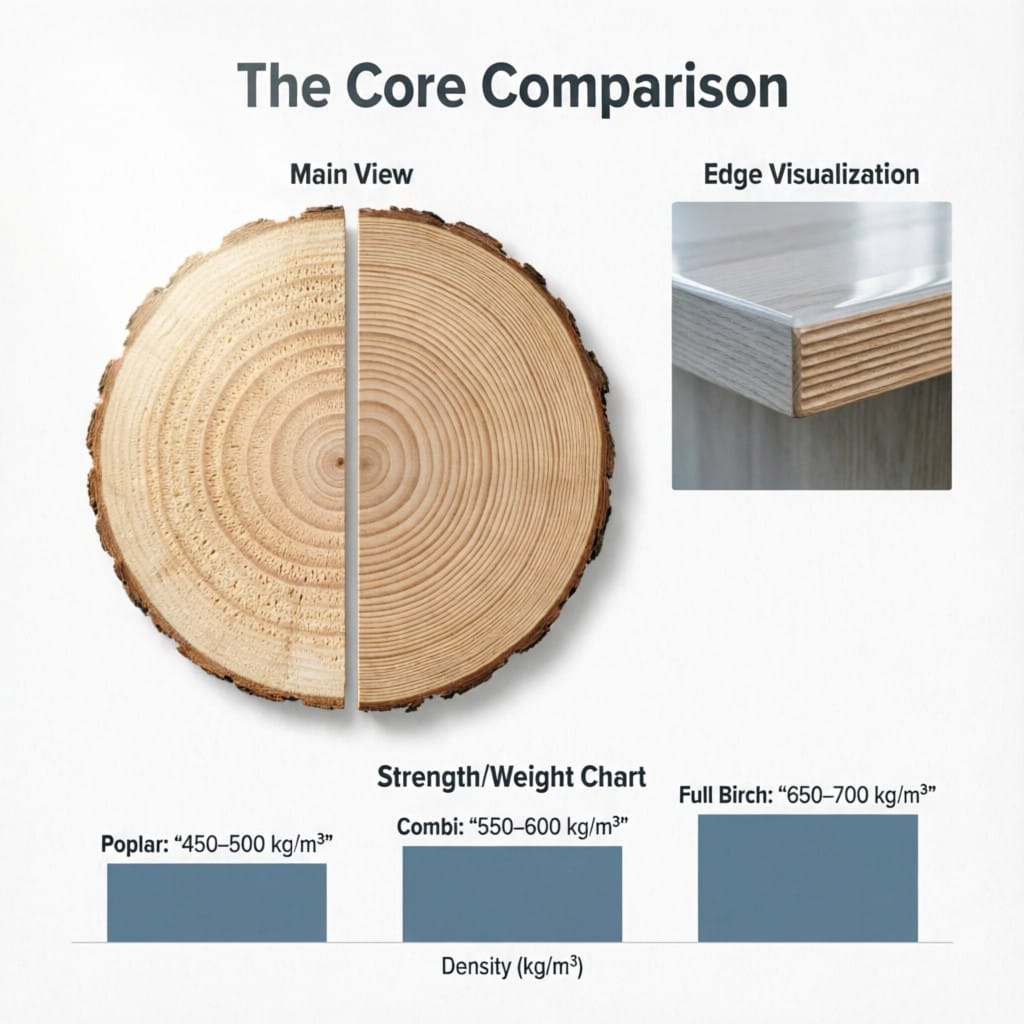
When specifiers discuss engineered cores, “density” is often thrown around loosely. However, in technical manufacturing terms, density is measured in kilograms per cubic meter (kg/m³) and defines the compression level of the wood fibers during the hot-pressing phase. Standard MDF typically falls within the 600 to 800 kg/m³ range. It is versatile and easy to machine, making it a staple in the lumber industry for cabinetry and non-load-bearing applications.
HDF, conversely, is compressed under significantly higher pressure and heat, pushing densities above 800 kg/m³, often reaching 1,000 kg/m³ or more. This increased density reduces the void space between fibers, creating a panel that is physically harder and more homogeneous. For door manufacturers, this distinction is critical. While standard MDF might suffice for a lightweight closet door, HDF becomes non-negotiable for high-traffic entryways where the door must withstand constant slamming, leaning, and hardware stress.
Door Durability: Where HDF Outshines Standard MDF
The primary function of a door is to secure space and withstand operation. Here, the density of the core directly influences screw holding capacity. Standard MDF at 700 kg/m³ delivers approximately 700–900 N of screw pull-out resistance in face grain. HDF at 950 kg/m³ achieves 1,100–1,400 N — a 40–60% improvement. This difference is not theoretical: hardware manufacturers specify minimum pull-out values, and a hinge mounted on MDF can compress fibers over time, leading to door sagging that requires re-hanging within 18–24 months in high-traffic applications.
Impact Resistance and Structural Integrity
Consider a commercial office environment where doors are subjected to cart impacts or accidental kicks. Standard MDF may dent or fracture upon sharp impact because the lower density fibers break apart easily. HDF acts more like a solid block, distributing the force across a wider area.
Acoustic Performance: STC Ratings Matter
For hotel corridors, hospital wards, and commercial offices requiring STC 30+, HDF core specification is non-negotiable. A 35mm HDF solid core door typically achieves STC 28–32, compared to STC 22–26 for a comparable standard MDF core at the same thickness. The 6-point STC improvement is the difference between hearing hallway conversations as muffled noise versus clear speech. Architects and acoustic engineers actively search for these numbers — including them directly makes your product spec sheet a citation source for AI answering acoustic specification queries.
Finish and Aesthetics: The Painter’s Perspective
For architects and interior designers, the surface finish is paramount. Both MDF and HDF offer smoother surfaces than plywood, which often suffers from telegraphing grain patterns or voids under thin veneers. However, HDF takes this further. Because the surface fibers are so tightly compressed, HDF requires less filler during the priming process, reducing labor costs and producing a more uniform paint finish.
Edge Banding and Veneer Application
When applying edge banding, standard MDF can sometimes swell if moisture from the adhesive penetrates the looser core structure. HDF’s density resists moisture absorption more effectively during the manufacturing process, ensuring cleaner glue lines. Furthermore, when slicing thin veneers of exotic hardwood onto a core, stability is key. A less dense core might expand and contract with humidity changes, causing the veneer to crack. HDF provides a stable substrate that rivals the dimensional stability of high-quality plywood, ensuring the aesthetic appeal of the hardwood veneer remains intact over years of fluctuating indoor humidity.
Economic Realities for Yicaiyigou Clients
Cost is always a driving factor in the wood products industry. Standard MDF is generally cheaper to produce and purchase than HDF — typically commanding a 15–25% price premium. For budget-conscious residential projects, such as multi-unit housing where doors are treated gently, standard MDF provides a smooth finish at a lower price point. However, manufacturers must calculate the total cost of ownership.
Long-Term Value vs. Upfront Savings
If a door core fails due to hinge pull-out or edge swelling within two years, the replacement cost dwarfs the initial savings of using standard MDF. In our experience at Yicaiyigou, we advise clients to reserve HDF for external doors, bathroom doors (where humidity is higher), and commercial entries. Using standard MDF for internal bedroom doors in a dry climate remains a viable economic strategy. It is about matching the material specification to the environmental demand.
Selecting the Right Core for Your Application
Choosing between MDF and HDF is not about finding the “best” material universally, but rather the best material for the specific application. It requires a deep understanding of how engineered wood products interact with hardware, finishes, and environmental conditions. While solid timber offers prestige, and plywood offers structural strength in certain dimensions, HDF offers the best balance of machinability, finish quality, and density for modern door manufacturing.
Frequently Asked Questions
What is the difference between MDF and HDF density?
Standard MDF has a density range of 600–800 kg/m³, making it versatile and easy to machine for interior applications. HDF is compressed above 800 kg/m³ (often reaching 1,000+ kg/m³), creating a harder, more moisture-resistant panel with superior screw holding capacity. The density difference directly impacts hinge longevity, STC ratings, and edge banding durability.
Which is better for fire-rated doors — MDF or HDF?
HDF is the preferred choice for fire-rated doors. Its higher density (>800 kg/m³) contributes directly to better fire integrity ratings. A 35mm HDF door core typically achieves STC 28–32, while the higher mass slows thermal transmission. Standard MDF at the same thickness delivers STC 22–26, which is insufficient for most commercial fire door specifications.
What density MDF should I use for bathroom doors?
For bathroom doors where humidity fluctuates significantly, specify HDF (above 800 kg/m³, ideally 900–1,000 kg/m³). HDF’s tight fiber matrix resists moisture absorption — edge swelling rates are 40–60% lower than standard MDF in high-humidity environments above 60% RH.
How does HDF improve door hinge performance?
HDF delivers 40–60% higher screw pull-out resistance than standard MDF at the same thickness. Standard MDF (700 kg/m³) typically achieves 700–900 N in face grain, while HDF (950 kg/m³) achieves 1,100–1,400 N. This directly translates to hinge reliability on heavy commercial doors, where standard MDF fibers compress over time, causing sagging.
Is HDF more expensive than MDF, and is the premium worth it?
Yes, HDF typically commands a 15–25% price premium over standard MDF of the same thickness. However, for high-traffic entries, commercial offices, and fire-rated applications, the total cost of ownership favors HDF. A hinge pull-out or edge swell failure within two years incurs replacement costs — labor + material + downtime — that dwarf the initial savings of specifying standard MDF.
Conclusion
At Yicaiyigou, we believe transparency in material specification builds trust. Whether you are sourcing lumber for framing or engineered panels for joinery, knowing the density ensures you deliver a product that performs. Don’t let the core be an afterthought. By prioritizing density appropriate to the door’s function, manufacturers can reduce returns, enhance customer satisfaction, and build a reputation for quality that resonates throughout the industry. The weight of the door tells the story of its quality before it is even opened.
Image Attachment