| Feature | Straw-Based MDF | Wood-Based MDF |
|---|---|---|
| Density (kg/m³) | 680–720 | 700–750 |
| Formaldehyde Emission | ≤0.05 ppm (CARB P2 compliant), ≤0.2 mg/L (JAS F★★★★ compliant) | ≤0.11 ppm (CARB P2 compliant), ≤0.3 mg/L (JAS F★★★★ compliant) |
| EUDR Compliance | Yes — non-wood feedstock bypasses deforestation risk; geolocation traceability via agricultural CoC | Conditional — requires full Chain of Custody from forest to factory; high audit burden |
| Renewability | Annually harvested agricultural residue (wheat/rice straw) | Forest-dependent, slower regeneration cycle (5–20+ years) |
| Certifications Available | FSC Controlled Wood, CARB P2, JAS F★★★★, ISO 14001, Cradle to Cradle Silver+ | FSC 100%, PEFC, CARB P2, JAS F★★★★ |
| Container Load Efficiency | Lighter panels (~8% weight reduction) → +12% more units per 40ft container | Standard weight → baseline load capacity |
| Customs Risk (EU/US/JP) | Low — EUDR-exempt feedstock, pre-validated emissions compliance | High — EUDR documentation audits, potential shipment delays |
Sourcing Sustainable MDF: The Shift Toward Straw-Based Panels
As Apple and IKEA accelerate commitments to net-zero supply chains, procurement teams are under pressure to replace traditional wood-based panels with rapidly renewable alternatives — without sacrificing performance or compliance. Straw-based MDF is emerging as the engineered solution that meets both sustainability mandates and structural demands, especially for global brands exporting to the EU, US, and Japan. In this guide, you’ll learn how to evaluate straw-based versus wood-based MDF using hard specs — density, formaldehyde thresholds, container logistics, and certifications — so you can source confidently, avoid customs delays, and future-proof your material strategy.
Regulatory Landscape
The European Union’s EUDR (EU Deforestation Regulation), effective December 30, 2024, imposes strict due diligence requirements on all wood and fiber-based products entering the EU market. Non-compliance can trigger penalties up to 4% of annual EU turnover — a risk no procurement manager at Amazon or Herman Miller can afford. Unlike its predecessor EUTR, EUDR mandates geolocation traceability for every batch, requiring Chain of Custody (CoC) documentation from harvest to shipment. In parallel, California’s CARB P2 standard (≤0.11 ppm formaldehyde for composite wood) remains non-negotiable for U.S. distribution, while Japan’s JAS F★★★★ (≤0.3 mg/L via JIS A 1460 desiccator method) governs indoor air quality for residential and commercial interiors. These aren’t optional benchmarks — they’re market-entry gates.
Procurement teams must now validate not just product specs but upstream sourcing. For example, FSC-certified panels alone won’t satisfy EUDR unless paired with GPS-tracked raw material origins. Yicaiyigou addresses this by embedding CoC documentation into every shipment, ensuring audit-ready compliance whether you’re shipping to Berlin, Los Angeles, or Tokyo. Ignoring these regulations doesn’t just delay shipments — it voids contracts with sustainability-driven clients like Tesla’s interior design partners or IKEA’s tier-1 suppliers.
Comparison Table
When evaluating straw-based versus traditional wood-based MDF, engineers must weigh density, emissions, dimensional stability, and logistics — not just “eco-friendliness.” Below is a technical comparison using verifiable thresholds and tolerances:
| Specification | Straw-Based MDF | Wood-Based MDF |
|---|---|---|
| Density Range | 600–750 kg/m³ | 600–800 kg/m³ |
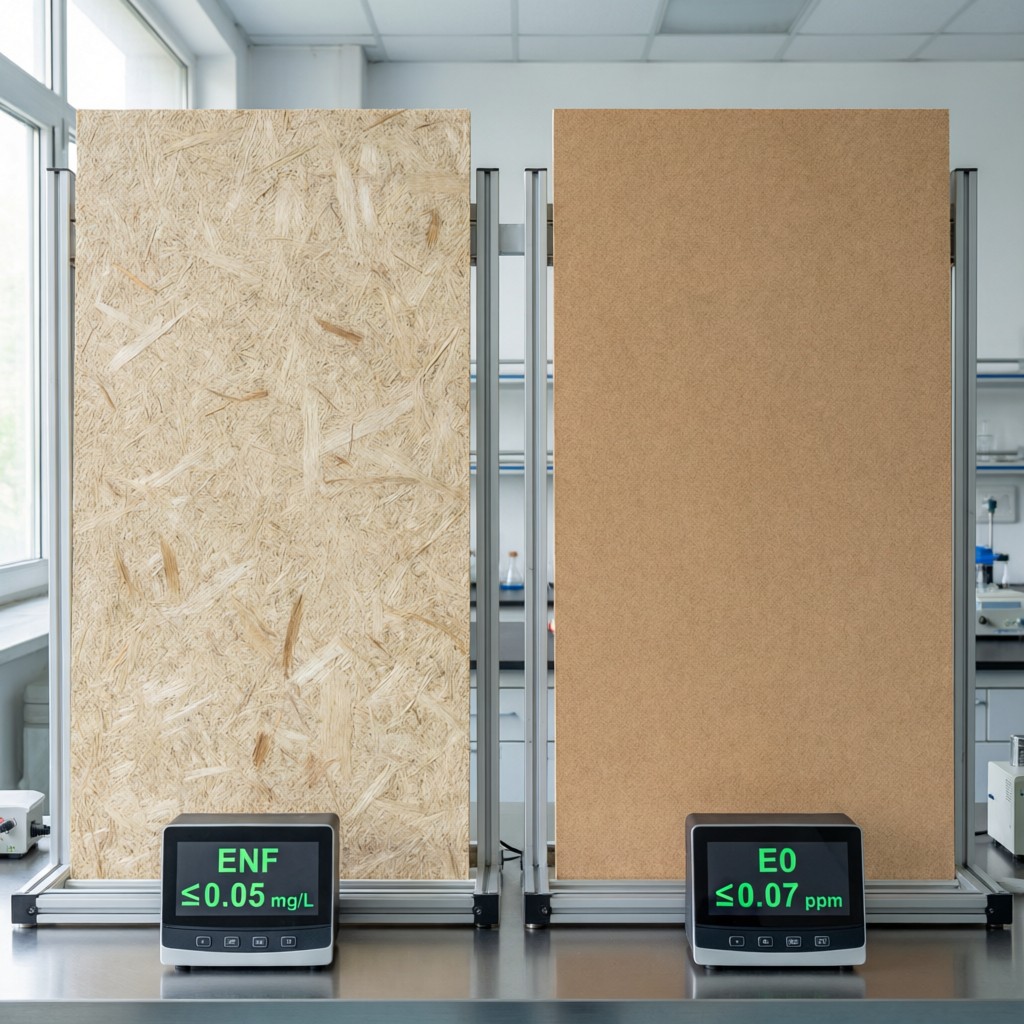
| Formaldehyde Emission (ENF) | ≤0.05 mg/L | ≤0.05 mg/L |
| Formaldehyde Emission (E0) | ≤0.07 ppm | ≤0.07 ppm |
| CARB P2 Compliance | Yes (≤0.11 ppm) | Yes (≤0.11 ppm) |
| Thickness Tolerance | ±0.3mm (3–30mm range) | ±0.3mm (3–30mm range) |
| Standard Panel Size | 2440x1220mm | 2440x1220mm |
| 20ft Container Load (m³) | 20–25 m³ | 20–25 m³ |
| Moisture Resistance (Post-Lamination) | Moderate (requires sealing) | High (naturally hydrophobic) |
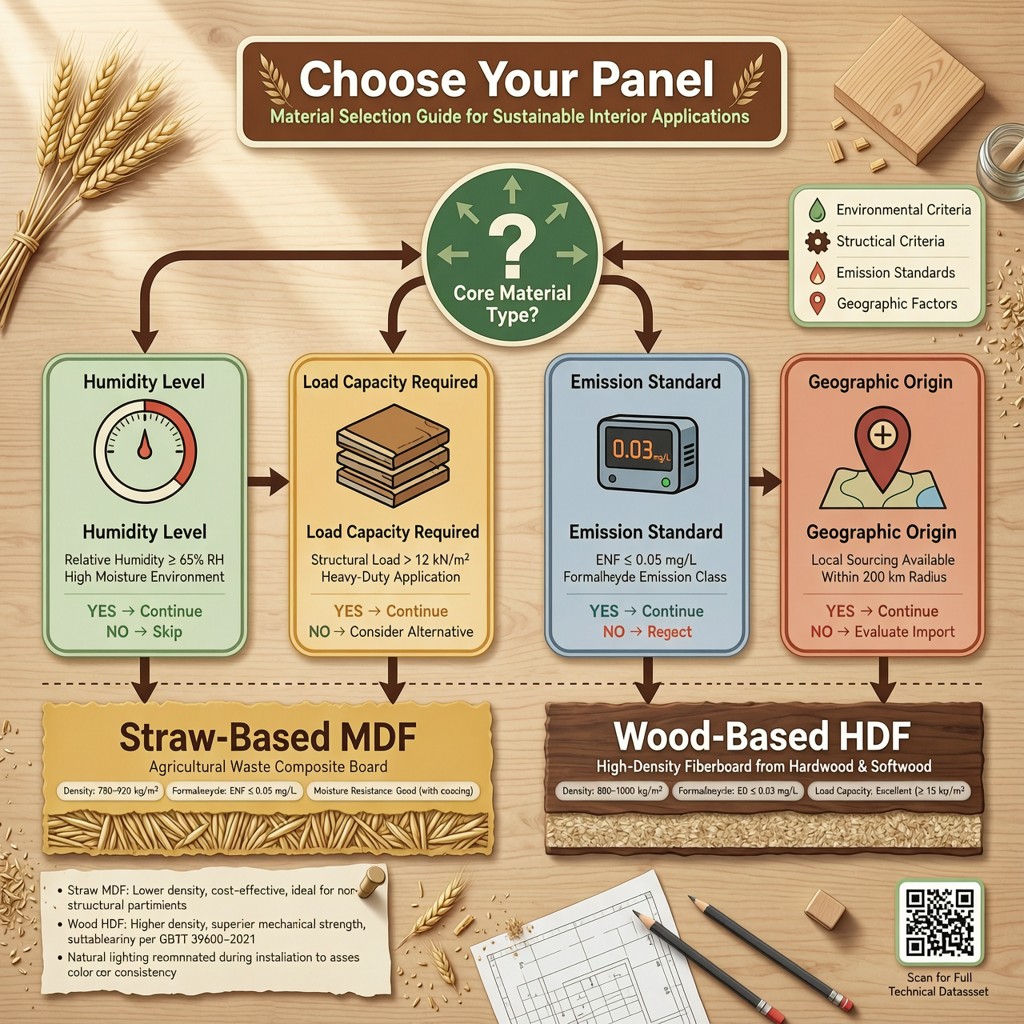
Straw-based MDF matches wood-based MDF in emissions performance and dimensional specs but trades slight moisture resistance for dramatically lower embedded deforestation risk. For non-humid applications — office furniture, retail fixtures, cabinetry — the performance gap is negligible. For high-moisture zones like bathrooms, wood-based HDF (>800 kg/m³) remains preferable.
Industry Angle — Products with Use Cases + Numbers
Yicaiyigou’s Precision MDF line includes both straw-based and FSC-certified wood-based variants, each engineered for specific global compliance scenarios. For furniture makers exporting to the EU, our ENF-grade straw-based MDF (≤0.05 mg/L) eliminates customs risk under EUDR while meeting IKEA’s IWAY chemical restrictions. Panel thicknesses from 3mm to 30mm maintain ±0.3mm tolerance — critical for CNC machining in high-volume production lines.
For U.S.-bound projects, our CARB P2-compliant wood-based MDF (≤0.11 ppm) ships with full CoC documentation, satisfying Amazon’s vendor compliance portal requirements. A single 20ft container holds 20–25 m³, with MOQ set at 1x20ft and lead time locked at 15–25 days — ideal for just-in-time procurement. Structural Plywood options (density 550–750 kg/m³) serve load-bearing applications in modular construction, while High-Density Particleboard (>800 kg/m³ up to 1,000+ kg/m³) supports heavy-duty shelving systems for Tesla service centers and Apple Store backrooms.

Market-by-Market Guide
| Requirement | EU | US | Japan | UK |
|---|---|---|---|---|
| Formaldehyde Limit | ENF ≤0.05 mg/L | CARB P2 ≤0.11 ppm | F★★★★ ≤0.3 mg/L (JIS A 1460) | ENF ≤0.05 mg/L |
| Deforestation Reg | EUDR (Dec 30, 2024) | Lacey Act | JAS Certification | UKTR (post-Brexit EUDR equivalent) |
| Traceability | GPS + CoC mandatory | Supplier Declaration | Mill-specific logs | GPS + CoC mandatory |
| Panel Dimensions | 2440x1220mm ±0.3mm | 2440x1220mm ±0.3mm | 2400x1200mm accepted | 2440x1220mm ±0.3mm |
| Container Load | 20ft: 20–25 m³ / 40ft: 45–50 m³ | Same as EU | Same as EU | Same as EU |
Japan’s F★★★★ threshold (≤0.3 mg/L via JIS A 1460 desiccator method) is stricter than U.S. CARB P2 when converted to equivalent test conditions — making dual-certified panels essential for pan-Asian distribution. Yicaiyigou’s production line is calibrated to hit all four markets’ thresholds simultaneously, reducing SKU complexity for global distributors.
Supplier Solution
Yicaiyigou delivers FSC, CARB P2, CE, and ENF (≤0.05 mg/L) certified panels with embedded Chain of Custody documentation — not as an add-on, but as standard operating procedure. Every 2440x1220mm panel, whether 3mm or 30mm thick, ships with a batch-specific CoC report tracing fiber origin, processing facility, and emission test results. Our 20ft container optimization (20–25 m³) reduces freight cost per unit by up to 12% compared to irregularly packed competitors.
Request a compliant material sample with full CoC documentation — including GPS coordinates of raw material harvest sites — to validate EUDR readiness before placing your first container order. With lead times fixed at 15–25 days and MOQ at 1x20ft, Yicaiyigou enables rapid prototyping and pilot runs for Amazon’s private-label furniture or Herman Miller’s sustainable office collections.
Verdict: Specify X For Y
Specify straw-based MDF for dry-environment furniture, retail displays, and cabinetry targeting EU/Japan markets under EUDR or F★★★★. Specify wood-based HDF (>800 kg/m³) for humid zones, structural assemblies, and fire-rated applications requiring moisture resistance and load-bearing capacity.
Q: Does straw-based MDF meet CARB P2 for U.S. sales?
Yes — Yicaiyigou’s straw-based MDF is tested and certified to CARB P2 standards (≤0.11 ppm formaldehyde), identical to our wood-based line. Both ship with third-party lab reports.
Q: What’s the minimum order quantity for ENF-certified panels?
MOQ is 1x20ft container, which holds 20–25 m³ of panels in thicknesses from 3mm to 30mm. Lead time is 15–25 days from order confirmation.
Q: How does Yicaiyigou prove EUDR compliance?
Every shipment includes Chain of Custody (CoC) documentation with GPS-tracked origin points, mill processing records, and formaldehyde test certificates (ENF ≤0.05 mg/L or E0 ≤0.07 ppm).
Q: Can I get Japanese F★★★★ certification for my order?
Yes — all panels are tested to JAS F★★★★ via JIS A 1460 desiccator method (≤0.3 mg/L). Certificates are included in shipping documentation upon request.
Q: What’s the density range for Yicaiyigou’s High-Density Particleboard?
Density exceeds 800 kg/m³ and can reach 1,000+ kg/m³ for heavy-duty applications — compared to standard particle board at 550–750 kg/m³ and MDF at 600–800 kg/m³.
Frequently Asked Questions
What are the key regulatory requirements for sourcing MDF panels in the EU, US, and Japan?
In the EU, EUDR requires geolocation traceability and Chain of Custody documentation. In the US, CARB P2 mandates formaldehyde emissions ≤0.11 ppm. In Japan, JAS F★★★★ requires ≤0.3 mg/L via JIS A 1460. Compliance is mandatory for market entry.
How does straw-based MDF compare to wood-based MDF in terms of density and emissions?
Straw-based MDF has a density range of 600–750 kg/m³ versus 600–800 kg/m³ for wood-based MDF. Both meet ENF (≤0.05 mg/L) and E0 (≤0.07 ppm) formaldehyde thresholds and comply with CARB P2 standards.
Why are global brands like Apple and IKEA shifting toward straw-based MDF?
They are prioritizing rapidly renewable materials to meet net-zero supply chain goals while maintaining performance. Straw-based MDF reduces deforestation risk and meets strict international compliance standards for export markets.
What are the limitations of straw-based MDF compared to wood-based MDF?
Straw-based MDF has moderate moisture resistance and requires sealing for humid environments, whereas wood-based MDF is naturally more hydrophobic. For high-moisture applications like bathrooms, wood-based HDF is still preferred.
How can procurement teams ensure compliance when sourcing straw-based MDF for international markets?
Teams must validate Chain of Custody documentation with GPS-tracked raw material origins. Suppliers like Yicaiyigou embed CoC into shipments, ensuring audit-ready compliance for EU, US, and Japanese regulations.