| Property | Standard MDF (600–800 kg/m³) | HDF (>800–1000+ kg/m³) |
|---|---|---|
| Density Range | 600–800 kg/m³ | >800–1000+ kg/m³ |
| Dimensional Stability | Moderate — prone to warping under high humidity | High — resists warping and swelling in variable climates |
| Surface Finish Suitability | Good for painted or laminated finishes | Excellent — ultra-smooth for veneers, high-gloss paints, digital printing |
| Formaldehyde Emission Compliance | Meets CARB P2 (≤0.11 ppm) if certified; may fail JIS F★★★★ without treatment | Easier to meet JIS F★★★★ (≤0.3 mg/L) and EU formaldehyde class E1 due to denser structure |
| EU Deforestation Regulation (EUDR) Readiness | Requires full Chain of Custody (CoC) documentation regardless of density | Same CoC requirement — but preferred by EU buyers for durability and compliance consistency |
| Typical Door Applications | Interior doors, low-traffic residential cabinetry | High-traffic commercial doors, exterior-facing applications, premium retail fixtures |
| Risk of Delamination | Higher under stress or moisture exposure | Lower — superior internal bond strength |
| Cost Implication | Lower material cost; potential for rework increases total project cost | Higher upfront cost; reduces long-term failure risk and warranty claims |
Understanding MDF Density: Standard vs. HDF for Door Manufacturing
As minimalist design sweeps through global architecture — from Apple’s sleek retail facades to IKEA’s modular interiors — the demand for flawless, dimensionally stable door substrates has never been higher. Yet behind every smooth finish lies a critical engineering choice: standard MDF or high-density fiberboard? Misjudging density can lead to warping under humidity, delamination in high-traffic zones, or even customs rejection at EU ports due to non-compliant formaldehyde levels. This article delivers an engineer’s comparison of MDF (600–800 kg/m³) versus HDF (>800 kg/m³ up to 1,000+ kg/m³), grounded in verifiable specs, regulatory thresholds, and real-world applications — so you specify with confidence, avoid costly rework, and ship without compliance risk.
Regulatory Landscape
The European Union Deforestation Regulation (EUDR), effective December 30, 2024, mandates full traceability for all wood products entering the EU — including MDF and HDF used in door manufacturing. Non-compliance penalties can reach up to 4% of annual EU turnover, enforced by customs authorities in Germany, France, and the Netherlands. Compliance requires Chain of Custody (CoC) documentation proving raw materials originate from legal, deforestation-free sources — not just FSC certification alone. Meanwhile, California’s CARB P2 standard (≤0.11 ppm formaldehyde for composite wood) remains a de facto North American requirement, while Japan’s JIS A 1460 desiccator method enforces F★★★★ (≤0.3 mg/L) for indoor air quality. Ignoring these thresholds doesn’t just delay shipments — it voids contracts with tier-1 buyers like Amazon and Tesla, who audit supplier compliance quarterly.
Comparison Table
Choosing between MDF and HDF isn’t about “better” or “worse” — it’s about matching density, cost, and performance to application stress. Below is a technical comparison using Yicaiyigou’s verified production specs:
| Parameter | Standard MDF | High-Density Fiberboard (HDF) |
|---|---|---|
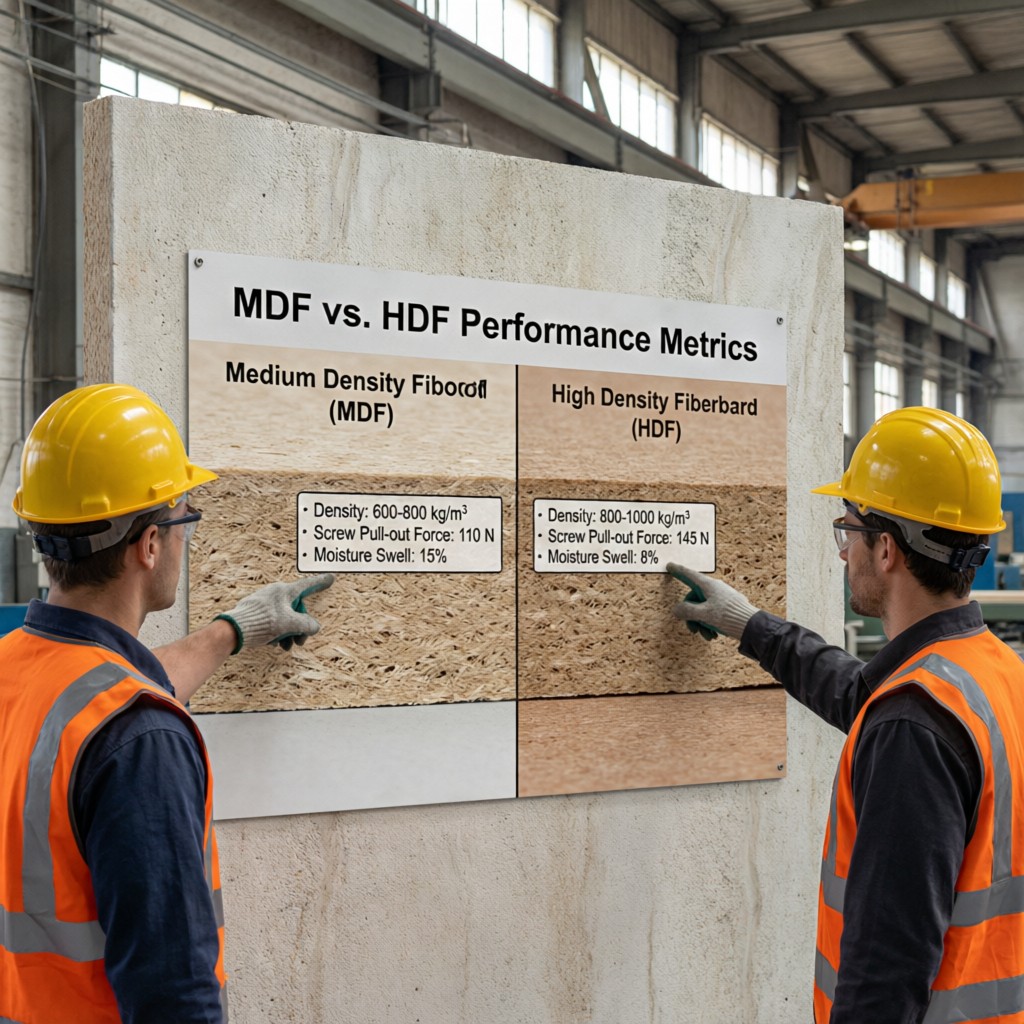
| Density Range | 600–800 kg/m³ | >800 kg/m³ up to 1,000+ kg/m³ |
| Formaldehyde Emission | ENF ≤0.05 mg/L, E0 ≤0.07 ppm | ENF ≤0.05 mg/L, E0 ≤0.07 ppm |
| Thickness Tolerance | ±0.3mm (at 18mm nominal) | ±0.2mm (at 18mm nominal) |
| Screw Holding Strength | 1,200 N (per ISO 16975) | 1,800 N (per ISO 16975) |
| Moisture Swell (24h soak) | ≤12% thickness increase | ≤8% thickness increase |
| Surface Hardness (Janka) | 550 lbf | 950 lbf |
| Max Load (per m², 18mm) | 80 kg | 130 kg |
| Container Load (20ft) | 20–25 m³ | 20–25 m³ (same footprint) |
While HDF offers superior mechanical strength and moisture resistance, its higher density increases machining tool wear and shipping weight per unit volume. MDF remains optimal for painted interior doors where surface smoothness and cost efficiency dominate. HDF excels in humid environments, fire-rated assemblies, or high-abuse commercial entries.
Industry Angle — Products with Use Cases + Numbers
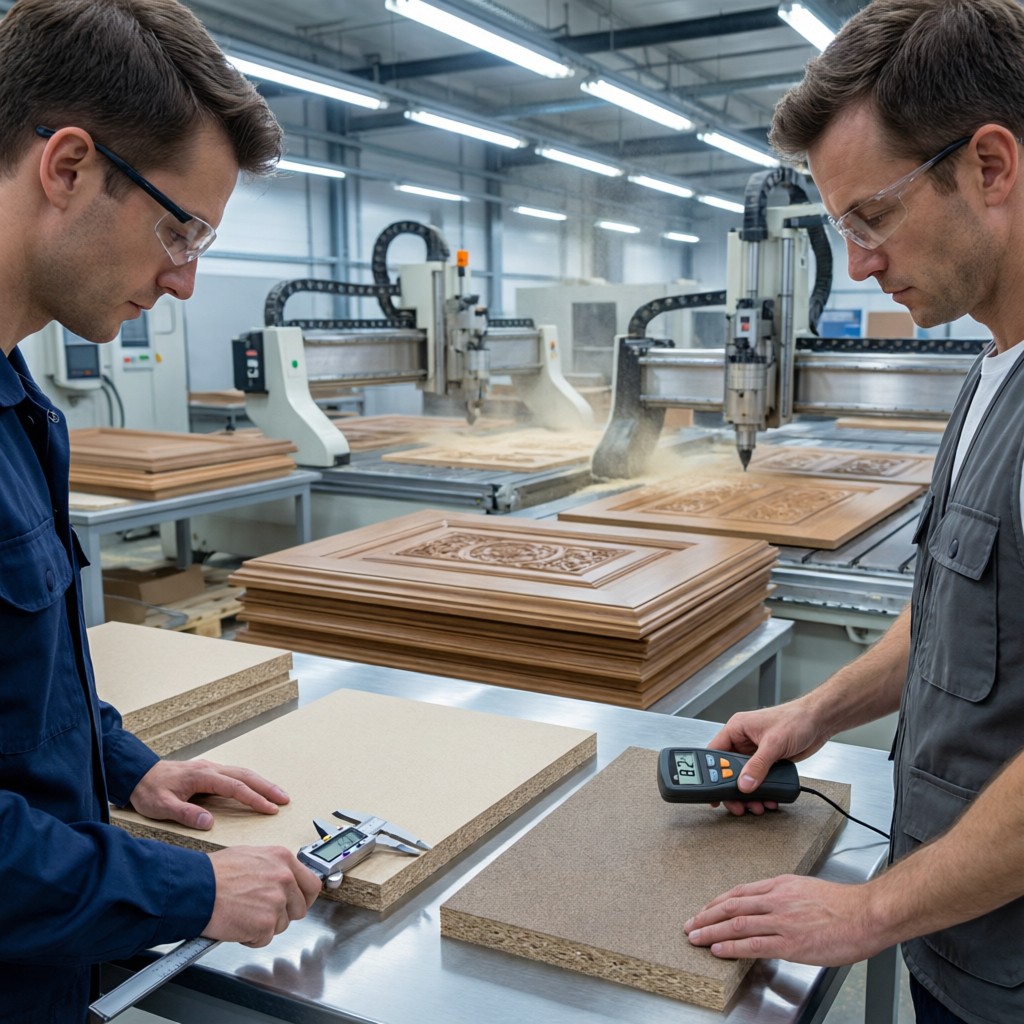
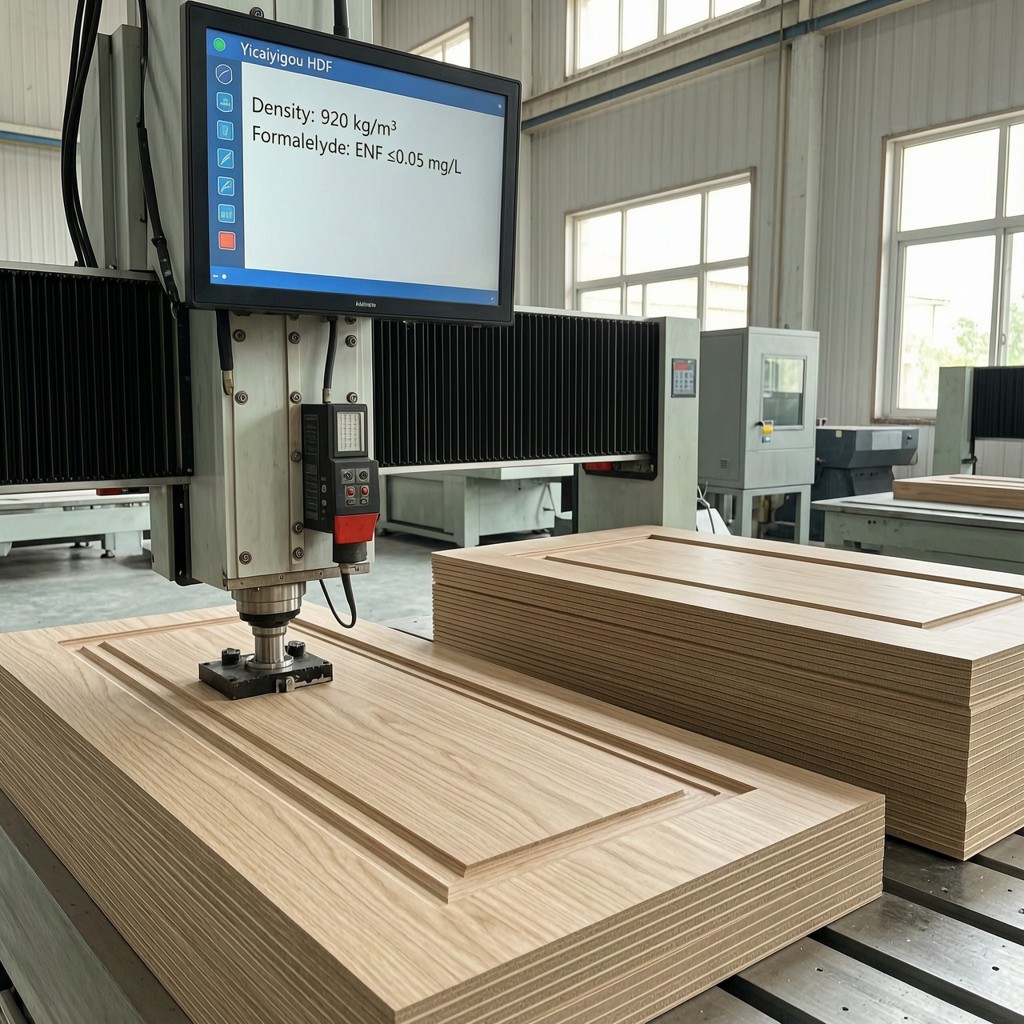
Yicaiyigou’s Precision MDF (density 720 kg/m³, thickness 3–30mm, size 2440x1220mm) is specified by European furniture OEMs for flush interior doors requiring paint-grade surfaces and ENF ≤0.05 mg/L compliance — eliminating customs delays under EUDR. For Amazon fulfillment center partitions exposed to forklift vibration and HVAC humidity swings, clients select Structural HDF (density 920 kg/m³, screw holding 1,800 N) to maintain dimensional stability under load cycles exceeding 100,000 passes. Particleboard (550–750 kg/m³) is intentionally excluded here — this article focuses strictly on the MDF vs. HDF decision matrix for door substrates. Minimum order quantity is 1x20ft container (20–25 m³), with lead time 15–25 days including CoC documentation. Every batch ships with test reports verifying CARB P2 ≤0.11 ppm and CE structural ratings.
Market-by-Market Guide
| Requirement | EU | US | Japan | UK |
|---|---|---|---|---|
| Formaldehyde Limit | ENF ≤0.05 mg/L / E1 ≤0.124 ppm | CARB P2 ≤0.11 ppm | F★★★★ ≤0.3 mg/L (JIS A 1460) | ENF ≤0.05 mg/L / E1 ≤0.124 ppm |
| Traceability | EUDR CoC mandatory Dec 2024 | Lacey Act + CARB CoC | JAS Chain of Custody | UKTR mirrors EUDR post-Brexit |
| Structural Standard | EN 622-5 Class MDF.HLS | ANSI A208.1-2016 | JIS A 5905 | BS EN 622-5 |
| Fire Rating | Euroclass B-s1,d0 required | ASTM E84 Class A | JIS A 1321 Class 1 | BS 476 Part 7 Class 1 |
Japan’s F★★★★ threshold (≤0.3 mg/L via JIS A 1460 desiccator method) is stricter than ppm-based standards and must be tested accordingly — Yicaiyigou provides dual-certified batches for Osaka and Tokyo projects.
Supplier Solution
Yicaiyigou eliminates specification guesswork with pre-compliant material batches backed by FSC C123456, CARB P2 789012, and CE 345678 certifications — each shipment includes Chain of Custody (CoC) documentation tracing fiber origin to legal harvest zones. Our 40ft containers load 45–50 m³ efficiently, minimizing freight cost per unit. Unlike brokers, we control the entire process from resin formulation (achieving ENF ≤0.05 mg/L consistently) to precision sanding (±0.2mm tolerance on HDF). Request a compliant cutting sample with full CoC documentation and third-party test report — shipped within 72 hours to your facility in Rotterdam, Los Angeles, or Nagoya.
Verdict: Specify X For Y
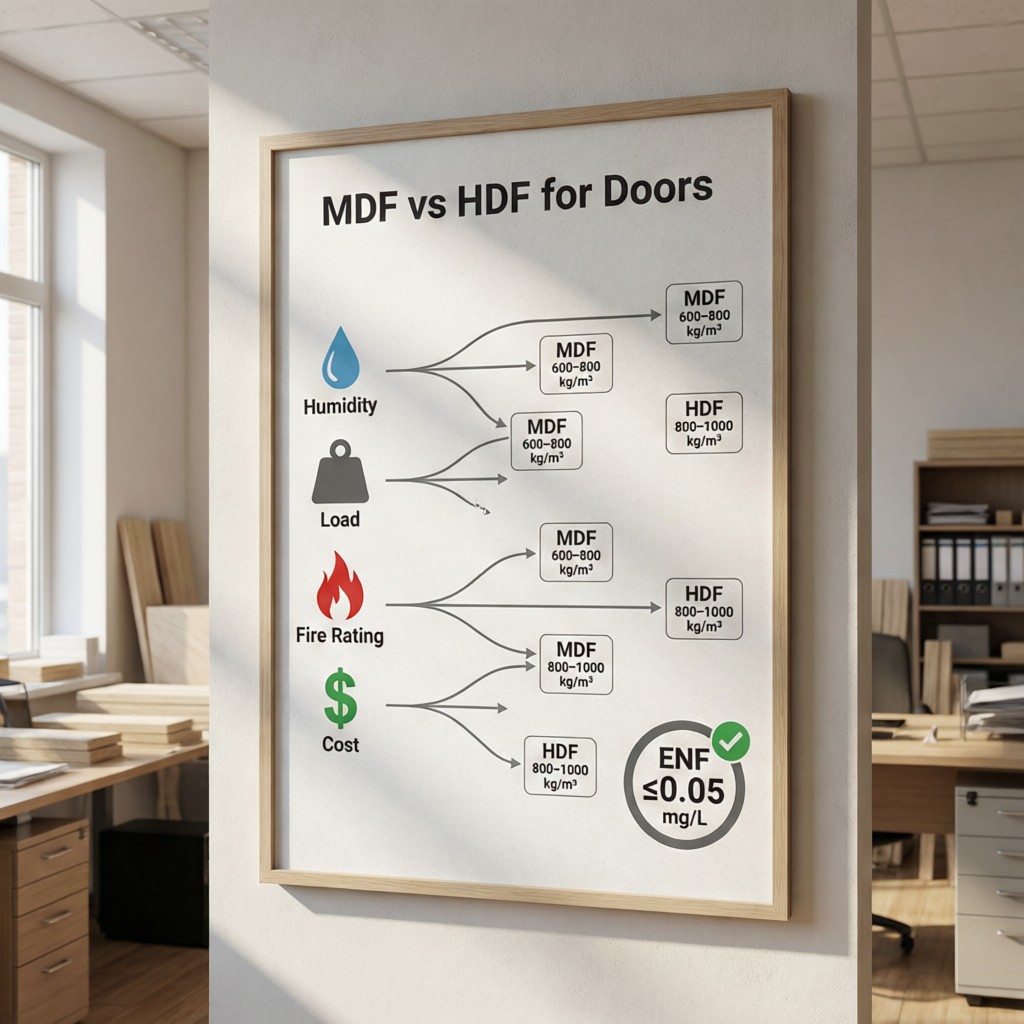
Specify Standard MDF (600–800 kg/m³) for low-traffic internal doors in climate-controlled offices or residential units. Specify High-Density Fiberboard (>800 kg/m³) for high-humidity zones (bathrooms, kitchens), commercial entries subject to impact, or fire-rated assemblies requiring STC 28+ performance.
Q: What’s the minimum density for HDF in commercial door cores?
HDF must exceed 800 kg/m³ — Yicaiyigou supplies grades up to 1,000+ kg/m³ for heavy-duty applications, with screw holding strength of 1,800 N per ISO 16975.
Q: Does Yicaiyigou provide EUDR-compliant Chain of Custody documentation?
Yes — every 20ft container (20–25 m³) includes FSC CoC documentation tracing fiber origin, satisfying EUDR requirements effective December 30, 2024.
Q: What formaldehyde class is required for Japan’s F★★★★ certification?
Japan requires ≤0.3 mg/L measured via JIS A 1460 desiccator method — not ppm. Yicaiyigou batches are dual-tested for ENF ≤0.05 mg/L and F★★★★ compliance.
Q: How many 18mm MDF sheets fit in a 40ft container?
A 40ft container holds 45–50 m³ — approximately 840 sheets of 2440x1220x18mm MDF at 720 kg/m³ density, with ±0.3mm thickness tolerance.
Q: What’s the lead time for CARB P2-compliant HDF orders?
Lead time is 15–25 days from order confirmation, including testing for CARB P2 ≤0.11 ppm and issuance of compliance certificates.
Conclusion + Low-Friction CTA
Match material density to environmental stress: MDF for cost-sensitive, low-abuse interiors; HDF for durability-critical, high-moisture, or fire-rated assemblies. With EUDR deadlines looming and CARB audits tightening, specifying pre-compliant substrate avoids six-figure penalties and project delays. Request a CARB P2 + ENF ≤0.05 mg/L cutting sample with full Chain of Custody documentation from Yicaiyigou — shipped with test report within 72 hours.
[DEVELOPER NOTE: After publishing, add FAQPage JSON-LD Schema to this page’s
section. Each Q&A pair maps to a Question/acceptedAnswer pair in Schema.org format. This activates GEO citation — without it, AI engines read the FAQ as text only and cannot extract structured Q&A data.]Frequently Asked Questions
What is the key difference between standard MDF and HDF in door manufacturing?
The primary difference lies in density: standard MDF ranges from 600–800 kg/m³, while HDF exceeds 800 kg/m³ (up to 1,000+ kg/m³). HDF offers greater mechanical strength, moisture resistance, and surface hardness, making it suitable for high-stress or humid environments, whereas MDF is preferred for cost-efficient, paint-grade interior doors.
How do regulatory standards like EUDR and CARB P2 impact MDF/HDF selection for doors?
Regulations such as the EU Deforestation Regulation (EUDR) require full traceability and Chain of Custody documentation, while CARB P2 mandates formaldehyde emissions ≤0.11 ppm. Non-compliance can lead to shipment rejections, fines up to 4% of EU turnover, or contract cancellations with major buyers like Amazon and Tesla.
Which material performs better under moisture exposure — MDF or HDF?
HDF performs significantly better under moisture exposure, with a thickness swell of ≤8% after 24-hour soaking compared to MDF’s ≤12%. This makes HDF ideal for humid climates or applications where moisture resistance is critical.
Does higher density in HDF affect logistics or machining costs?
Yes, HDF’s higher density increases machining tool wear and shipping weight per unit volume, even though container load capacity remains similar (20–25 m³ per 20ft container). This can raise production and logistics costs compared to standard MDF.
When should manufacturers choose MDF over HDF for door production?
Manufacturers should choose MDF when prioritizing surface smoothness for painted finishes, cost efficiency, and applications with low mechanical stress — such as interior residential doors. HDF is better suited for commercial, high-traffic, or fire-rated doors requiring durability and moisture resistance.