Did you know that a single port congestion delay can erase the entire profit margin on a container of premium hardwood? In the volatile world of international trade, the choice of departure port is not merely a logistical checkbox; it is a strategic financial decision. For Yicaiyigou, navigating the complexities of exporting from China means understanding the nuanced differences between the nation’s heavyweights.
When shipping lumber and engineered wood products, the debate often centers on two giants: Qingdao and Lianyungang. Both serve as critical gateways to global markets, but their operational strengths differ significantly depending on cargo type, destination, and supply chain urgency.
The Geographic Chessboard: Shandong vs. Jiangsu Ports
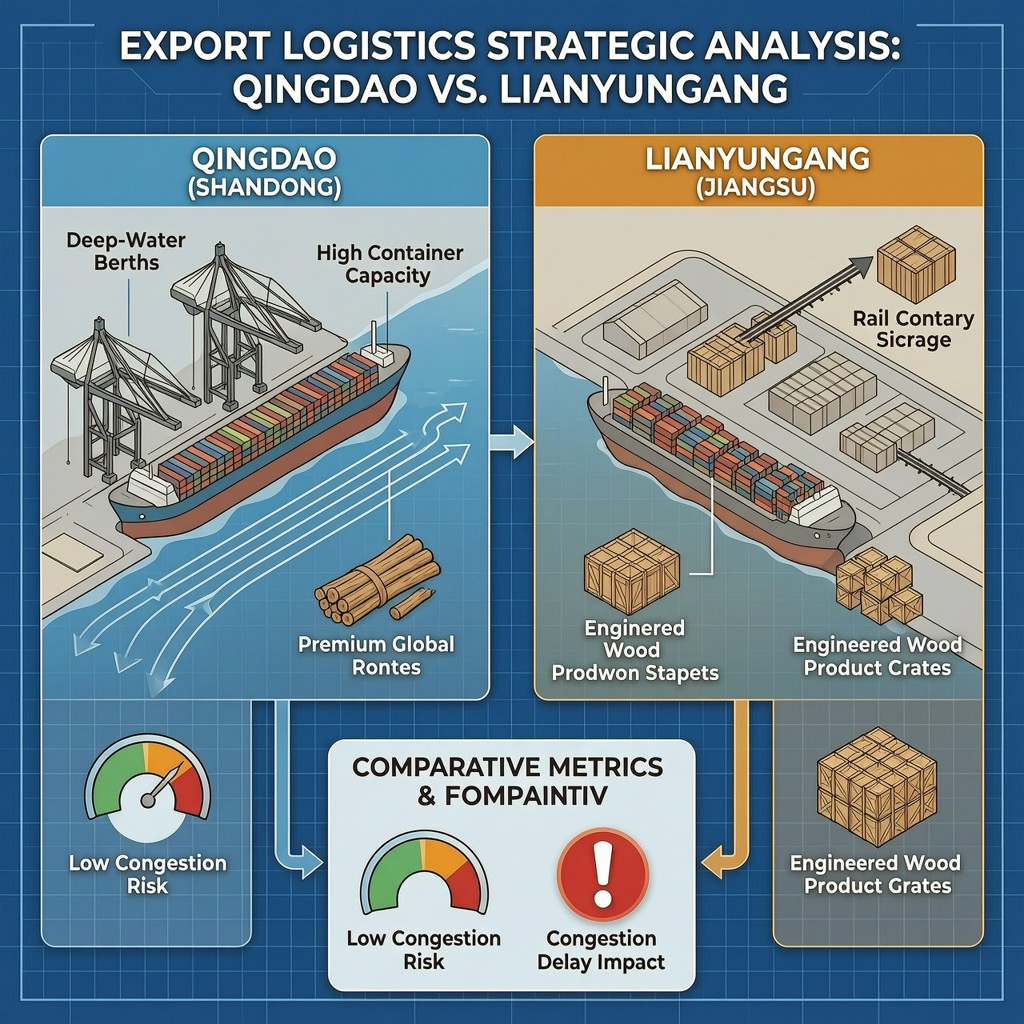
To understand the logistics flow, one must first look at the map. Qingdao, located in Shandong Province, is one of the world’s busiest container ports. It boasts deep-water berths capable of handling the largest mother vessels directly, reducing the need for transshipment.
For Yicaiyigou clients importing heavy timber loads into North America or Northern Europe, Qingdao’s frequency of sailings is a major advantage. The port’s infrastructure is designed for high-volume throughput, meaning containers move from the gate to the ship with remarkable speed during non-peak seasons.
Conversely, Lianyungang in Jiangsu Province holds a unique strategic position as the eastern bridgehead of the New Eurasian Land Bridge. While it handles significant container traffic, its rail connectivity is its standout feature. For clients whose final destination involves inland distribution via rail upon arrival, or for those sourcing wood products from inland Jiangsu or Anhui provinces, Lianyungang can offer reduced inland trucking costs.
The geographic proximity to specific manufacturing hubs means less fuel consumption and lower carbon emissions before the cargo even hits the water. Choosing between them often depends on where the factory floor is located relative to the port gate.
Specialized Handling for Timber and Plywood Cargo
Wood is a hygroscopic material, meaning it absorbs and releases moisture from the surrounding environment. This biological reality makes logistics handling critical. Plywood and engineered boards are particularly susceptible to edge damage and moisture warping if not containerized correctly. Qingdao’s terminals are highly automated, which is excellent for standard dry containers but requires precise coordination for specialized hardwood shipments that may need ventilation or specific dunnage placement.
Lianyungang, while slightly smaller in total throughput, often offers more flexible manual handling options for break-bulk or specialized project cargo. When shipping long-length lumber that exceeds standard container dimensions, the flexibility of the stevedores becomes paramount. Yicaiyigou leverages relationships with port operators to ensure that timber is stowed to prevent shifting during rough seas.
We prioritize ports where warehouse storage near the quay allows for pre-loading inspection. This ensures that the moisture content of the wood products is verified before sealing the container, preventing claims of decay upon arrival. The technical capability to handle fumigation documentation on-site is also a key differentiator, as both ports comply with ISPM 15 standards, but processing times can vary during peak export seasons.
Calculating the True Cost of Ocean Freight Routes
Many importers make the mistake of looking only at the ocean freight rate. However, the landed cost involves inland transportation, port handling charges, and potential demurrage fees. Qingdao typically commands higher terminal handling charges due to its premium status and infrastructure costs. However, these costs are often offset by the sheer volume of shipping lines competing for space, which can drive down the base ocean freight rate for standard 40-foot high-cube containers filled with plywood.
Lianyungang may present a lower base rate for specific routes, particularly those heading to Southeast Asia or via rail to Central Asia. For Yicaiyigou, the calculation involves a dynamic equation. If the factory is 200 kilometers closer to Lianyungang, the trucking savings might outweigh a slightly higher ocean freight rate. Furthermore, congestion surcharges are less frequent in Lianyungang compared to Qingdao during peak holiday seasons.
When shipping high-value hardwood, reliability often trumps minor cost savings. A delayed shipment of lumber can halt construction projects abroad, leading to penalty clauses that far exceed shipping savings. Therefore, we analyze historical congestion data for both ports before locking in a booking.
Strategic Port Selection for Global Wood Products
At Yicaiyigou, we do not believe in a one-size-fits-all approach. Our logistics team evaluates each order based on the specific commodity and the client’s timeline. For urgent orders of finished wood products destined for retail shelves in Los Angeles, Qingdao’s direct weekly sailings are usually the preferred choice. The reliability of the schedule ensures that inventory levels remain stable.
However, for large-scale infrastructure projects requiring bulk timber or where the destination allows for longer transit times, Lianyungang offers a robust alternative with less congestion risk. We also consider the equipment availability. During peak seasons, 40-foot containers can be scarce in Qingdao due to high demand from electronics and machinery exporters.
Lianyungang may have better equipment availability for lumber shipments during these windows. By maintaining active contracts with carriers at both ports, Yicaiyigou retains the agility to switch departure points if unexpected disruptions occur. This flexibility is the backbone of our commitment to delivering quality hardwood and plywood on time, every time.
The decision between Qingdao and Lianyungang is ultimately about risk management and cost optimization. Whether moving sensitive timber or durable wood products, the port choice dictates the journey’s smoothness. Yicaiyigou stands ready to navigate these waters, ensuring that every container of lumber arrives ready for use.
Image Attachment