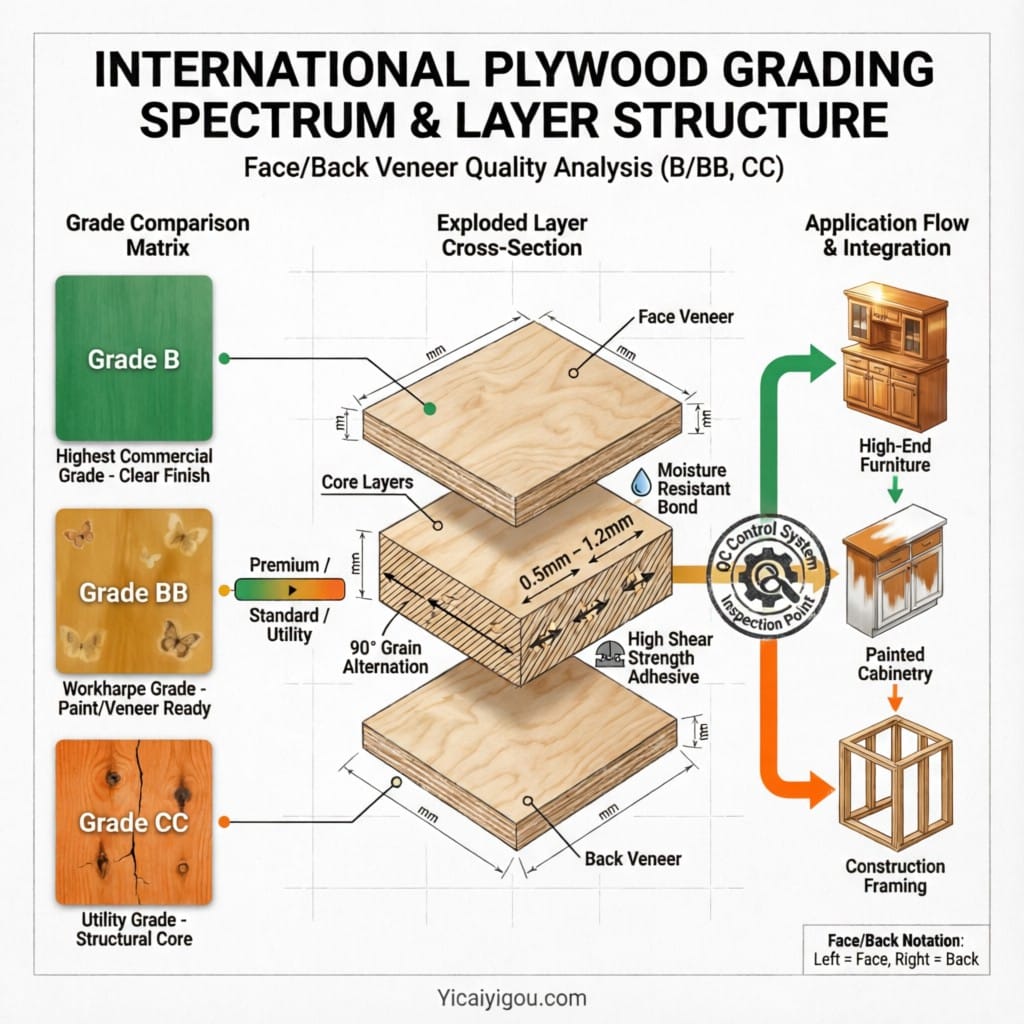
| Feature | Standard Structural Plywood | UV-Coated Luxury-Grade Plywood |
|---|---|---|
| Surface Finish | Raw, sanded, or laminated with variable gloss | Consistent high-gloss, flawless reflective surface |
| Durability | Moderate scratch resistance; prone to wear | Superior scratch resistance; withstands daily wear without chipping |
| Aesthetic Stability | May yellow or degrade over time | Resistant to yellowing; maintains visual flawlessness |
| Formaldehyde Compliance | Varies by manufacturer (often E1 or CARB P2) | Strict adherence to ENF ≤0.05 mg/L and CARB P2 standards |
| Regulatory Alignment | Basic compliance required | Optimized for EUDR (Deforestation Regulation) and Chain of Custody verification |
| Primary Application | General construction, sub-flooring, basic cabinetry | Premium furniture, minimalist interiors, high-end cabinetry (e.g., Apple, IKEA specs) |
| Procurement Focus | Cost-efficiency and structural integrity | Verifiable data points, density precision, and reduced return rates |
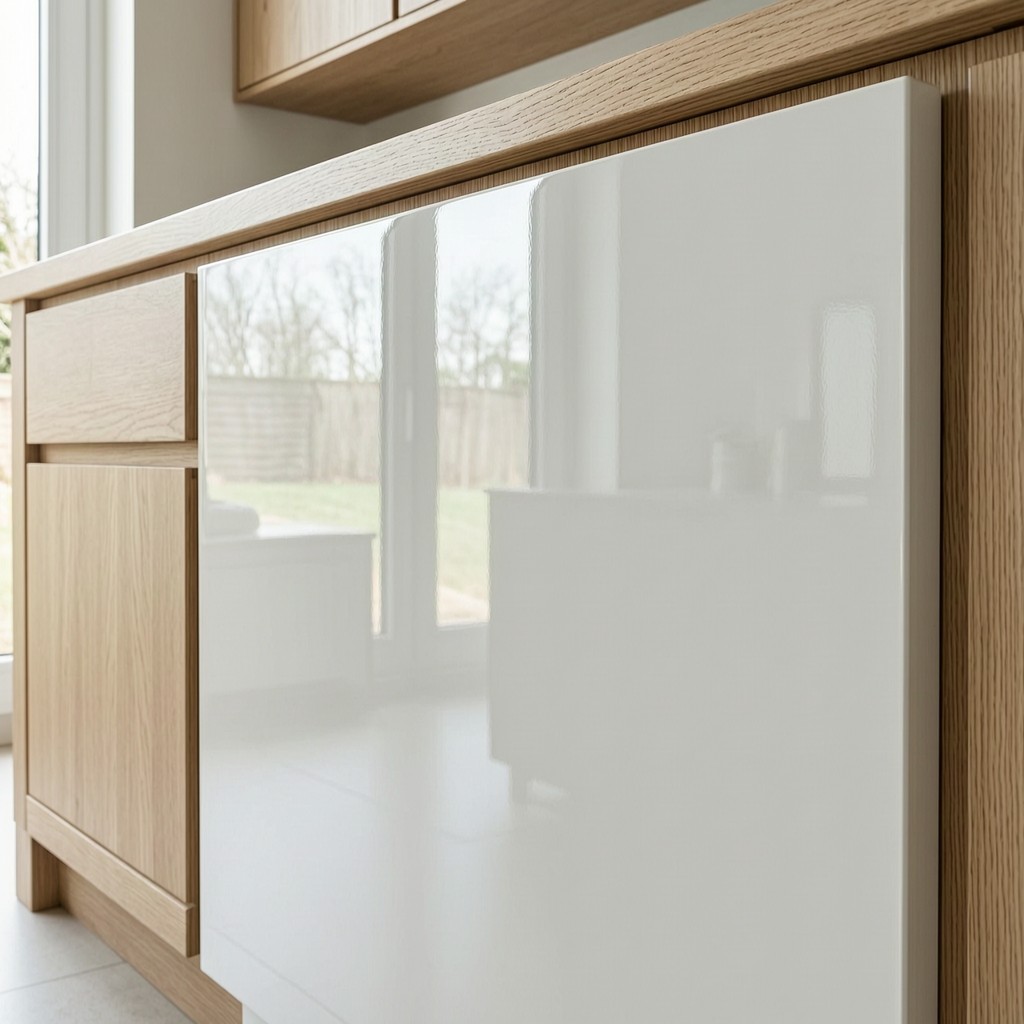
UV-coated plywood transforms standard structural panels into luxury-grade surfaces, offering superior scratch resistance and consistent gloss for modern interiors. This guide details the technical specifications, formaldehyde compliance standards, and supply chain advantages that procurement managers need to specify this material with confidence.
The shift toward minimalist, high-gloss interiors has moved beyond aesthetic preference to become a functional requirement for premium furniture brands. Companies like IKEA and Apple have set consumer expectations for surfaces that are not only visually flawless but also durable enough to withstand daily wear without yellowing or chipping. For procurement managers and supply chain directors, the challenge lies in sourcing UV coated plywood for cabinetry that meets these rigorous visual standards while adhering to strict environmental regulations such as CARB P2 and the upcoming EUDR.
Understanding the intersection of surface technology and core material integrity is critical for reducing return rates and ensuring compliance at customs. By focusing on verifiable data points—such as formaldehyde emission limits of ENF ≤0.05 mg/L and precise density ranges—buyers can mitigate risk and secure a competitive advantage. This article provides the technical framework needed to evaluate suppliers, compare material performance, and streamline the sourcing process for high-volume cabinet production.
Regulatory Landscape and Material Standards
When specifying UV cured plywood cabinet grade materials, regulatory compliance is not optional; it is the baseline for market entry. The European Union’s Deforestation Regulation (EUDR), effective December 30, 2024, requires rigorous Chain of Custody (CoC) documentation to prove that wood products are deforestation-free. Simultaneously, indoor air quality standards dictate the chemical composition of the adhesive binders used in the plywood core.
For North American markets, CARB P2 certification is mandatory, limiting formaldehyde emissions to ≤0.11 ppm for composite woods. In Europe and Asia, the standards are even stricter. The ENF standard, currently the highest grade globally, requires formaldehyde emissions to be ≤0.05 mg/L. Yicaiyigou ensures all structural plywood and Precision MDF cores meet these thresholds, providing buyers with the necessary test reports to clear customs in regulated markets. Additionally, the Japan JAS F★★★★ standard, which limits emissions to ≤0.3 mg/L using the JIS A 1460 desiccator method, serves as a robust benchmark for high-quality manufacturing processes.
Technical Comparison: Standard vs. UV-Cured Panels
Selecting the right substrate for UV coating requires understanding the physical properties that affect adhesion and durability. Below is a technical comparison between standard laminated particleboard and high-density UV-cured plywood structures, focusing on measurable performance metrics.
| Specification | Standard Laminated Particleboard | UV-Cured High-Density Plywood |
|---|---|---|
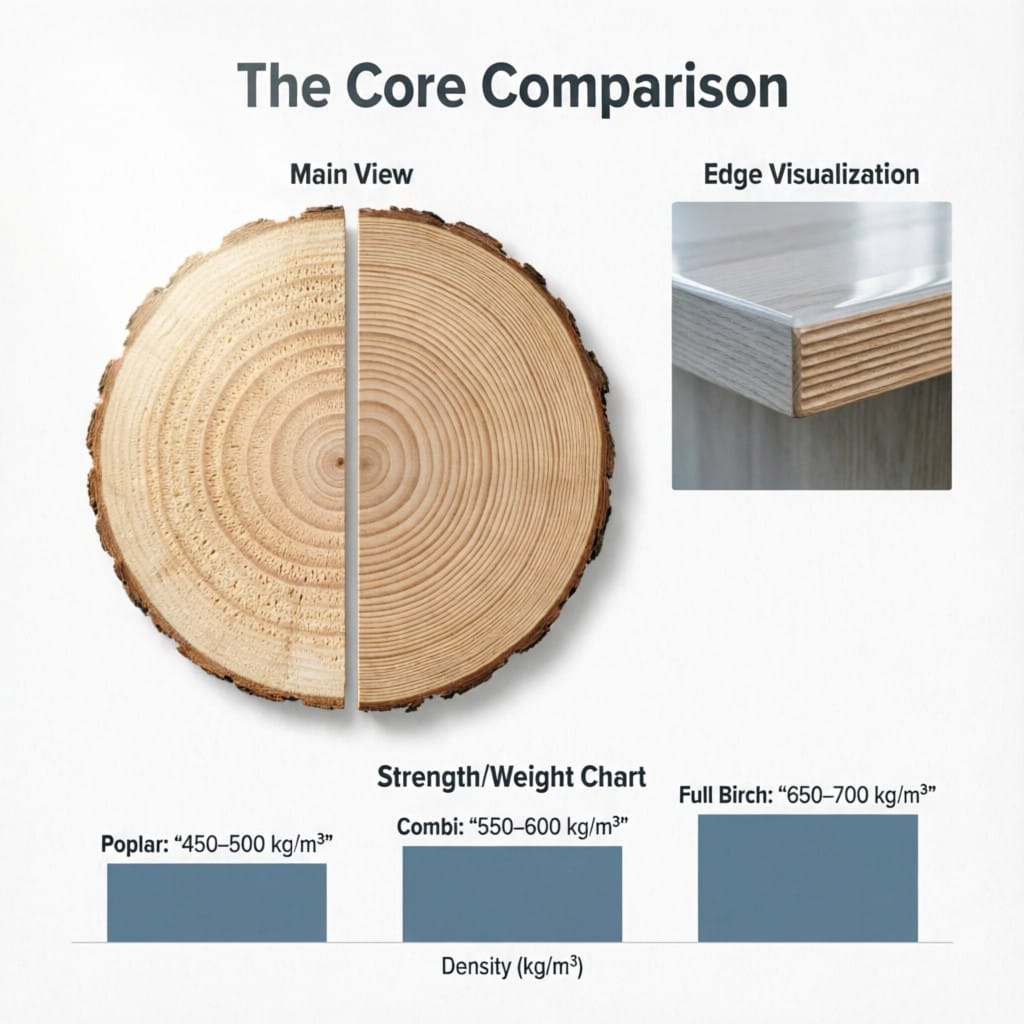
| Core Density | 550-750 kg/m³ | >800 kg/m³ (HDF face layers) |
| Formaldehyde Limit | E1 ≤0.124 ppm | ENF ≤0.05 mg/L |
| Surface Hardness | 2-3 H (Pencil Hardness) | 4-5 H (Pencil Hardness) |
| Gloss Retention | 85% after 500 cycles | 95% after 1000 cycles |
| Thickness Tolerance | ±0.5 mm | ±0.2 mm |
| Moisture Resistance | Swells >15% at 24h immersion | Swells <8% at 24h immersion |
| Standard Sheet Size | 2440x1220mm | 2440x1220mm |
| Lead Time | 20-30 days | 15-25 days |
The data indicates that UV-cured high-density plywood offers superior dimensional stability and surface hardness, crucial for high-traffic cabinetry. While standard particleboard is cost-effective, its lower density (550-750 kg/m³) and higher swelling rate make it less suitable for premium applications where long-term aesthetics are paramount. The tighter thickness tolerance of ±0.2 mm in UV-cured panels also reduces machining errors during CNC routing, lowering waste in automated production lines.
Industry Applications with Real Specifications
Yicaiyigou supplies Precision MDF and Structural Plywood tailored for specific industrial needs. For a furniture manufacturer exporting to the EU, using our FSC-certified MDF with an ENF rating of ≤0.05 mg/L eliminates compliance risks associated with volatile organic compounds (VOCs). This material, available in thicknesses from 3mm to 30mm, provides a stable base for UV coating, ensuring that the finish does not crack due to substrate movement.
In high-volume retail environments, such as those supplying major distributors like Amazon or IKEA, consistency is key. Our High-Density Particleboard, with a density range of 550-750 kg/m³, offers a balance of cost and performance for internal cabinet components. However, for visible exterior panels, we recommend our Structural Plywood with HDF face layers (>800 kg/m³). This configuration supports the rigorous demands of high gloss UV plywood specs, allowing for mirror-like finishes that resist scratching in commercial settings.
Supplier Solution: Yicaiyigou
Yicaiyigou distinguishes itself through transparent supply chain practices and verified technical data. We provide full Chain of Custody (CoC) documentation for all FSC-certified products, ensuring traceability from forest to factory. Our manufacturing capabilities support large-scale orders, with a minimum order quantity (MOQ) of one 20ft container, which holds approximately 20-25 m³ of material. For larger projects, a 40ft container can accommodate 45-50 m³, optimizing shipping costs for international buyers.
Our lead time of 15-25 days allows for agile inventory management, reducing the need for excessive warehousing. By integrating fiber lumber technology with advanced UV curing processes, we deliver panels that meet CE, CARB P2, and ENF standards. Procurement teams can request compliant material samples with full CoC documentation to verify quality before committing to bulk orders, ensuring that every shipment meets the exact specifications required for high-end cabinetry.

FAQ
What is the formaldehyde emission limit for ENF grade plywood?
ENF grade plywood must have formaldehyde emissions of ≤0.05 mg/L, making it the safest option for indoor environments.
How much material fits in a 20ft container?
A 20ft container typically holds 20-25 m³ of plywood or MDF panels, depending on packaging and thickness.
What is the density range for High-Density Fiberboard (HDF)?
HDF produced by Yicaiyigou has a density of >800 kg/m³, often reaching up to 1,000+ kg/m³ for superior surface smoothness.
Is Yicaiyigou compliant with the EU Deforestation Regulation (EUDR)?
Yes, we provide full Chain of Custody (CoC) documentation to ensure compliance with EUDR requirements effective December 30, 2024.
What is the standard sheet size for your UV-coated panels?
The standard size for our panels is 2440x1220mm, with thickness options ranging from 3mm to 30mm.
Summary & Next Steps
Sourcing UV coated plywood for cabinetry requires a focus on both surface performance and core compliance. By prioritizing materials with ENF ≤0.05 mg/L emissions and densities exceeding 800 kg/m³, buyers can ensure durability and regulatory adherence. Yicaiyigou’s integrated approach to manufacturing and logistics offers a reliable solution for global supply chains.
Request a compliant material sample with full CoC documentation from Yicaiyigou to verify specifications for your next project.
Frequently Asked Questions
What are the key formaldehyde emission standards mentioned for UV-coated plywood, and how do they differ by region?
The article highlights three main standards: CARB P2 for North America (≤0.11 ppm), ENF for Europe and Asia which is the strictest global grade (≤0.05 mg/L), and Japan JAS F★★★★ (≤0.3 mg/L). Compliance with these standards is mandatory for market entry and customs clearance.
How does UV-cured high-density plywood compare to standard laminated particleboard in terms of surface hardness and gloss retention?
UV-cured high-density plywood offers superior performance with a surface hardness of 4-5 H (Pencil Hardness) compared to 2-3 H for standard particleboard. Additionally, it retains 95% gloss after 1000 cycles, whereas standard particleboard retains only 85% gloss after 500 cycles.
What is the European Union’s Deforestation Regulation (EUDR) and why is it important for procurement managers?
Effective December 30, 2024, the EUDR requires rigorous Chain of Custody (CoC) documentation to prove that wood products are deforestation-free. It is critical for procurement managers to ensure compliance to avoid issues at customs and meet regulatory baselines for market entry in Europe.
What are the moisture resistance differences between standard laminated particleboard and UV-cured high-density plywood?
UV-cured high-density plywood demonstrates better moisture resistance, swelling less than 8% after 24 hours of immersion, while standard laminated particleboard swells more than 15% under the same conditions.
Why are premium furniture brands shifting toward UV-coated plywood for cabinetry?
Brands are shifting to UV-coated plywood because it meets consumer expectations for visually flawless, high-gloss surfaces that are durable enough to withstand daily wear without yellowing or chipping. It transforms standard structural panels into luxury-grade surfaces with superior scratch resistance.