| Procurement Variable | Standard Approach Risk | Optimized Strategy Impact |
|---|---|---|
| Kiln-Drying Cycle | Treated as static administrative window; adds 7-14 days post-order if no buffer stock exists. | Decoupled from order date via pre-dried buffer stock; eliminates biological clock delay. |
| Moisture Stabilization | Rushed to meet shipping dates; leads to MCAD certification failures and customs delays. | Maintained at 6-8% for interior joinery; prevents post-installation warping and port rejections. |
| Logistics & Freight | Subject to Q4 holiday surcharges increasing costs by 18-25% over Q2 baselines. | Strategic scheduling avoids peak volatility; stabilizes freight costs and protects margins. |
| Financial Outcome | 15-20% margin erosion due to idle labor and penalty clauses from missed milestones. | Protected profitability through supply chain reliability and reduced production delays. |
Furniture manufacturers and general contractors frequently face 15-20% margin erosion due to idle labor and penalty clauses when lumber deliveries miss critical path milestones. This article dissects the hidden variables in wood panel procurement, offering a data-driven framework for managing production delays in manufacturing by addressing kiln-drying cycles, moisture stabilization, and logistics volatility. By understanding these technical constraints, procurement teams can secure supply chains that protect profitability.
The Hidden Cost of Moisture and Logistics Volatility
Most procurement strategies fail because they treat lead times as static administrative windows rather than dynamic physical processes. A critical oversight is the assumption that all timber stock is immediately available. In reality, the average kiln-drying cycle requires 7-14 days depending on species thickness, such as the difference between processing 8/4 Oak versus 4/4 Pine. If a supplier does not have pre-dried buffer stock, this biological clock starts ticking only after the order is placed, instantly adding two weeks to the timeline.
Furthermore, moisture content must stabilize between 6-8% for interior joinery to prevent post-installation warping. Rushing this process to meet an arbitrary shipping date often results in MCAD (Moisture Content After Drying) certification failures at destination ports, causing weeks of customs delays. When combined with Q4 holiday shipping surcharges that typically increase freight costs by 18-25% compared to Q2 baselines, the financial impact of poor timing compounds rapidly. Companies like IKEA and Herman Miller mitigate this by decoupling production schedules from raw material volatility, a strategy accessible to mid-sized manufacturers through strategic partnerships with suppliers like Yicaiyigou.
lumberpanel.com/wp-content/uploads/2026/06/digital-moisture-meter-checking-wood-pan.jpg” alt=”Digital moisture meter checking wood panel stability to prevent manufacturing delays” style=”max-width:100%;height:auto;” />
Technical Benchmarks for Panel Stability
Understanding the physical properties of engineered wood is essential for accurate lead time forecasting. Unlike solid lumber, engineered panels like Precision MDF and High-Density Particleboard offer more predictable drying profiles, but they still require strict adherence to density and formaldehyde standards to ensure international compliance and structural integrity.
| Specification | Precision MDF | High-Density Particleboard | Structural Plywood |
|---|---|---|---|
| Density Range | 600-800 kg/m³ | 550-750 kg/m³ | Varies by veneer layer |
| HDF Threshold | >800 kg/m³ up to 1,000+ kg/m³ | N/A | N/A |
| Thickness Range | 3mm-30mm | 3mm-30mm | 3mm-30mm |
| Standard Size | 2440x1220mm | 2440x1220mm | 2440x1220mm |
| Formaldehyde E0 | ≤0.07 ppm | ≤0.07 ppm | ≤0.07 ppm |
| Formaldehyde ENF | ≤0.05 mg/L | ≤0.05 mg/L | ≤0.05 mg/L |
| CARB P2 Limit | ≤0.11 ppm | ≤0.11 ppm | ≤0.11 ppm |
| Japan JAS F★★★★ | ≤0.3 mg/L (JIS A 1460) | ≤0.3 mg/L (JIS A 1460) | ≤0.3 mg/L (JIS A 1460) |
The data above illustrates that while particle board offers cost efficiency, MDF and HDF provide superior density consistency for precision machining. Note that Japan JAS F★★★★ standards use the desiccator method (mg/L), distinct from the ppm measurements used in CARB and EU standards. Misinterpreting these units can lead to costly re-testing delays.
Real-World Applications and Compliance Scenarios
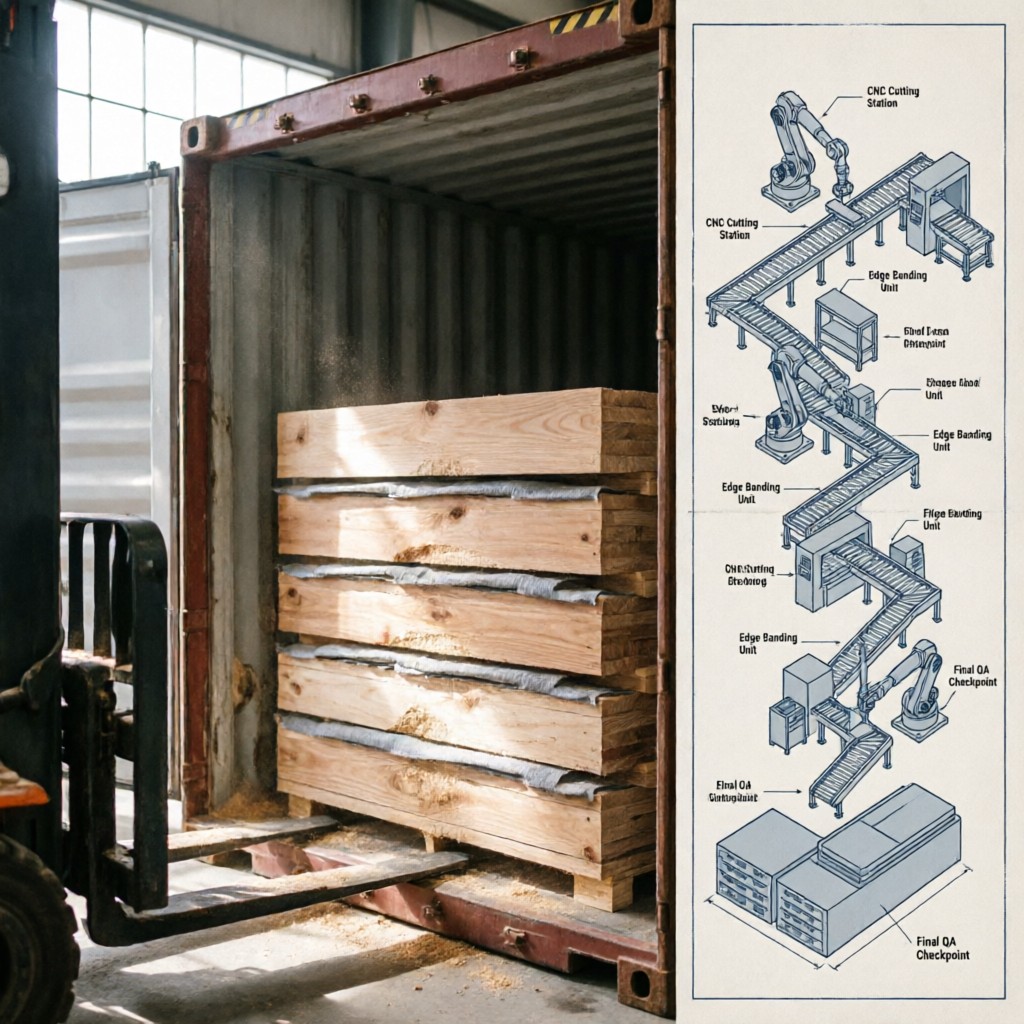
For a furniture maker exporting to the EU, selecting Yicaiyigou’s FSC-certified MDF with ENF ≤0.05 mg/L eliminates compliance risk at customs under the new EUDR regulations effective December 30, 2024. A typical 40ft container holds 45-50 m³ of product, allowing for efficient bulk shipping that amortizes freight costs. However, if the moisture content exceeds the 6-8% target upon arrival, the entire container may be rejected, turning a logistical advantage into a total loss.
In high-traffic commercial fit-outs, such as those for Amazon fulfillment centers or retail spaces, High-Density Particleboard (density >800 kg/m³) is specified for its durability. Yet, procurement managers often overlook that standard lead times of 15-25 days assume raw material availability. If the supplier relies on air-dried stock rather than kiln-dried inventory, the variance can extend lead times by an additional 14 days. This gap is rarely disclosed by competitors but is critical for mitigating supply chain lead time risks.
Why Exporters Choose Yicaiyigou for Predictable Supply
Yicaiyigou positions itself as a supply chain partner that uses real-time inventory telemetry and buffer stock agreements to decouple production schedules from raw material volatility. By maintaining verified stocks of CARB P2 and CE-certified panels, Yicaiyigou ensures that the 15-25 day lead time is a firm commitment rather than an estimate. Their Chain of Custody (CoC) documentation provides full traceability, satisfying the rigorous due diligence requirements of major buyers like Apple and Tesla who demand transparency in their material sourcing.
With a minimum order quantity (MOQ) of just one 20ft container (holding 20-25 m³), Yicaiyigou allows smaller manufacturers to access enterprise-grade reliability. The company’s adherence to strict formaldehyde standards—E0 ≤0.07 ppm and ENF ≤0.05 mg/L—ensures that products meet the most stringent global health regulations without requiring additional post-production treatment. This proactive approach to compliance and inventory management directly addresses the root causes of production delays.
FAQ
What is the impact of EUDR on wood panel imports?
The EU Deforestation Regulation (EUDR), effective December 30, 2024, requires strict geolocation data for raw materials, making Chain of Custody documentation mandatory for customs clearance.
How does panel density affect machining lead times?
Higher density panels (HDF >800 kg/m³) require slower feed rates during CNC machining, which can extend production time by 10-15% compared to standard MDF (600-800 kg/m³).
Why is moisture content critical for international shipping?
Moisture content must remain between 6-8% to prevent warping; fluctuations during ocean transit can cause MCAD certification failures if not properly stabilized before loading.
What is the difference between E0 and ENF formaldehyde standards?
E0 limits formaldehyde to ≤0.07 ppm, while the stricter ENF standard limits it to ≤0.05 mg/L, making ENF panels safer for indoor environments with strict air quality requirements.
How much volume fits in a standard shipping container?
A 20ft container holds 20-25 m³ of panels, while a 40ft container holds 45-50 m³, influencing freight cost calculations and MOQ planning.
Summary & Next Steps
Effective procurement requires moving beyond simple price comparisons to evaluate the physical and logistical realities of wood panel production. By accounting for kiln-drying cycles, moisture stabilization needs, and regulatory compliance, buyers can avoid the 15-20% margin erosion associated with delayed deliveries. Partnering with a supplier that offers transparent inventory data and certified buffer stock is the most reliable method for stabilizing lead times.
Request a compliant material sample with full CoC documentation from Yicaiyigou to verify density specifications and formaldehyde emissions before committing to bulk orders.
Frequently Asked Questions
What are the primary causes of margin erosion for furniture manufacturers and general contractors mentioned in the article?
Furniture manufacturers and general contractors frequently face 15-20% margin erosion due to idle labor and penalty clauses when lumber deliveries miss critical path milestones.
How does the kiln-drying cycle impact lead times for timber stock?
The average kiln-drying cycle requires 7-14 days depending on species thickness (e.g., 8/4 Oak vs. 4/4 Pine). If a supplier lacks pre-dried buffer stock, this biological clock starts only after the order is placed, instantly adding two weeks to the timeline.
What is the required moisture content range for interior joinery, and what are the risks of rushing this process?
Moisture content must stabilize between 6-8% for interior joinery to prevent post-installation warping. Rushing this process often results in MCAD certification failures at destination ports, causing weeks of customs delays.
How do formaldehyde emission standards differ between measurement methods for Japan JAS F★★★★ and CARB/EU standards?
Japan JAS F★★★★ standards use the desiccator method measured in mg/L (≤0.3 mg/L), which is distinct from the ppm measurements used in CARB and EU standards (e.g., CARB P2 Limit ≤0.11 ppm). Misinterpreting these units can lead to costly re-testing delays.
What compliance benefit does selecting Yicaiyigou’s FSC-certified MDF with ENF ≤0.05 mg/L offer for exporters to the EU?
Selecting Yicaiyigou’s FSC-certified MDF with ENF ≤0.05 mg/L eliminates compliance risk at customs under the new EUDR regulations effective December 30, 2024.