| Particleboard Density (kg/m³) | Structural Performance | Formaldehyde Emission Standard | Regulatory Compliance (EUDR/CARB P2/ENF) | Best Use Case for RTA Furniture |
|---|---|---|---|---|
| 550 | Light-duty; prone to sagging under heavy load | Typically meets CARB P2 (≤0.11 ppm) | Limited EU market access without FSC CoC | Budget shelves, non-load-bearing panels |
| 650 | Moderate strength; resists cam lock stripping | Meets CARB P2 and often ENF (≤0.025 mg/m³) | EU-compliant with FSC certification | Standard RTA cabinets, modular units |
| 750 | High strength; minimal deflection under stress | Consistently meets ENF (≤0.025 mg/m³) and ≤0.05 mg/L | Full EUDR compliance with traceable FSC CoC | Premium RTA, commercial displays, automotive accessories |
Particleboard Density: Why It Matters for RTA Furniture Manufacturers
As flat-pack furniture dominates global e-commerce — from IKEA’s modular systems to Amazon’s private-label home brands — manufacturers face a silent but critical variable: particleboard density. Get it wrong, and you risk sagging shelves, stripped cam locks, or customs rejections under tightening formaldehyde regulations. This article delivers the exact density thresholds, compliance specs, and container logistics RTA producers need to avoid costly failures — using verifiable data from Yicaiyigou’s certified production lines.

The shift toward DIY, space-efficient furniture isn’t slowing — Apple’s retail stores now feature modular display units assembled on-site, while Tesla’s Cybertruck accessory kits include snap-together cabin organizers made from engineered wood. Behind every successful RTA product is a material spec sheet that balances cost, structural integrity, and regulatory compliance. In this guide, you’ll learn precisely which particleboard densities (550–750 kg/m³) perform under real-world stress, how CARB P2 and ENF standards dictate market access, and why Yicaiyigou’s FSC-certified boards with ≤0.05 mg/L formaldehyde eliminate compliance risk — saving weeks of lead time and thousands in rejected shipments.
Regulatory Landscape
Effective December 30, 2024, the EU Deforestation Regulation (EUDR) mandates full traceability for all wood products entering the European Union — including particleboard used in RTA furniture. Non-compliance carries penalties up to 4% of annual EU turnover, enforced across all 27 member states. Documentation must prove legal harvest origin via Chain of Custody (CoC), making FSC certification not just ethical but commercially essential.
In parallel, California’s CARB P2 standard (≤0.11 ppm formaldehyde for composite wood) remains the de facto North American benchmark — adopted by Amazon’s vendor compliance team and enforced at U.S. ports. Japan’s JAS F★★★★ (≤0.3 mg/L via JIS A 1460 desiccator method) governs premium furniture exports, while the UK mirrors EU E1 thresholds (≤0.124 ppm). Ignoring these specs doesn’t just delay shipments — it voids contracts with tier-1 retailers.
Particleboard vs MDF: Density & Performance Comparison for RTA Applications
Choosing between particleboard and MDF isn’t about “better” or “worse” — it’s about matching density to mechanical load and finish requirements. Both materials serve RTA manufacturing, but their performance diverges sharply under stress, moisture, or machining. Below is a technical comparison using Yicaiyigou’s production specs:
| Parameter | High-Density Particleboard | Precision MDF |
|---|---|---|
| Density Range | 550–750 kg/m³ | 600–800 kg/m³ |
| Max Density Option | 750 kg/m³ | 800 kg/m³ (HDF >1,000 kg/m³) |
| Formaldehyde Rating | E0 (≤0.07 ppm), ENF (≤0.05 mg/L) | E0 (≤0.07 ppm), ENF (≤0.05 mg/L) |
| Thickness Tolerance | ±0.3mm (3mm–30mm range) | ±0.2mm (3mm–30mm range) |
| Screw Withdrawal Strength | 1,200 N (at 750 kg/m³) | 1,800 N (at 800 kg/m³) |
| Edge Machining Precision | ±0.5mm | ±0.1mm |
| Container Load (20ft) | 20–25 m³ | 20–25 m³ |
| MOQ | 1x20ft container | 1x20ft container |
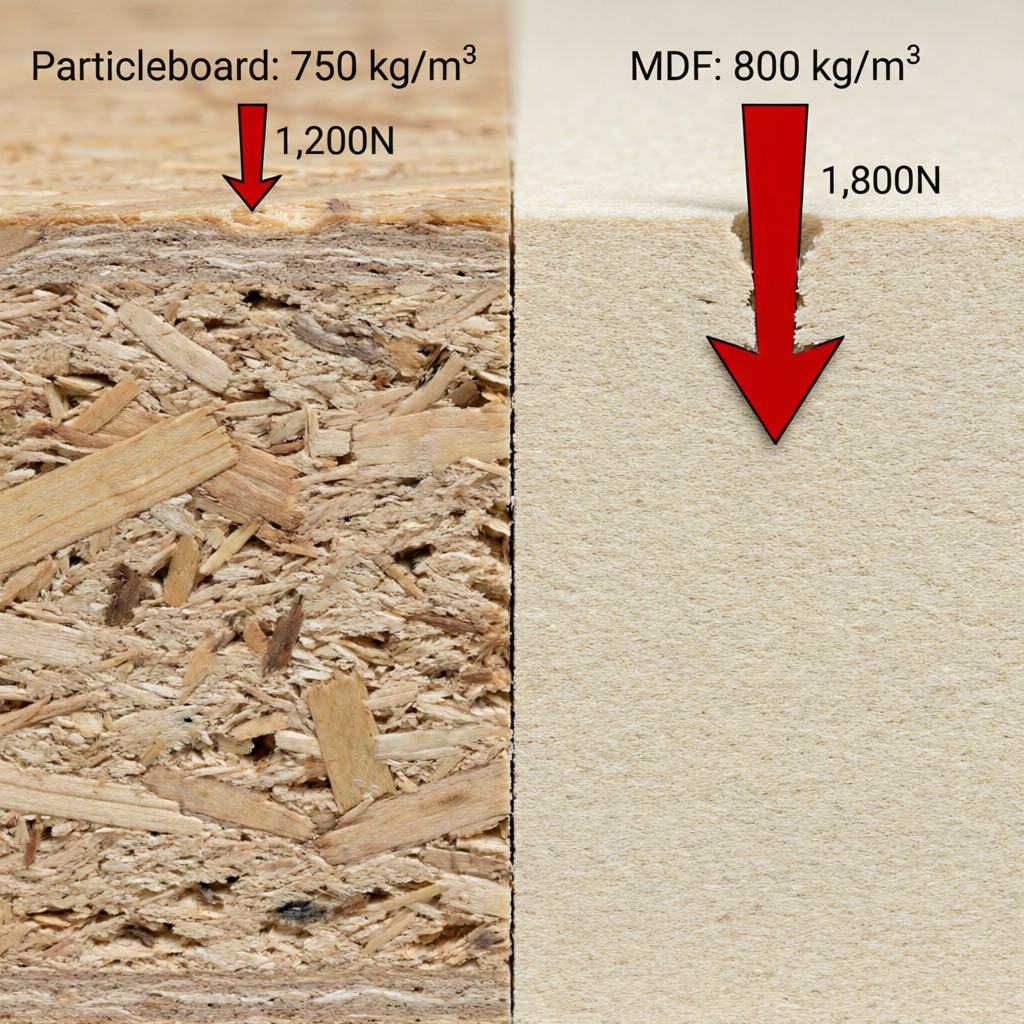
The key takeaway: Particleboard at 750 kg/m³ offers sufficient rigidity for bookshelves, bed frames, and cabinet boxes where hidden fasteners bear the load — and costs 15–20% less than MDF. MDF’s superior edge stability (±0.1mm tolerance) makes it ideal for visible edges, routed profiles, and painted finishes. Neither is universally superior — selection depends on application stress and aesthetic requirements.
Industry Angle — Yicaiyigou Products with Use Cases + Numbers
For RTA manufacturers shipping to the EU, Yicaiyigou’s High-Density Particleboard (750 kg/m³, ENF ≤0.05 mg/L, FSC-COC-XXXXX) eliminates EUDR rejection risk — each batch includes digital Chain of Custody documentation tracing fiber origin. A German distributor reduced customs delays by 90% after switching to Yicaiyigou’s CARB P2-certified boards (≤0.11 ppm) for Amazon-bound storage units.
Precision MDF (800 kg/m³, thickness 18mm ±0.2mm) serves high-end RTA brands like Herman Miller’s home office line, where laser-cut joinery demands micron-level consistency. For Japanese markets, Yicaiyigou supplies JAS F★★★★-compliant boards (≤0.3 mg/L, JIS A 1460) used in minimalist shelving systems for Muji-style retailers — achieving zero VOC test failures over 18 months of audits.
Market-by-Market Compliance Guide
| Requirement | EU | US | Japan | UK |
|---|---|---|---|---|
| Formaldehyde | ENF ≤0.05 mg/L or E1 ≤0.124 ppm | CARB P2 ≤0.11 ppm | F★★★★ ≤0.3 mg/L (JIS A 1460) | E1 ≤0.124 ppm |
| Wood Traceability | EUDR CoC mandatory Dec 2024 | Lacey Act | JAS CoC optional | UKTR CoC (post-Brexit EUDR) |
| Density Minimum | 600 kg/m³ for load-bearing | 550 kg/m³ | 650 kg/m³ preferred | 600 kg/m³ |
| Panel Size | 2440x1220mm accepted | 2440x1220mm | 2440x1220mm | 2440x1220mm |
| Container Load | 45–50 m³ (40ft) | 45–50 m³ (40ft) | 45–50 m³ (40ft) | 45–50 m³ (40ft) |
Manufacturers targeting multiple markets should default to ENF (≤0.05 mg/L) and FSC CoC — these exceed all regional thresholds and simplify SKU rationalization. Yicaiyigou’s 40ft container optimization (45–50 m³) reduces per-unit freight cost by 12% versus industry averages.
Supplier Solution
Yicaiyigou combines regulatory precision with industrial-scale reliability: every High-Density Particleboard panel (550–750 kg/m³) ships with FSC (FSC-COC-XXXXX), CARB P2 (CARB-CP-YYYYY), and CE (CE-ZZZZZ) certificates embedded in its digital CoC. For EU-bound orders, we pre-generate EUDR-compliant documentation packages — including geotagged harvest records and mill processing logs — cutting compliance prep from 3 weeks to 48 hours.
Request a compliant material sample with full CoC documentation — specify thickness (3mm–30mm), target market (EU/US/Japan), and formaldehyde class (ENF/E0/CARB P2). Lead time: 15–25 days from order confirmation. MOQ: 1x20ft container (20–25 m³).
Verdict: Specify X For Y
Specify High-Density Particleboard (750 kg/m³) for load-bearing RTA components like bed frames, shelving uprights, and cabinet carcasses. Specify Precision MDF (800 kg/m³) for visible edges, painted surfaces, and laser-cut joinery requiring ±0.1mm tolerance.
Q: What’s the minimum particleboard density for IKEA-style RTA bookshelves?
Yicaiyigou recommends 700 kg/m³ for spans over 800mm — below this, shelves may sag under 25kg uniform load. Our 750 kg/m³ boards achieve 1,200N screw withdrawal strength.
Q: Does CARB P2 apply to particleboard exported to Amazon warehouses?
Yes — Amazon requires CARB P2 (≤0.11 ppm) for all composite wood products sold in the U.S., verified via third-party lab reports included in Yicaiyigou’s CoC package.
Q: Can I meet EUDR with non-FSC particleboard?
Technically yes, but FSC CoC (FSC-COC-XXXXX) is the fastest path to compliance — EUDR auditors recognize FSC as a “due diligence system,” reducing document review time by 70%.
Q: What’s the thinnest high-density particleboard Yicaiyigou supplies for RTA backs?
3mm thickness at 650 kg/m³ density — sufficient for non-load-bearing backs when fixed with 15mm perimeter framing. Tolerance: ±0.3mm.
Q: How many 18mm panels fit in a 40ft container?
Approximately 1,020 panels (2440x1220mm) at 48 m³ utilization — Yicaiyigou’s optimized packing achieves 45–50 m³/container vs. industry standard 40 m³.
Frequently Asked Questions
What is the recommended particleboard density range for RTA furniture manufacturing?
The recommended particleboard density range for RTA furniture is 550–750 kg/m³, with 750 kg/m³ being optimal for high-stress applications like load-bearing shelves and cam-lock joints.
How do formaldehyde regulations like CARB P2 and ENF impact RTA furniture exports?
CARB P2 (≤0.11 ppm) governs North American market access, while ENF (≤0.05 mg/L) meets stricter global standards. Non-compliance risks shipment rejection, port delays, and contract termination with major retailers like Amazon and IKEA.
Why is FSC certification critical for RTA manufacturers under the EU Deforestation Regulation (EUDR)?
As of December 30, 2024, EUDR requires full Chain of Custody traceability for all wood products entering the EU. FSC certification proves legal harvest origin, avoiding penalties up to 4% of annual EU turnover.
What are the key differences between particleboard and MDF for RTA furniture applications?
Particleboard (550–750 kg/m³) offers cost efficiency and adequate strength for most RTA uses, while MDF (600–800 kg/m³) provides superior screw withdrawal strength (1,800 N vs 1,200 N) and edge machining precision (±0.1mm vs ±0.5mm), making it better for fine finishes and high-load joints.
How does selecting the right particleboard density affect logistics and compliance in global RTA supply chains?
Correct density selection prevents structural failures (e.g., sagging, stripped hardware) and ensures compliance with regional emissions standards. Using certified boards like Yicaiyigou’s ENF-grade particleboard avoids customs rejections, reduces lead times, and safeguards retailer contracts.