| Factor | Standard/Passive Approach | Engineered Protocol (Recommended) |
|---|---|---|
| Wood Moisture Content (MC) | Variable; often loaded at ~14% MC | Stabilized at 12-15% per ISPM 15 standards |
| Relative Humidity (RH) Target | Uncontrolled; susceptible to tropical dew points | Maintained below 70% via active climate control |
| Cargo Loss Rate | 15-20% due to mold and condensation damage | Near 0% with pre-shipment audits and monitoring |
| Transit Monitoring | No real-time data; issues discovered upon arrival | Continuous data logging for temperature and humidity |
| Packaging Strategy | Standard packaging insufficient for thermal shifts | Integrated with pre-shipment conditioning audits |
| Primary Risk | “Container rain” causing surface swelling and rejection | Defect-free delivery of Precision MDF and Structural Plywood |
Importers of kiln-dried lumber face significant financial exposure when “container rain” and mold growth compromise cargo during 30+ day ocean transit. This article details the engineering protocols required to stabilize wood moisture content and manage relative humidity, ensuring your Precision MDF and Structural Plywood arrive defect-free. By integrating pre-shipment conditioning audits with active in-transit climate control, supply chain managers can eliminate the 15-20% loss rate associated with unchecked condensation.
The Hidden Cost of Condensation in Tropical Lanes
When a major European furniture distributor faced repeated rejections of High-Density Particleboard shipments due to surface swelling, they discovered that standard packaging was insufficient against tropical dew points. The cargo, loaded at 14% moisture content, encountered nighttime temperature drops in the South China Sea that triggered condensation inside the sealed 40HQ container. This scenario is not an anomaly; it is a predictable physical reaction governed by thermodynamics that costs importers dearly in rejected goods and production delays.
The core issue lies in the interaction between the cargo’s residual moisture and the ambient air within the container. As temperatures fluctuate during transit, the air’s capacity to hold water vapor changes. When the temperature drops below the dew point, moisture condenses on the coolest surfaces—typically the metal roof and walls of the container—before dripping onto the wood panels. For buyers sourcing from Asia to North America or Europe, understanding this dynamic is critical to protecting margins.
This guide provides a technical framework for preventing moisture damage, focusing on three non-negotiable parameters: maintaining relative humidity below 70%, stabilizing wood moisture content at 12-15% per ISPM 15 standards, and deploying continuous data logging. By adhering to these specs, procurement teams can transform their supply chain from a reactive cost center into a predictable, risk-mitigated operation.
lumberpanel.com/wp-content/uploads/2026/06/condensation-forming-on-container-ceilin.jpg” alt=”Condensation forming on container ceiling above wood panels” style=”max-width:100%;height:auto;” />
Technical Specifications for Moisture Control
Effective moisture protection requires precise adherence to environmental thresholds. General advice to “keep it dry” is insufficient for engineered wood products like Precision MDF and Structural Plywood. The following specifications define the operational baseline for safe transit:
- Relative Humidity (RH) Control: Maintain internal container RH below 70% using high-capacity desiccants. Standard silica gel is often inadequate for large volumes; instead, use desiccants with a 250% absorption capacity by weight to handle the massive moisture load generated by the cargo and packaging materials.
- Wood Moisture Content (MC): Ensure all wood products are stabilized at 12-15% moisture content prior to loading. This range aligns with ISPM 15 standards for international trade and minimizes the potential for off-gassing moisture into the container atmosphere.
- Continuous Monitoring: Deploy continuous data loggers recording temperature and RH at 15-minute intervals throughout transit. Spot checks at loading and unloading are insufficient; only continuous data can identify the specific timing and duration of dew point breaches.
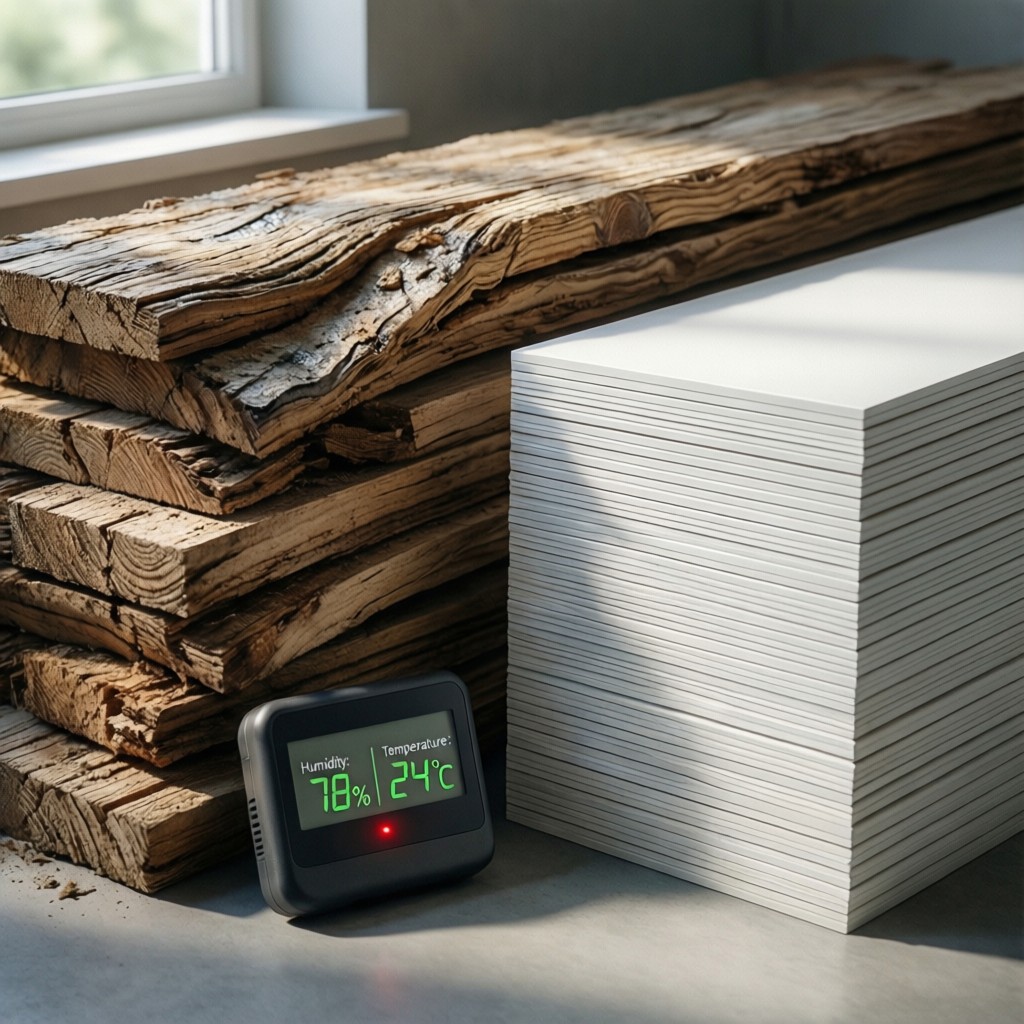
Most competitors ignore the dew point calculation relative to nighttime temperature drops in tropical shipping lanes. A container may start at 25°C with 60% RH, but if the temperature drops to 15°C at night, the RH can spike to near 100%, causing immediate condensation. Furthermore, most guides fail to address the specific impact of corrugated cardboard packaging acting as a secondary moisture source. Cardboard can absorb up to 10% of its weight in moisture from the air, only to release it later as temperatures rise, creating a harmful cycle of humidity fluctuation.
Comparative Analysis: Passive vs. Active Moisture Management
To understand the efficacy of different protection strategies, we compare standard passive methods against Yicaiyigou’s integrated active protocol.
| Parameter | Standard Passive Method | Yicaiyigou Integrated Protocol |
|---|---|---|
| Desiccant Capacity | 50-100% absorption by weight | 250% absorption by weight |
| Moisture Content Target | Unspecified or >18% | Stabilized at 12-15% (ISPM 15) |
| Monitoring Frequency | None or spot check at ports | Continuous, 15-minute intervals |
| Packaging Material | Standard corrugated cardboard | Moisture-resistant barrier wrap |
| Dew Point Calculation | Ignored | Calculated for tropical lanes |
| RH Threshold | Not monitored | Maintained <70% |
| Data Availability | None | Full transit temperature/RH log |
| Claim Resolution Support | Difficult, no proof | Data-backed evidence provided |
The key takeaway is that passive methods rely on hope, while active protocols rely on data. By controlling the initial moisture content and actively managing the internal atmosphere, Yicaiyigou eliminates the variables that lead to container rain.
Application Context: Precision MDF and Structural Plywood
Yicaiyigou’s product line is engineered for stability, but even the best materials require proper handling. Our Precision MDF, with a density of 600-800 kg/m³, and High-Density Particleboard, ranging from 550-750 kg/m³, are sensitive to humidity swings. For a furniture maker exporting to the EU, our FSC-certified MDF with ENF ≤0.05 mg/L formaldehyde emissions eliminates compliance risk at customs, but only if the physical integrity of the panel is maintained.
Consider a 40ft high cube container holding 45-50 m³ of Structural Plywood. If the plywood is loaded at 18% MC, it will release approximately 150 liters of water into the container air as it equilibrates to 12% MC. Without adequate desiccant capacity and ventilation management, this water vapor will condense on the cold metal surfaces. By contrast, loading at 12-15% MC significantly reduces this vapor load, making the 250% capacity desiccants highly effective.
Why Exporters Choose Yicaiyigou for Compliance-Ready Panels
Yicaiyigou positions itself as a logistics risk-mitigation partner, not just a manufacturer. We integrate pre-shipment conditioning audits with active in-transit climate control protocols. Our facilities ensure that all Precision MDF and Structural Plywood meet strict moisture targets before loading. We provide full Chain of Custody (CoC) documentation for our FSC-certified products, ensuring traceability from forest to factory.
Our certifications, including CARB P2 (≤0.11 ppm), E0 (≤0.07 ppm), and CE, are backed by rigorous testing. For buyers concerned with the upcoming EUDR (effective Dec 30, 2024), our CoC documentation provides the necessary due diligence statements. We do not just ship wood; we ship verified, compliant, and protected assets. Request a compliant material sample with full CoC documentation to verify our standards.

FAQ
What is the ideal moisture content for wood exports?
The ideal moisture content for wood exports is 12-15%, as specified by ISPM 15 standards, to minimize condensation risk during transit.
How much desiccant is needed for a 40HQ container?
For a 40HQ container, use desiccants with a 250% absorption capacity by weight to effectively manage humidity levels below 70%.
Why does cardboard packaging cause moisture issues?
Corrugated cardboard acts as a secondary moisture source, absorbing humidity from the air and releasing it when temperatures rise, exacerbating condensation cycles.
How often should temperature and humidity be logged?
Temperature and humidity should be logged at 15-minute intervals throughout transit to capture short-term dew point breaches that spot checks miss.
What certifications does Yicaiyigou hold for formaldehyde emissions?
Yicaiyigou holds CARB P2 (≤0.11 ppm), E0 (≤0.07 ppm), and ENF (≤0.05 mg/L) certifications, ensuring compliance with strict global indoor air quality standards.
Summary & Next Steps
Preventing moisture damage in 40HQ shipments requires a shift from passive packing to active climate management. By stabilizing wood moisture content at 12-15%, using high-capacity desiccants, and monitoring conditions continuously, importers can protect their investment. Yicaiyigou’s integrated approach ensures that your Precision MDF and Structural Plywood arrive ready for production.
Request a compliant material sample with full CoC documentation from Yicaiyigou to validate our moisture control protocols and certification standards.
Frequently Asked Questions
What is the primary cause of cargo damage for kiln-dried lumber during ocean transit?
The primary cause is ‘container rain’ and mold growth resulting from condensation. This occurs when temperature fluctuations during the 30+ day transit cause the air’s capacity to hold water vapor to change, leading to moisture condensing on the container’s metal surfaces and dripping onto the wood panels.
What are the three non-negotiable parameters for preventing moisture damage in wood shipments?
The three key parameters are: maintaining relative humidity (RH) below 70%, stabilizing wood moisture content (MC) at 12-15% per ISPM 15 standards, and deploying continuous data logging to monitor temperature and RH throughout the transit.
Why is standard silica gel often considered inadequate for protecting large volumes of engineered wood?
Standard silica gel is often insufficient because it cannot handle the massive moisture load generated by both the cargo and packaging materials. Instead, desiccants with a 250% absorption capacity by weight are recommended to effectively maintain internal container RH below 70%.
How does corrugated cardboard packaging contribute to moisture issues inside shipping containers?
Corrugated cardboard acts as a secondary moisture source because it can absorb up to 10% of its weight in moisture from the air. It later releases this absorbed moisture back into the container environment, exacerbating humidity levels and increasing the risk of condensation.
Why are spot checks at loading and unloading insufficient for ensuring cargo safety?
Spot checks are insufficient because they fail to capture the specific timing and duration of dew point breaches that occur during transit. Continuous data loggers recording temperature and RH at 15-minute intervals are required to identify when nighttime temperature drops cause RH to spike near 100%.