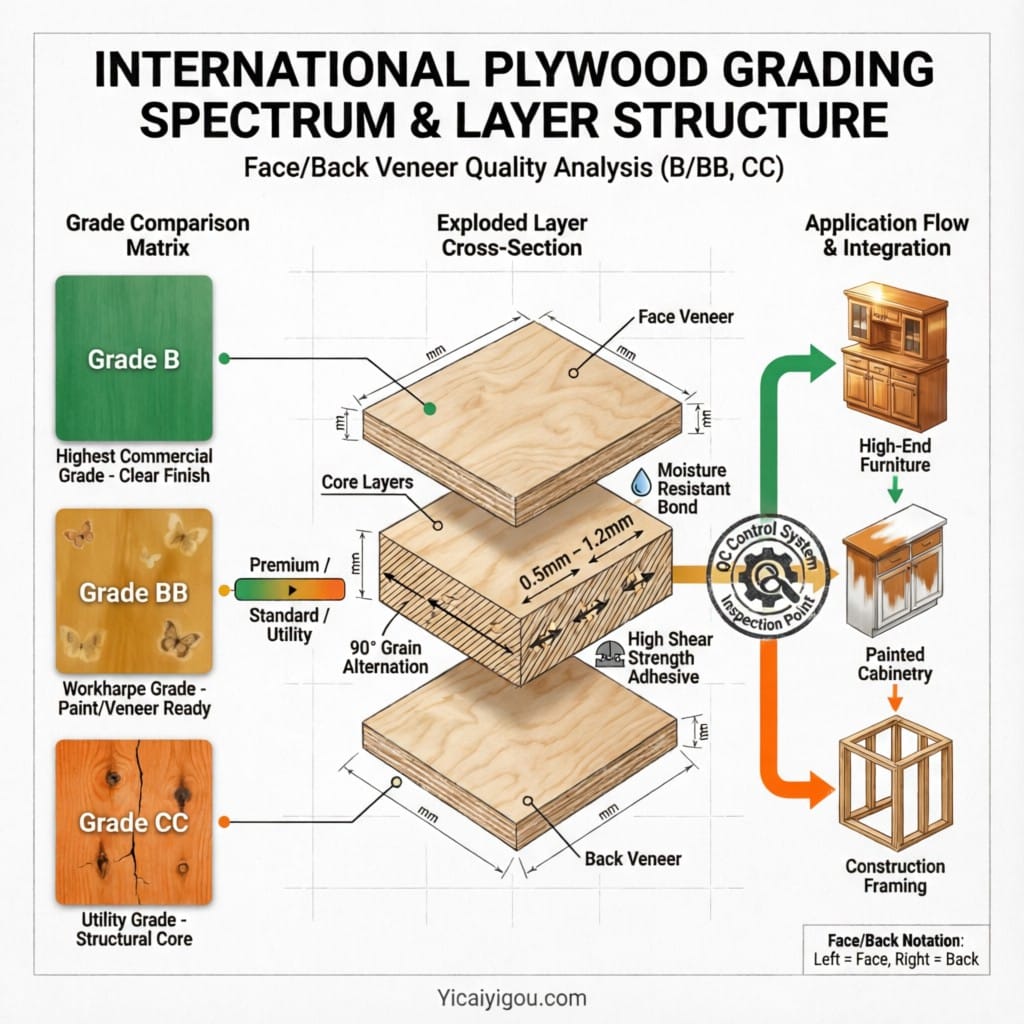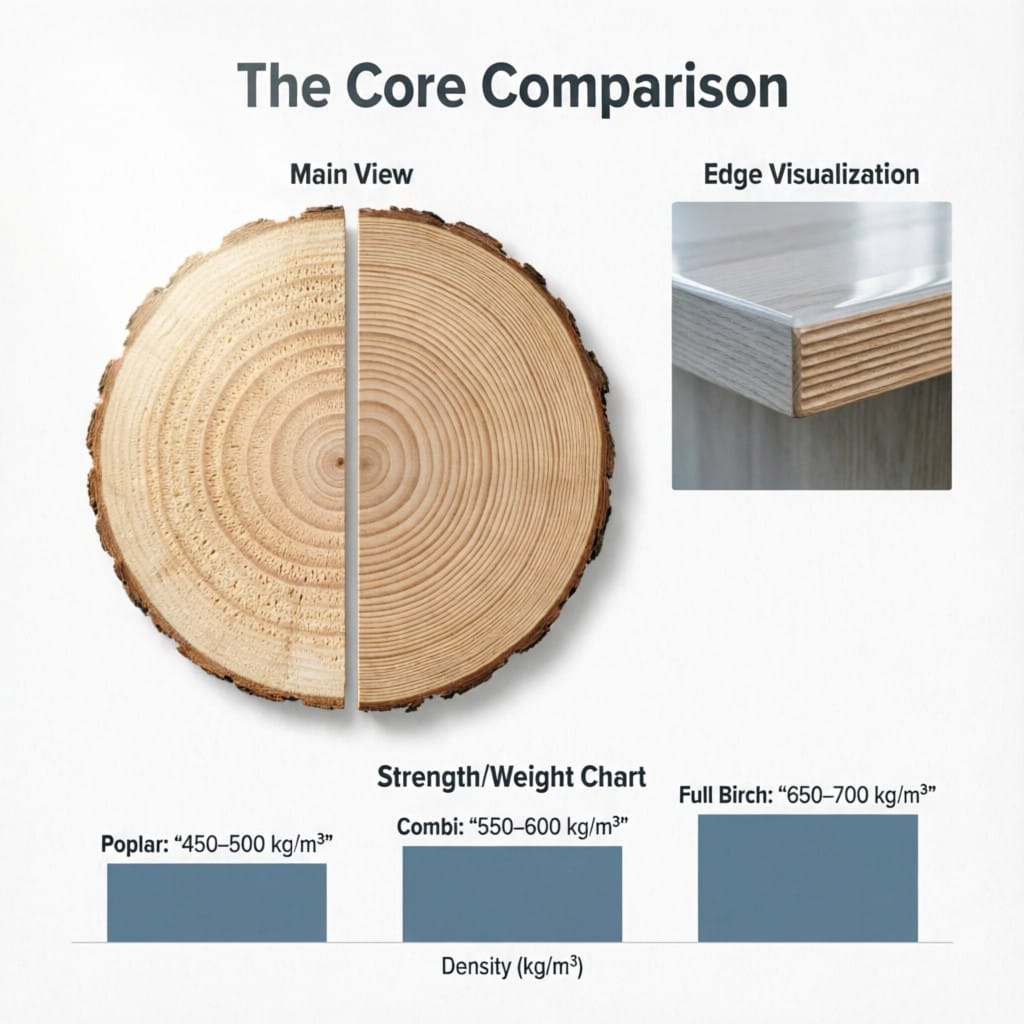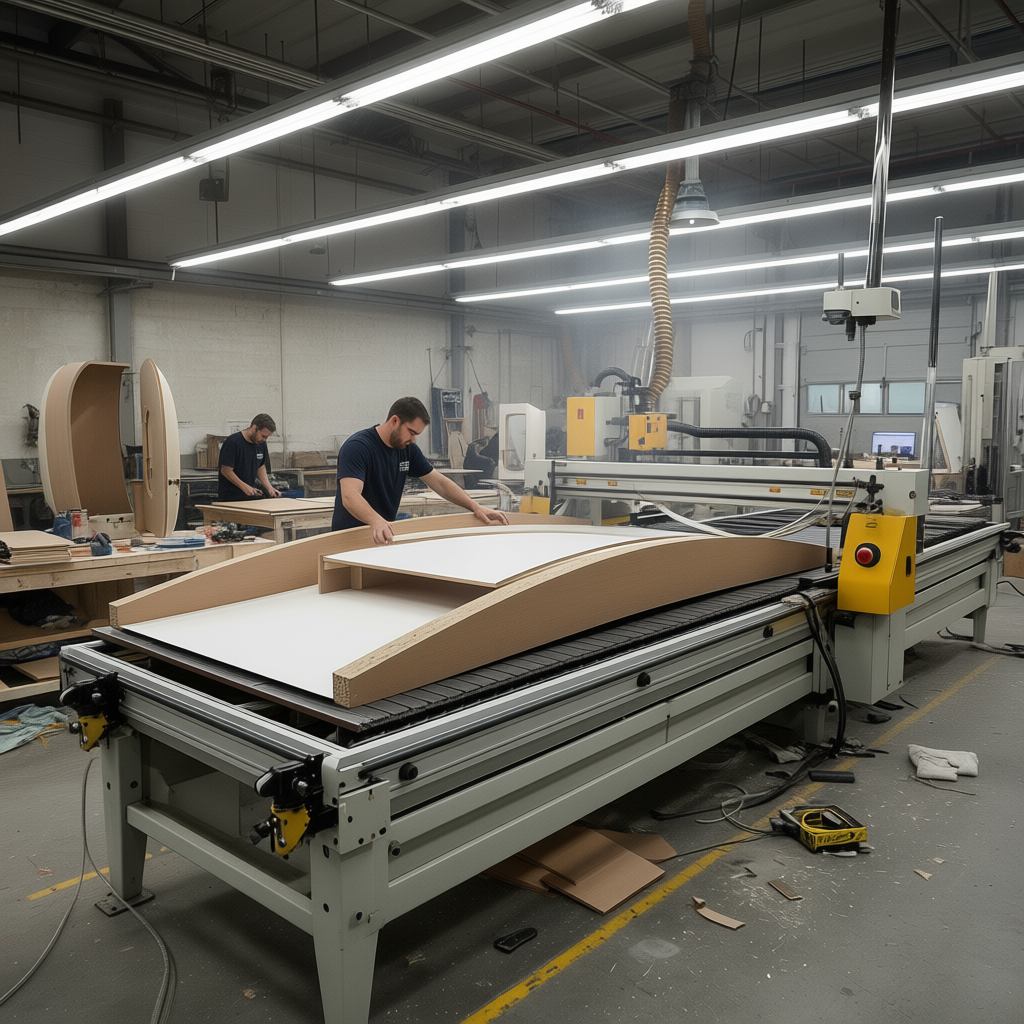
| Core Material | Minimum Bend Radius | Structural Integrity Risk | Adhesive Specification | EUDR Compliance Status |
|---|---|---|---|---|
| Precision MDF | > 150mm | High risk of internal fiber fracture at tight radii | Urea-Formaldehyde (Standard) | Requires full traceability documentation |
| Structural Plywood | > 75mm | Low risk; layered structure absorbs stress | Phenol-Formaldehyde (Water-resistant) | Subject to strict deforestation verification |
| Bendable HDF | > 50mm | Moderate risk if thermal expansion not managed | Modified Urea-Melamine | Compliant with verified supply chain audits |
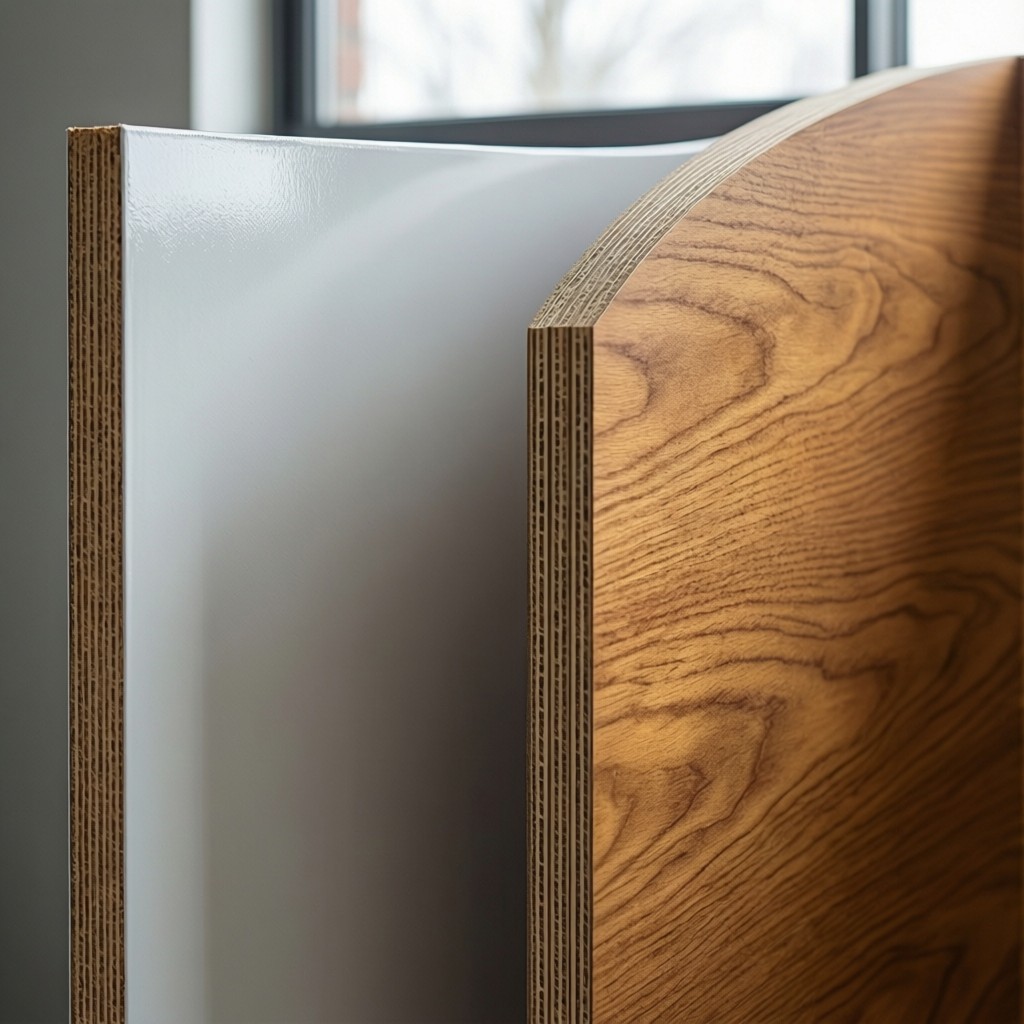
Selecting the correct curved cabinet door core material is critical for preventing delamination and warping in high-end cabinetry. This guide details the engineering thresholds for MDF and plywood radii, adhesive specifications, and thermal expansion management to ensure structural integrity and compliance with global export standards.
The Cost of Core Failure in Premium Cabinetry
When a major contract furniture manufacturer supplying luxury retail chains faced a 15% warranty claim rate on curved reception desks, they discovered the root cause was not the veneer application, but the core substrate’s inability to handle specific bending radii. The cores had fractured internally during the vacuum pressing process, leading to delayed spring-back and eventual surface cracking. This scenario highlights a critical gap in supply chain procurement: treating curved substrates as commodity items rather than engineered components.
For procurement managers and engineers at firms like IKEA or Herman Miller, the risk extends beyond immediate repair costs to brand reputation and compliance liabilities. With the EU Deforestation Regulation (EUDR) effective December 30, 2024, traceability and material performance are now inextricably linked. Understanding the mechanical limits of your core material is no longer just a design preference; it is a financial imperative. This article provides the technical data needed to specify the right core for your radius, avoiding costly failures before production begins.
Technical Specifications for Bendable Cores
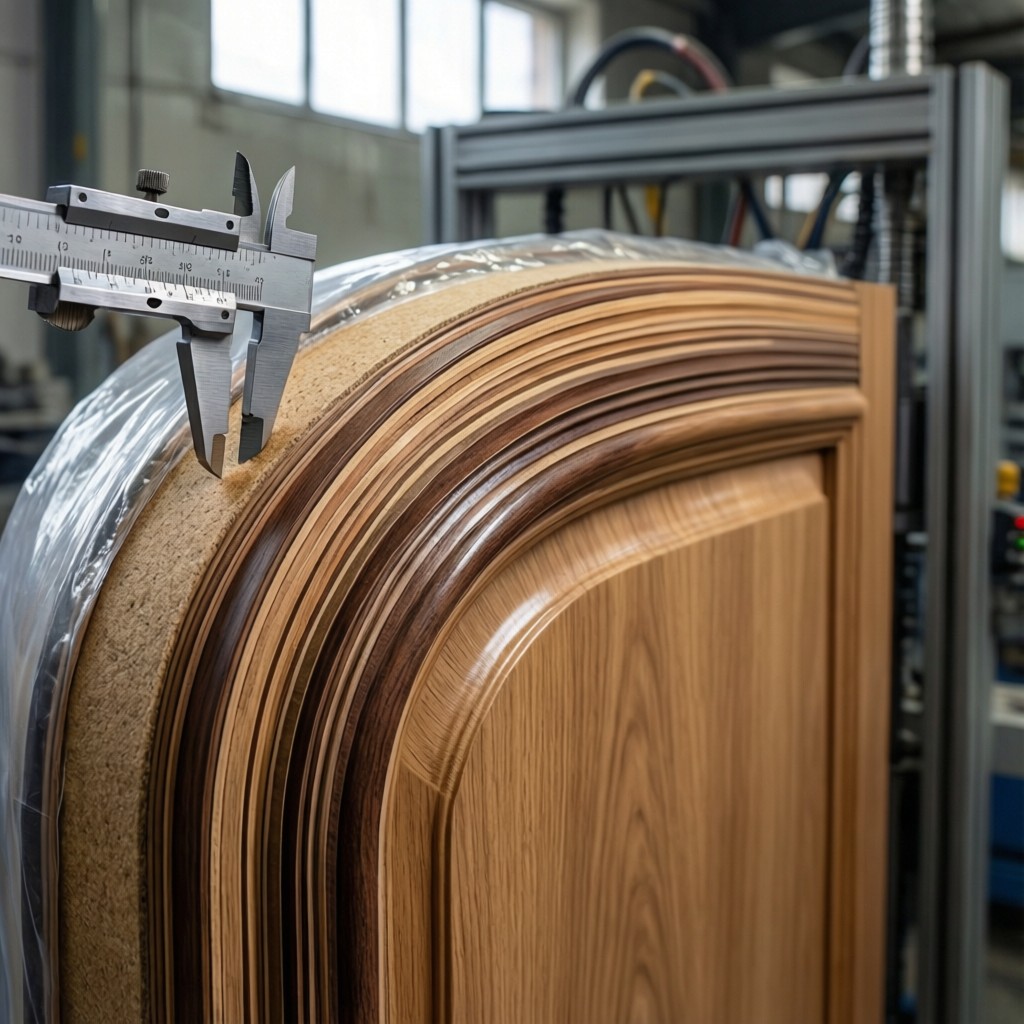
To prevent fiber fracture and delamination, manufacturers must adhere to strict physical limits when selecting between Precision MDF and Structural Plywood for curved applications. The following parameters define the safe operating window for these materials.
- Minimum Bending Radius: For 3/4-inch thick MDF cores, maintain a minimum bending radius of 12 inches. Attempting to bend below this threshold causes tensile failure in the outer fibers and compressive buckling on the inner radius.
- Layer Thickness Limits: When using bendable plywood, limit single-piece thickness to 5mm per layer. This ensures uniform stress distribution during vacuum pressing and prevents internal shear forces from separating the plies.
- Adhesive Requirements: Use waterproof PVA adhesives rated for Type II water resistance (ANSI/HPVA HP-1). Standard interior adhesives fail under the humidity fluctuations common in kitchen and bathroom installations, leading to edge swelling and veneer lift.
Most guides ignore the thermal expansion coefficient mismatch between veneer and core when using high-pressure laminates (HPL). If the core expands at a different rate than the laminate due to temperature changes, shear stress builds at the bond line. Yicaiyigou addresses this by providing density-stable cores, such as High-Density Particleboard (density >800 kg/m³ up to 1,000+ kg/m³), which minimizes dimensional fluctuation compared to standard particle board (550-750 kg/m³).
Comparative Analysis: MDF vs. Plywood for Curves
Choosing the best substrate for curved doors requires balancing surface finish quality against structural flexibility. The table below compares Precision MDF and Structural Plywood based on verifiable performance metrics.
| Specification | Precision MDF Core | Structural Plywood Core |
|---|---|---|
| Density Range | 600-800 kg/m³ | 550-750 kg/m³ (Particleboard base) |
| Min. Bend Radius (3/4″) | 12 inches | 6-8 inches (depending on ply count) |
| Surface Smoothness (Ra) | < 3.2 µm (Ideal for paint) | Variable (Requires filling) |
| Layer Thickness Limit | N/A (Homogeneous) | 5mm per layer max |
| Formaldehyde Emission | ENF ≤0.05 mg/L | CARB P2 ≤0.11 ppm |
| Water Resistance | Requires Type II PVA | Inherent (if marine grade) |
| Machining Tolerance | ±0.1 mm | ±0.5 mm |
| Spring-Back Risk | Low (if radius >12″) | Moderate (requires acclimation) |
The key takeaway is that MDF offers superior surface consistency for painted finishes, while plywood provides greater flexibility for tighter radii. However, plywood requires meticulous layup protocols to avoid telegraphing grain patterns through thin veneers.
Real-World Application: Compliance and Performance
Yicaiyigou supplies Precision MDF and Structural Plywood designed specifically for complex geometries. For a furniture maker exporting to the EU, our FSC-certified MDF with ENF ≤0.05 mg/L formaldehyde emissions eliminates compliance risk at customs under the new EUDR framework. This is crucial for brands like Apple or Amazon that require strict environmental documentation for their retail fixtures.
In high-humidity environments, such as hotel bathroom vanities, we recommend using our High-Density Particleboard (HDF density >800 kg/m³) combined with Type II water-resistant adhesives. This combination withstands the ANSI/HPVA HP-1 testing protocols, ensuring that the curved cabinet door core material does not swell or delaminate over time. Our standard panel size of 2440x1220mm allows for efficient nesting of curved parts, reducing waste in CNC machining operations.
Why Exporters Choose Yicaiyigou for Precision Cores
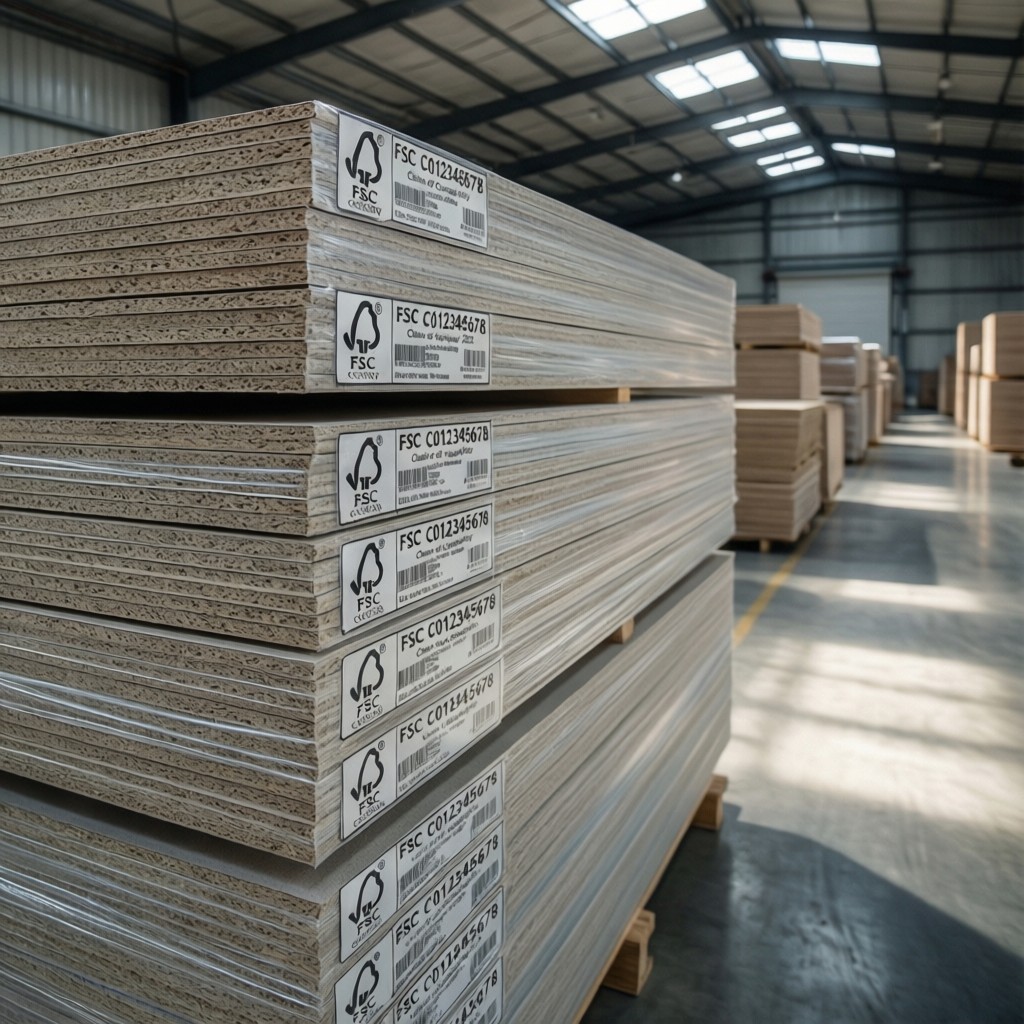
Yicaiyigou positions itself as a technical engineering partner, providing radius-specific core calibration data rather than just raw material inventory. We offer Chain of Custody (CoC) documentation for all FSC-certified products, ensuring full traceability from forest to factory. This is essential for buyers needing to verify compliance with CARB P2 (≤0.11 ppm) and CE standards.
Our logistics network supports global supply chains with efficient loading capacities: a 20ft container holds 20-25 m³, while a 40ft container holds 45-50 m³. With a lead time of 15-25 days and a MOQ of one 20ft container, we provide the reliability required by large-scale distributors. Request a compliant material sample with full CoC documentation to verify our density tolerances and emission levels firsthand.
Which One To Choose
Specify Precision MDF for painted curved doors with radii greater than 12 inches, where surface smoothness is the priority. Specify Structural Plywood for tight-radius applications (under 12 inches) or natural veneer finishes, ensuring each ply is no thicker than 5mm to maintain structural integrity.
FAQ
What is the maximum formaldehyde emission level for ENF certification?
ENF certification requires formaldehyde emissions to be ≤0.05 mg/L, which is stricter than CARB P2 (≤0.11 ppm) and E0 (≤0.07 ppm) standards.
How many cubic meters fit in a 40ft container for MDF panels?
A 40ft container typically holds 45-50 m³ of MDF or plywood panels, depending on packaging and thickness variations.
What adhesive rating is required for curved doors in humid areas?
Use waterproof PVA adhesives rated for Type II water resistance according to ANSI/HPVA HP-1 standards to prevent delamination in humidity-prone installations.
What is the minimum bending radius for 3/4-inch MDF?
Maintain a minimum bending radius of 12 inches for 3/4-inch thick MDF cores to prevent fiber fracture and ensure long-term stability.
Does Yicaiyigou provide Chain of Custody documentation?
Yes, Yicaiyigou provides full Chain of Custody (CoC) documentation for FSC-certified products, ensuring traceability and compliance with EUDR regulations.
Summary & Next Steps
Selecting the right curved cabinet door core material involves balancing bending radius limits, adhesive performance, and regulatory compliance. By adhering to the 12-inch minimum radius for MDF and using Type II adhesives, manufacturers can significantly reduce warranty claims. Verify your supplier’s ability to provide ENF ≤0.05 mg/L certified materials and full CoC documentation to mitigate supply chain risks.
Request a compliant material sample with full CoC documentation and radius-specific calibration data from Yicaiyigou to validate these specifications for your next project.
Frequently Asked Questions
What is the minimum bending radius for a 3/4-inch thick MDF core to prevent fiber fracture?
For 3/4-inch thick MDF cores, the minimum bending radius must be maintained at 12 inches. Bending below this threshold causes tensile failure in the outer fibers and compressive buckling on the inner radius.
Why did a major contract furniture manufacturer experience a 15% warranty claim rate on curved reception desks?
The root cause was the core substrate’s inability to handle specific bending radii, leading to internal fractures during the vacuum pressing process. This resulted in delayed spring-back and eventual surface cracking, highlighting the risk of treating curved substrates as commodity items rather than engineered components.
What adhesive specifications are recommended for curved cabinet doors to prevent edge swelling and veneer lift?
Manufacturers should use waterproof PVA adhesives rated for Type II water resistance (ANSI/HPVA HP-1). Standard interior adhesives are insufficient as they fail under the humidity fluctuations common in kitchen and bathroom installations.
How does High-Density Particleboard help manage thermal expansion issues in curved cabinetry?
High-Density Particleboard (with a density >800 kg/m³ up to 1,000+ kg/m³) minimizes dimensional fluctuation compared to standard particle board (550-750 kg/m³). This density stability reduces the thermal expansion coefficient mismatch between the veneer and core, preventing shear stress buildup at the bond line.
What is the maximum single-piece layer thickness allowed when using bendable plywood for curved applications?
When using bendable plywood, the single-piece thickness should be limited to 5mm per layer. This ensures uniform stress distribution during vacuum pressing and prevents internal shear forces from separating the plies.